
Introduction
Windows are often overlooked when discussing cleanroom construction, yet they play an essential role in maintaining cleanliness, visibility, safety, and operational efficiency. Unlike conventional building windows, cleanroom windows must integrate seamlessly with the wall system while preventing particle accumulation, air leakage, and contamination.
Whether installed in pharmaceutical manufacturing facilities, biotechnology laboratories, semiconductor plants, food-processing cleanrooms, or hospital operating theatres, cleanroom windows are designed to support controlled environments without compromising the integrity of the cleanroom envelope.
A properly designed cleanroom window is more than a viewing panel. It contributes to smooth workflow, reduces unnecessary personnel movement, allows visual supervision, and helps maintain pressure differentials by minimizing door openings.
This guide explains how cleanroom windows are constructed, the different types available, where they are used, and the key factors engineers and buyers should consider when selecting the right solution.
What Is a Cleanroom Window?
A cleanroom window is a sealed observation window specifically designed for installation within cleanroom wall systems.
Unlike standard architectural windows, cleanroom windows are engineered to provide:
- Smooth, easy-to-clean surfaces
- Airtight sealing
- Flush integration with wall panels
- Resistance to cleaning chemicals
- Long-term dimensional stability
- Clear visibility between controlled areas
Most cleanroom windows are permanently fixed rather than operable. Opening windows would introduce uncontrolled air leakage and increase the risk of contamination.
Because of this, cleanroom windows primarily serve as observation panels rather than ventilation devices.
Why Are Cleanroom Windows Important?
Although windows occupy only a small portion of the cleanroom envelope, they provide several important operational benefits.
Improved Process Visibility
Operators and supervisors can observe manufacturing activities without entering the controlled area.
This reduces unnecessary personnel traffic while allowing production monitoring and quality inspections.
Reduced Door Openings
Personnel often open doors simply to check production status.
Observation windows allow visual communication without disturbing airflow or pressure relationships.
Reducing unnecessary door openings helps support stable cleanroom operation.
Enhanced Safety
Observation windows allow personnel outside the room to monitor equipment operation and identify abnormal conditions before entering.
In laboratories or pharmaceutical facilities, this may improve both operational efficiency and workplace safety.
Better Workflow
Windows also facilitate communication between adjacent rooms, particularly in facilities where multiple production areas operate simultaneously.
In hospital environments, observation windows may allow staff to monitor activities while minimizing unnecessary movement between sterile and non-sterile zones.
Typical Applications
Cleanroom windows are widely used across many controlled environments.
Common applications include:
Pharmaceutical Manufacturing
Observation windows are frequently installed between production rooms, corridors, weighing areas, and packaging rooms.
Biotechnology Laboratories
Researchers may monitor experiments or equipment without repeatedly entering controlled laboratory spaces.
Electronics and Semiconductor Facilities
Windows allow production monitoring while reducing contamination risks associated with personnel movement.
Medical Device Manufacturing
Observation windows support production supervision, quality control, and process management.
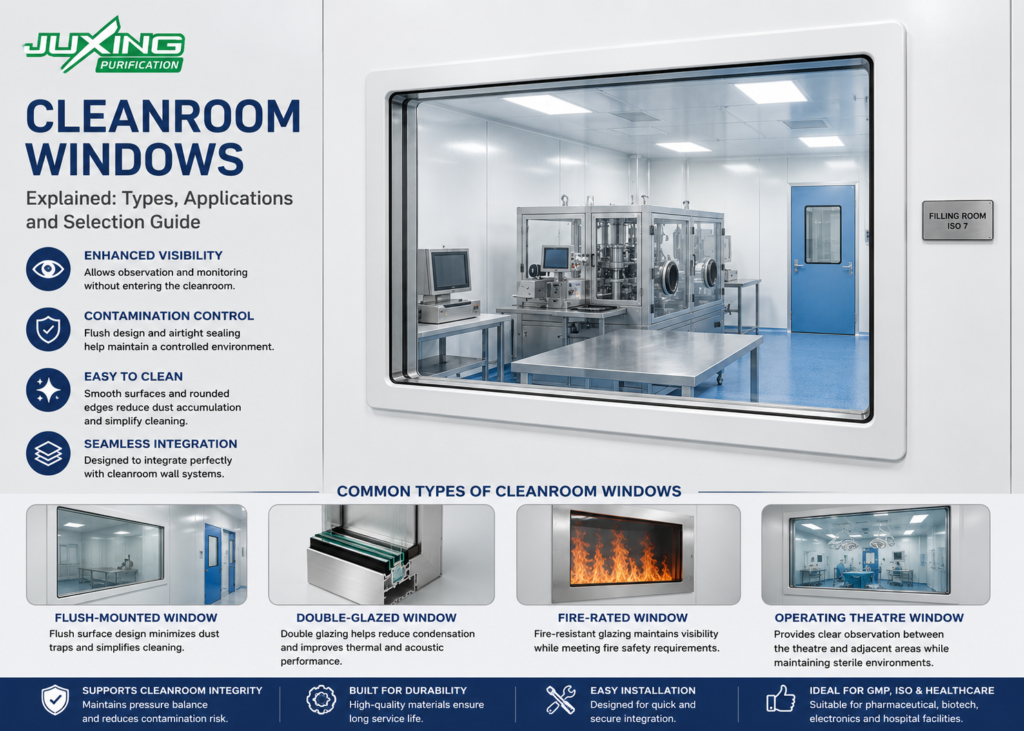
Hospital Operating Theatres
Operating theatres commonly use flush observation windows between the theatre and adjacent control rooms or corridors.
These windows allow medical staff to observe surgical procedures or room activities while maintaining the integrity of the operating environment.
Common Types of Cleanroom Windows
Different projects require different window configurations.
Flush-Mounted Windows
Flush-mounted windows are the most common option for modern cleanrooms.
The glass surface sits flush with the wall panel, minimizing ledges where dust could accumulate.
The smooth transition between the wall and the window also simplifies routine cleaning and disinfection.
Double-Glazed Windows
Many cleanroom windows use double glazing.
The sealed air space between the glass panels helps reduce condensation while improving thermal and acoustic performance.
High-quality edge sealing is important because moisture entering the cavity may lead to fogging.
Fire-Rated Observation Windows
Some projects require fire-rated glazing to comply with local building regulations.
Fire-rated cleanroom windows are commonly installed where fire compartmentation must be maintained while preserving visibility.
The required fire rating depends on local codes and project specifications.
Radiation Shielding Windows
Healthcare facilities containing X-ray rooms, CT suites, or other radiation areas may require lead-glass observation windows.
These specialized windows combine radiation protection with visual observation.
They should not be confused with standard cleanroom windows.
Key Design Features
Although appearance may seem simple, several design details influence long-term performance.
Flush Surface Design
A flush surface minimizes dust traps and simplifies cleaning.
Rounded transitions between the frame and wall further reduce particle accumulation.
Airtight Sealing
Proper sealing helps reduce uncontrolled air leakage around the window frame.
The sealing system should remain stable after repeated cleaning and environmental changes.
Safety Glass
Tempered or laminated safety glass is commonly used because of its improved impact resistance.
Glass selection should comply with local safety regulations and project requirements.
Compatible Frame Materials
Common frame materials include:
- Powder-coated steel
- Stainless steel
- Aluminum alloy
The appropriate material depends on the wall system, cleaning chemicals, humidity, and project specifications.
Easy Cleaning
Window surfaces should tolerate repeated cleaning with disinfectants commonly used in pharmaceutical and healthcare facilities.
Smooth joints and minimal crevices reduce maintenance effort.
How to Choose the Right Cleanroom Window
Selecting a cleanroom window involves more than choosing the required dimensions.
Important considerations include:
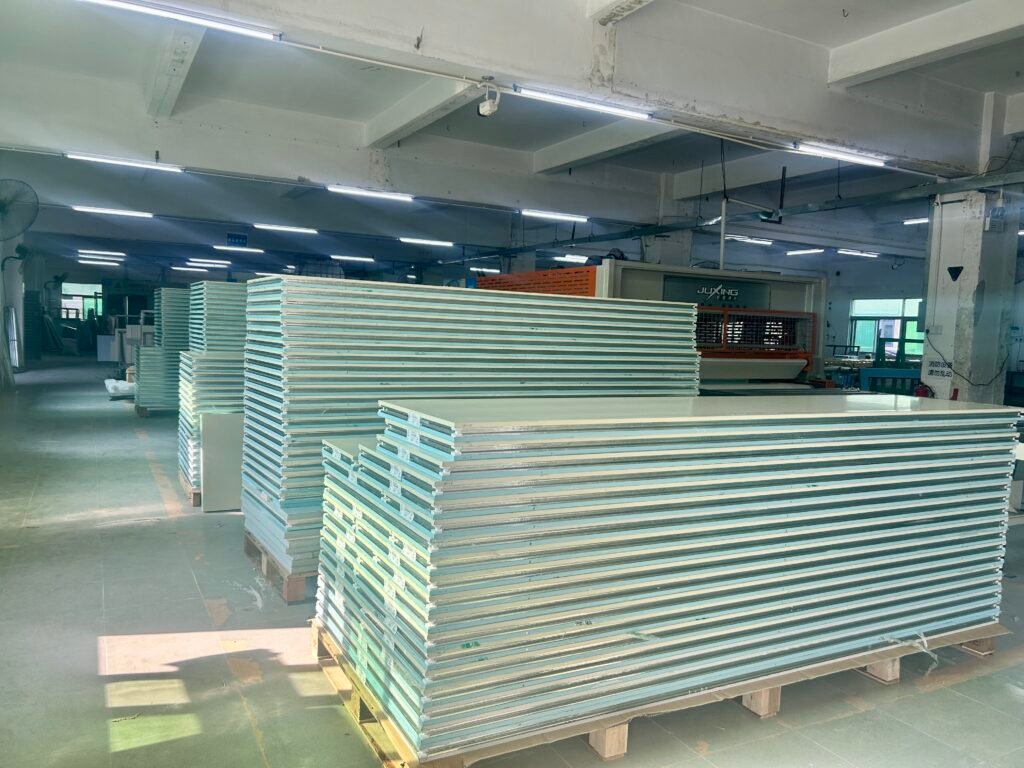
Wall System Compatibility
The window should match the wall-panel thickness and installation method.
Different modular wall systems may require different frame designs.
Cleanroom Classification
Higher-grade cleanrooms generally require tighter control over air leakage, surface finish, and cleanability.
Although ISO 14644 does not prescribe specific window designs, the selected window should support the required cleanroom performance.
Glass Specification
Consider:
- Glass thickness
- Safety requirements
- Fire rating
- Radiation shielding
- Light transmission
- Anti-condensation requirements
The specification should match the intended application.
Installation Method
Factory-installed windows often provide better dimensional accuracy than field-assembled units.
Proper installation is essential to maintain wall integrity and airtightness.
Maintenance
Replacement of damaged glass should be possible without unnecessary disruption to surrounding wall panels.
Maintenance access should be considered during the design stage.
Common Misconceptions
All Flush Windows Are Suitable for Cleanrooms
No.
Some architectural flush windows are designed for appearance rather than contamination control.
The sealing system, installation method, and frame design are equally important.
Double Glazing Eliminates Condensation
Not always.
Condensation depends on humidity, temperature differences, glass specification, and installation quality.
Double glazing reduces the likelihood but does not guarantee condensation-free performance.
Bigger Windows Are Always Better
Large observation windows improve visibility but may increase cost and require additional structural reinforcement.
The optimal size depends on operational requirements.
Standard Building Windows Can Be Used
Generally no.
Conventional windows are usually not designed to meet cleanroom requirements for airtightness, cleanability, or integration with modular wall systems.
Expert Tip
When reviewing supplier quotations, don’t compare only the window dimensions. Ask whether the window is factory assembled or site assembled, how the glazing cavity is sealed, what type of safety glass is supplied, whether the frame is compatible with your wall system, and how the airtight seal is maintained after installation. These details often have a greater impact on long-term performance than the visible appearance alone.
Frequently Asked Questions
Can cleanroom windows be opened?
Most cleanroom windows are fixed and non-operable to avoid uncontrolled air leakage and contamination.
What type of glass is commonly used?
Tempered safety glass and laminated safety glass are commonly specified, depending on project requirements.
Why are cleanroom windows flush with the wall?
Flush-mounted designs reduce dust accumulation, simplify cleaning, and provide a smooth hygienic surface.
Are cleanroom windows required to be double glazed?
Not necessarily.
Double glazing is common because it improves thermal performance and helps reduce condensation, but the final specification depends on the project.
Can cleanroom windows be installed in operating theatres?
Yes.
Observation windows are widely used in modular operating theatres to improve visibility between the theatre and adjacent support areas while maintaining the integrity of the controlled environment.
How long do cleanroom windows typically last?
Service life depends on material quality, installation, cleaning procedures, and environmental conditions. Properly installed cleanroom windows can provide many years of reliable performance with routine inspection and maintenance.
Conclusion
Cleanroom windows are an integral part of the cleanroom envelope, providing visibility, supporting operational efficiency, and helping maintain controlled environmental conditions. Although their appearance may seem straightforward, factors such as flush integration, airtight sealing, glazing specification, frame compatibility, and installation quality all influence long-term performance.
Selecting the appropriate cleanroom window requires consideration of the facility’s cleanliness requirements, wall system, operational needs, and applicable regulations. When correctly designed and installed, cleanroom windows contribute to a hygienic, durable, and efficient controlled environment while supporting both contamination control and day-to-day operations.