
What Is Differential Pressure in Cleanrooms? A Practical Guide for Engineers and Facility Managers
Introduction
Maintaining cleanliness in a controlled environment involves much more than installing HEPA filters or using high-quality cleanroom materials. One of the most important yet often misunderstood engineering principles is differential pressure, which controls the direction of airflow between adjacent spaces.
A properly designed pressure cascade helps prevent airborne contaminants from moving into critical production areas, supporting stable environmental conditions for pharmaceutical manufacturing, biotechnology laboratories, semiconductor facilities, hospitals, and other contamination-sensitive applications.
This guide explains how cleanroom differential pressure works, why it matters, and the key design considerations for achieving reliable contamination control.
What Is Differential Pressure?
Differential pressure is the difference in air pressure between two adjacent spaces.
Because air naturally flows from areas of higher pressure to areas of lower pressure, engineers deliberately create pressure differences to control airflow direction.
For example:
| Room | Pressure |
|---|---|
| ISO 7 Cleanroom | +30 Pa |
| Airlock | +20 Pa |
| Corridor | +10 Pa |
Air always flows outward from the cleanest area toward the less clean area, helping prevent contaminants from entering the cleanroom.
Why Is Differential Pressure Important?
Proper pressure control offers several benefits:
- Prevents contamination migration
- Maintains ISO cleanliness classifications
- Supports GMP compliance
- Protects products and personnel
- Reduces cross-contamination between production zones
- Improves environmental stability
Without controlled pressure differences, opening a door can allow uncontrolled air movement that introduces particles, microorganisms, or hazardous substances into critical areas.
Positive Pressure Cleanrooms
Positive pressure means the cleanroom pressure is higher than surrounding spaces.
When a door opens or minor air leakage occurs, filtered air flows outward instead of allowing contaminated air to enter.
Typical applications include:
- Pharmaceutical manufacturing
- Medical device production
- Electronics assembly
- Semiconductor fabrication
- Hospital operating theaters
- Sterile packaging areas
Negative Pressure Cleanrooms
Negative pressure means the room pressure is lower than surrounding areas.
Air flows into the room rather than out.
Negative pressure is used to contain hazardous materials.
Typical applications include:
- Biosafety laboratories
- Isolation rooms
- Cytotoxic drug preparation
- Hazardous pharmaceutical production
- Certain chemical processing facilities
Understanding Pressure Cascade Design
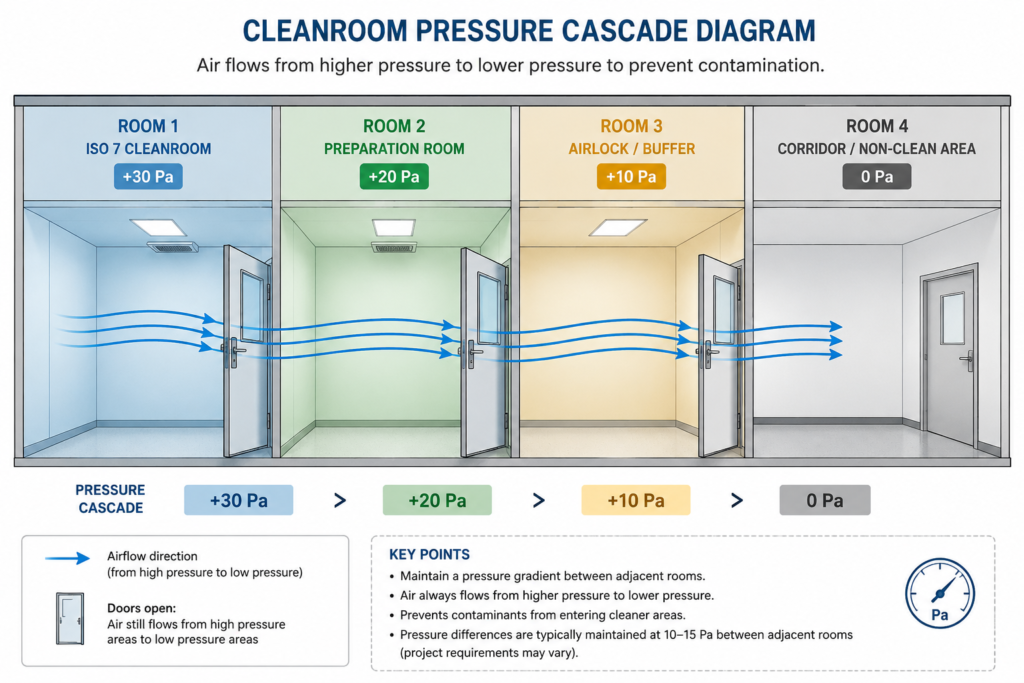
Instead of maintaining a single pressure difference, most facilities establish a pressure cascade.
Example:
| Area | Typical Pressure |
|---|---|
| Critical Processing Room | +30 Pa |
| Preparation Room | +20 Pa |
| Airlock | +15 Pa |
| Corridor | +5 Pa |
This gradual pressure reduction minimizes turbulence and maintains controlled airflow between zones.
The exact pressure values should be determined during HVAC system design based on process requirements and applicable regulations.
How Differential Pressure Is Created
Pressure differences are achieved by balancing:
- Supply air volume
- Return air volume
- Exhaust air volume
- Leakage through doors and building envelope
Generally:
Supply Air > Exhaust Air → Positive Pressure
Supply Air < Exhaust Air → Negative Pressure
The HVAC control system continuously adjusts airflow to maintain the target pressure.
Typical Differential Pressure Values
There is no single universal pressure requirement for every cleanroom.
Many facilities are designed with pressure differences in the range of approximately 10–15 Pa between adjacent rooms as an engineering practice, although project-specific requirements, risk assessments, and local regulations may justify different values.
Engineers should always follow the project’s design specifications and applicable standards rather than relying on fixed numbers.
The Role of Airtight Doors
Even a well-balanced HVAC system cannot maintain pressure if significant air leakage occurs around doors.
Hermetic cleanroom doors help by:
- Reducing air leakage
- Maintaining stable pressure
- Improving energy efficiency
- Supporting contamination control
- Minimizing pressure fluctuations during operation
Door selection should consider sealing performance, durability, automation requirements, and compatibility with the cleanroom classification.
Monitoring Differential Pressure
Modern facilities typically monitor pressure continuously using differential pressure transmitters connected to the building management system (BMS) or cleanroom monitoring system.
Common monitoring features include:
- Real-time pressure display
- Alarm notifications
- Data logging
- Trend analysis
- Remote monitoring
Continuous monitoring helps detect HVAC imbalance before contamination risks develop.
Common Design Mistakes
Using identical pressure in every room
Without a pressure gradient, airflow direction becomes unpredictable.
Ignoring door leakage
Poor door sealing can significantly reduce pressure stability.
Improper air balancing
Incorrect supply and exhaust airflow prevents stable pressure control.
Lack of continuous monitoring
Pressure can drift over time without operators noticing.
Opening multiple doors simultaneously
Interlocking door systems help preserve pressure cascades.
Best Practices
- Design pressure cascades during early project planning.
- Coordinate HVAC, architectural, and cleanroom equipment design.
- Use airtight doors with reliable sealing performance.
- Verify pressure during commissioning.
- Continuously monitor differential pressure during operation.
- Periodically recalibrate pressure sensors according to maintenance procedures.
Conclusion
Differential pressure is one of the fundamental engineering controls that enables cleanrooms to achieve reliable contamination control. By directing airflow through carefully designed pressure cascades, facilities can protect sensitive products, support regulatory compliance, and maintain consistent operating conditions.
Successful pressure control depends on the combined performance of HVAC systems, airtight construction, appropriate door sealing, and continuous monitoring. When these elements are designed and maintained together, differential pressure becomes a reliable foundation for long-term cleanroom performance.
FAQ
What is differential pressure in a cleanroom?
It is the air pressure difference between adjacent rooms used to control airflow direction and reduce contamination risks.
Why are positive pressure cleanrooms commonly used?
Positive pressure pushes filtered air outward, helping prevent contaminants from entering critical processing areas.
When should a negative pressure room be used?
Negative pressure is used when hazardous substances must be contained, such as in isolation rooms or biosafety laboratories.
What is a pressure cascade?
A pressure cascade is a sequence of gradually decreasing pressure levels between connected spaces to maintain controlled airflow.
Can airtight doors improve pressure stability?
Yes. Properly sealed hermetic doors reduce air leakage and help maintain the intended pressure differential.
Does ISO 14644 specify an exact pressure difference?
ISO 14644 focuses on cleanroom performance and classification rather than prescribing a universal pressure differential. Pressure values are determined by the facility’s design, risk assessment, and applicable regulatory requirements.