
Introduction
Personnel are one of the largest sources of contamination in a cleanroom. Even when wearing cleanroom garments, operators continuously release particles from clothing, skin, and movement. Without proper contamination control at entry points, these particles can be carried into controlled environments and affect product quality, process stability, or patient safety.
An air shower is one of the most widely used personnel decontamination devices in cleanroom facilities. Installed at the entrance to controlled areas, it uses high-velocity HEPA-filtered air to remove loose particles from personnel before they enter the cleanroom.
Although air showers are common in pharmaceutical, electronics, biotechnology, food processing, and healthcare facilities, they are not required for every cleanroom project. Their effectiveness depends on the cleanliness classification, process risk, personnel flow, and the overall contamination-control strategy.
This article explains how cleanroom air showers work, where they should be installed, their key design features, and how to select the right model for your project.
What Is a Cleanroom Air Shower?
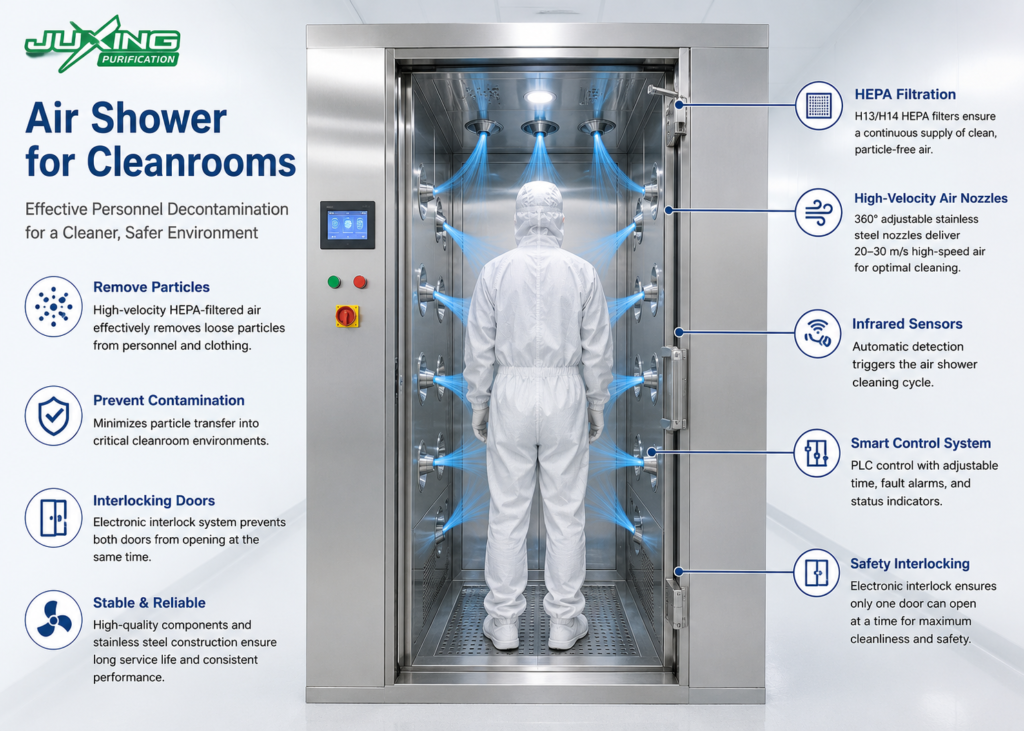
A cleanroom air shower is an enclosed transition chamber installed between uncontrolled and controlled environments. Before entering the cleanroom, personnel remain inside the chamber while high-velocity jets of HEPA-filtered air remove loose particles from garments, gloves, footwear, and exposed surfaces.
An air shower is not intended to sterilize personnel or disinfect clothing. Instead, it reduces the number of non-viable airborne particles that may otherwise enter the cleanroom.
A typical personnel air shower consists of:
- Stainless steel or powder-coated steel enclosure
- High-efficiency centrifugal fan
- HEPA or ULPA filters
- Adjustable stainless-steel air nozzles
- Automatic or manual doors
- Door interlocking system
- Infrared sensors
- PLC or microprocessor controller
- LED lighting
- Emergency stop button
Some projects also use cargo air showers designed for carts, pallets, or material transfer.
How Does an Air Shower Work?
The operating sequence is straightforward but carefully controlled.
Step 1 – Enter the Air Shower
Personnel enter the chamber through the outer door.
Once the door closes, the interlocking system prevents the opposite door from opening.
This ensures that unfiltered air cannot directly enter the cleanroom.
Step 2 – Automatic Cleaning Cycle
Infrared sensors or push-button controls activate the cleaning cycle.
The fan forces air through HEPA filters before delivering high-velocity air through multiple adjustable nozzles positioned around the chamber walls and ceiling.
Typical air velocity ranges between 20–30 m/s at the nozzle outlet, although actual design values vary by manufacturer and project requirements.
The high-speed airflow dislodges loose particles from garments and exposed surfaces.
Step 3 – Particle Removal
The removed particles are drawn toward return-air grilles.
The air is recirculated through the filtration system, allowing contaminants to be captured before the cleaned air is supplied again.
Unlike general room ventilation, the airflow inside an air shower forms a dedicated cleaning loop within the chamber.
Step 4 – Exit to the Cleanroom
After the preset cleaning time—typically between 15 and 30 seconds—the cleanroom-side door unlocks automatically, allowing personnel to enter the controlled area.
The cleaning duration can usually be adjusted according to project requirements.
Why Are Air Showers Used?
Air showers provide an additional contamination-control barrier at critical cleanroom entrances.
Their primary benefits include:
- Reducing loose particles carried by personnel
- Supporting cleanroom contamination-control procedures
- Reducing particle transfer during personnel entry
- Improving cleanroom housekeeping efficiency
- Helping maintain stable environmental conditions
- Complementing gowning procedures rather than replacing them
It is important to understand that an air shower cannot compensate for poor gowning practices.
Personnel should always complete the required gowning procedure before entering the air shower.
Where Are Air Showers Commonly Used?
Air showers are widely used in industries where particle contamination may affect product quality or process reliability.
Typical applications include:
Pharmaceutical Manufacturing
Personnel entering clean manufacturing areas may pass through air showers before accessing production spaces, depending on facility design and contamination-control strategy.
Medical Device Manufacturing
Many medical-device facilities use air showers to reduce particulate contamination before operators enter controlled production environments.
Electronics and Semiconductor Production
Fine particles may affect semiconductor wafers, circuit boards, optical components, and precision electronic assemblies.
Air showers help reduce the number of loose particles introduced by personnel.
Biotechnology and Laboratory Facilities
Research laboratories and biotechnology production areas may install air showers where contamination control is part of the facility design.
Food and Beverage Processing
Certain food-processing environments use air showers to reduce dust and foreign-particle transfer into hygienic production areas.
Hospital and Healthcare Facilities
Air showers are generally less common in hospital operating theatres than in industrial cleanrooms.
Hospital contamination control usually relies on proper gowning procedures, pressure control, HEPA filtration, and airflow design rather than personnel air showers.
This distinction is often overlooked by buyers.
Are Air Showers Required for Every Cleanroom?
No.
Neither ISO 14644 nor GMP universally requires every cleanroom to have an air shower.
Whether an air shower is appropriate depends on factors such as:
- Cleanroom classification
- Process sensitivity
- Personnel traffic
- Contamination risk assessment
- Facility layout
- Customer specifications
- Local regulations
Some ISO Class 8 facilities operate successfully without air showers, while some ISO Class 7 or pharmaceutical facilities consider them beneficial as part of a broader contamination-control strategy.
Therefore, the decision should be based on project-specific risk assessment rather than cleanliness class alone.
Key Factors When Selecting an Air Shower
Choosing an air shower involves more than selecting the chamber size.
Important considerations include:
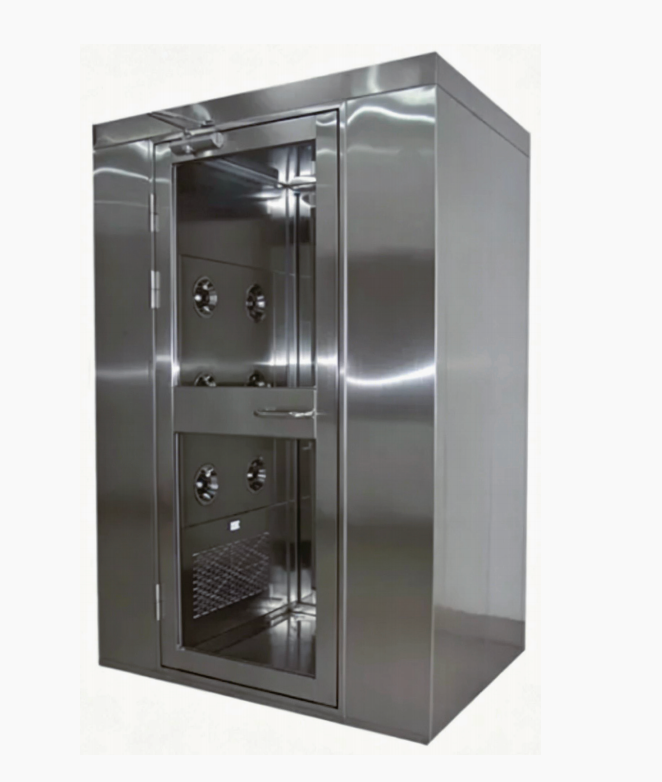
Chamber Size
The chamber should accommodate the expected number of personnel without restricting movement.
Single-person and multi-person models are both common.
Construction Material
Common materials include:
- Powder-coated steel
- Stainless steel 304
- Stainless steel 316
Material selection depends on corrosion resistance, cleaning requirements, and industry standards.
Filter Efficiency
Most cleanroom air showers use H13 or H14 HEPA filters.
Critical applications may require ULPA filtration where appropriate.
Air Velocity
Higher velocity does not necessarily mean better cleaning.
The airflow should effectively remove loose particles while remaining comfortable and avoiding excessive noise.
Door Type
Projects may use:
- Swing doors
- Automatic sliding doors
- Manual hinged doors
Door selection often depends on personnel flow, available space, and project requirements.
Interlocking System
Door interlocking is one of the most important safety features.
It prevents both doors from opening simultaneously and minimizes contamination transfer between adjacent environments.
Control System
Modern air showers may include:
- PLC control
- Touch-screen interface
- Adjustable cleaning cycle
- Fault alarms
- Emergency stop
- Filter replacement reminders
Common Misconceptions
Air Showers Sterilize Personnel
Incorrect.
Air showers remove loose particles but do not sterilize clothing or eliminate microorganisms.
Higher Air Velocity Is Always Better
Not necessarily.
Excessively high airflow may increase noise while providing little additional cleaning benefit.
Proper nozzle arrangement is equally important.
Air Showers Replace Gowning Procedures
No.
Air showers should complement—not replace—proper gowning protocols.
Every Cleanroom Needs an Air Shower
Again, no.
Many cleanrooms achieve excellent contamination control through well-designed gowning areas, personnel procedures, and HVAC systems without installing air showers.
Expert Tip
When evaluating supplier quotations, ask for more than the chamber dimensions. Confirm the filter grade, actual air velocity, nozzle quantity and layout, door interlocking method, controller type, noise level, lighting, filter replacement access, and maintenance requirements. These details have a greater impact on long-term performance than the external dimensions alone.
Frequently Asked Questions
How long should an air shower cycle last?
Most personnel air showers operate for approximately 15–30 seconds, although the duration can usually be adjusted according to project requirements.
What filter is used in an air shower?
Most cleanroom air showers are equipped with H13 or H14 HEPA filters. Some specialized applications may use ULPA filters.
Does every ISO cleanroom require an air shower?
No. ISO 14644 does not require an air shower for every cleanroom. The decision should be based on contamination risk, facility layout, and project requirements.
Can an air shower remove microorganisms?
Air showers primarily remove loose particles from clothing and surfaces. They are not designed to sterilize personnel or replace disinfection procedures.
What is the difference between an air shower and an airlock?
An airlock primarily controls pressure relationships and airflow between adjacent rooms. An air shower actively removes loose particles from personnel using high-velocity HEPA-filtered air. Some facilities combine both functions in a single entrance system.
Conclusion
Air showers are an effective contamination-control device when properly integrated into an overall cleanroom design. Rather than being a universal requirement, they should be selected according to the project’s cleanliness objectives, contamination risks, personnel flow, and operational procedures.
A well-designed air shower combines appropriate filtration, balanced airflow, reliable door interlocking, and user-friendly controls to support a cleanroom’s overall contamination-control strategy. However, it should always be considered one component of a broader system that includes proper gowning, HVAC design, differential pressure control, and validated operating procedures.