
Quick Answer
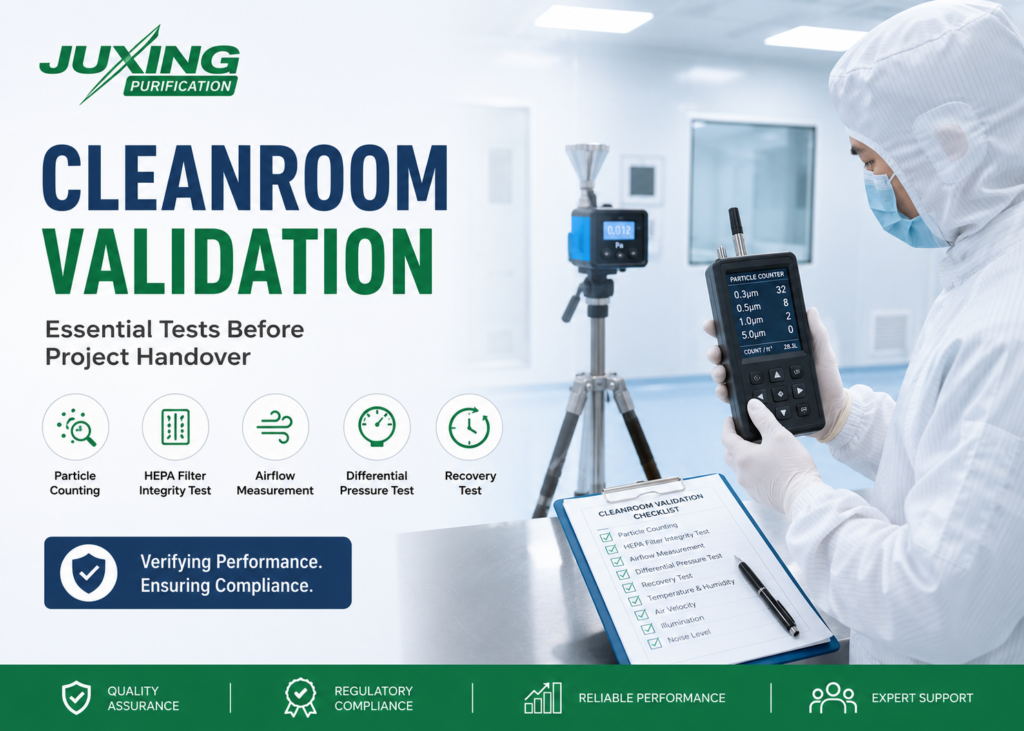
Cleanroom validation is the documented process of verifying that a completed cleanroom performs according to its design specifications and applicable standards. Before project handover or production begins, validation confirms that critical environmental parameters—including cleanliness, airflow, differential pressure, temperature, humidity, and filtration performance—meet the required acceptance criteria. A comprehensive validation program helps ensure regulatory compliance, operational reliability, and long-term cleanroom performance.
Key Takeaways
- Cleanroom validation verifies that a completed cleanroom performs as designed.
- Validation includes multiple performance tests rather than a single inspection.
- Typical tests include airborne particle counting, airflow measurement, HEPA filter integrity testing, differential pressure verification, and recovery testing.
- Validation should be carried out using calibrated instruments and documented procedures.
- A complete validation package simplifies project acceptance and future audits.
Introduction
Completing the construction of a cleanroom does not automatically mean that it is ready for production or clinical use. Before a facility is handed over to the owner, every critical environmental parameter must be verified to ensure that the cleanroom performs according to its design intent.
ISO 14644 provides the internationally recognized framework for cleanroom classification, testing, and performance verification, while industry regulations such as GMP may introduce additional validation requirements depending on the application.
Cleanroom validation provides documented evidence that the facility consistently achieves the required cleanliness level, airflow performance, pressure relationships, filtration efficiency, and environmental conditions. Rather than relying on visual inspection alone, validation confirms that all major building systems—including HVAC, filtration, and room pressurization—operate together as an integrated contamination-control system.
For pharmaceutical manufacturing, biotechnology laboratories, semiconductor facilities, hospitals, and medical device production, proper validation reduces operational risks, supports regulatory inspections, and gives owners confidence before production begins.
What Is Cleanroom Validation?
Cleanroom validation is a documented process used to demonstrate that a cleanroom consistently meets predefined performance requirements under normal operating conditions.
Unlike routine maintenance, validation measures actual environmental performance using standardized testing methods and calibrated instruments.
A complete validation program typically verifies:
- Airborne particle concentration
- Airflow volume and velocity
- Air changes per hour (ACH)
- Differential pressure
- HEPA filter integrity
- Recovery performance
- Temperature and humidity
- Lighting
- Noise level
The exact scope depends on the cleanroom classification, project specifications, applicable regulations, and industry requirements.
Why Is Cleanroom Validation Important?
Without validation, there is no objective evidence that a cleanroom performs according to its original design.
Even if the construction quality appears satisfactory, hidden problems—such as incorrect airflow balance, leaking HEPA filters, unstable pressure differentials, or insufficient ventilation—may only become apparent through systematic testing.
Proper cleanroom validation helps organizations:
- Verify compliance with ISO 14644 and project specifications.
- Confirm that HVAC systems operate as designed.
- Identify installation defects before project acceptance.
- Reduce contamination risks.
- Support GMP qualification and regulatory inspections where applicable.
- Establish baseline performance data for future maintenance and requalification.
Validation should therefore be viewed not as a final inspection, but as an essential quality assurance process that confirms the cleanroom is ready for reliable long-term operation.
Common Cleanroom Validation Tests
A complete cleanroom validation program evaluates multiple environmental parameters rather than relying on a single performance indicator. Together, these tests verify that the cleanroom operates as an integrated system capable of maintaining the required cleanliness and environmental stability.
The following tests are among the most commonly performed before project handover and during periodic requalification.
1. Airborne Particle Count Test
The airborne particle count test determines whether a cleanroom meets its specified cleanliness classification by measuring airborne particle concentrations at designated sampling locations.
This test is one of the fundamental requirements for demonstrating compliance with ISO 14644-1 and is typically performed using calibrated particle counters.
Results are compared with the maximum allowable particle concentrations for the target ISO Class.
Typical objectives include:
- Confirming ISO cleanliness classification
- Identifying contamination sources
- Establishing baseline operating conditions
- Supporting commissioning documentation
2. Air Changes per Hour (ACH) Verification
Air Changes per Hour (ACH) measures how many times the total volume of air within the cleanroom is replaced each hour.
Although higher ACH often improves contamination control, the required air change rate depends on the cleanroom classification, airflow design, occupancy, and manufacturing process.
During validation, engineers verify that the measured airflow matches the project design calculations.
Typical measurements include:
- Supply airflow volume
- Return airflow volume
- Air balance
- ACH calculation
Proper ACH verification also helps evaluate overall HVAC system performance.
3. Differential Pressure Test
Maintaining the correct differential pressure between adjacent rooms is essential for controlling airflow direction and preventing cross-contamination.
Pressure measurements verify that the designed pressure cascade has been successfully achieved.
For example:
- Sterile production rooms often maintain positive pressure.
- Containment laboratories may require negative pressure.
- Airlocks help stabilize pressure transitions between rooms.
Pressure is typically measured using calibrated digital differential pressure gauges.
Validation confirms:
- Pressure cascade
- Room-to-room pressure relationships
- Pressure stability
- HVAC balancing
4. HEPA Filter Integrity Test
The HEPA Filter Integrity Test verifies that installed HEPA filters are free from leaks that could allow contaminated air to bypass the filtration system.
This test is commonly known as:
- HEPA Leak Test
- DOP Test
- PAO Test
Depending on local standards and project specifications.
An aerosol challenge is introduced upstream of the filter while downstream measurements detect any leakage.
Successful testing confirms:
- Correct filter installation
- Proper gasket sealing
- Housing integrity
- Filter performance
5. Airflow Visualization (Smoke Study)
The Airflow Visualization Test, commonly referred to as a smoke study, allows engineers to observe airflow patterns inside the cleanroom.
Instead of relying solely on numerical measurements, smoke visualization provides a clear understanding of how air moves around equipment, workstations, doors, and personnel.
Typical objectives include:
- Identifying turbulence
- Detecting dead zones
- Confirming unidirectional airflow
- Evaluating contamination risks
Smoke studies are especially important for aseptic processing and critical cleanroom operations.
6. Recovery Time Test
The Recovery Time Test evaluates how quickly a cleanroom returns to its specified cleanliness level after being intentionally challenged with particles.
Recovery performance reflects the combined effectiveness of:
- HVAC design
- Airflow distribution
- Filtration system
- Air change rate
A shorter recovery time generally indicates more efficient contaminant removal, although acceptable limits depend on project specifications and operational requirements.
7. Air Velocity Measurement
Air velocity testing measures the speed of airflow supplied through HEPA filters, ceiling diffusers, or laminar flow systems.
Measurements help verify:
- Uniform airflow distribution
- Compliance with design specifications
- Performance of unidirectional airflow systems
For ISO Class 5 and similar cleanrooms using unidirectional airflow, maintaining appropriate air velocity is particularly important for protecting critical process areas.
8. Temperature and Relative Humidity Test
Temperature and humidity directly influence both product quality and personnel comfort.
Validation confirms that environmental conditions remain within the specified operating range under normal working conditions.
Stable environmental control helps:
- Improve process consistency
- Protect sensitive materials
- Enhance operator comfort
- Support regulatory compliance
9. Illumination Test
Adequate lighting is essential for safe operation, inspection, and manufacturing accuracy.
Validation measures illumination levels throughout the cleanroom to confirm compliance with project specifications and applicable standards.
Testing usually considers:
- Average illumination
- Uniformity
- Critical work areas
- Emergency lighting (where applicable)
10. Noise Level Test
Although often overlooked, excessive noise can reduce operator comfort and productivity.
Noise measurements help verify that HVAC equipment, fans, and other mechanical systems operate within acceptable limits.
The results may also assist in identifying abnormal equipment operation during commissioning.
Expert Observation
One of the most common misconceptions is that passing the particle count test alone means the cleanroom has been fully validated.
In reality, a cleanroom functions as an integrated environmental system. Excellent particle count results cannot compensate for unstable differential pressure, leaking HEPA filters, inadequate air changes per hour (ACH), or poor airflow distribution.
Successful validation therefore requires evaluating all critical performance parameters together rather than focusing on a single test result.
When Should a Cleanroom Be Revalidated?
Cleanroom validation is not a one-time activity performed only at project completion. Throughout the operational life of a cleanroom, modifications to equipment, HVAC systems, filters, or facility layout may affect environmental performance. Revalidation helps confirm that the cleanroom continues to operate within its specified acceptance criteria.
The frequency and scope of revalidation depend on applicable regulations, risk assessments, operational changes, and company quality procedures.
Revalidation is commonly performed under the following circumstances.
After HEPA Filter Replacement
Replacing terminal HEPA filters may affect airflow distribution, pressure relationships, and filtration performance.
Following filter replacement, facilities typically perform HEPA Filter Integrity Testing and may also verify airflow, pressure, and particle counts where appropriate.
After HVAC System Modifications
Changes to the ventilation system—such as replacing fans, adjusting airflow, upgrading ductwork, or modifying control parameters—can influence multiple cleanroom performance indicators.
Following significant HVAC work, organizations often re-evaluate:
- Air Changes per Hour (ACH)
- Air velocity
- Differential Pressure
- Temperature and humidity
- Airflow balance
After Facility Renovation or Layout Changes
Even relatively small construction activities may introduce contamination or alter airflow patterns.
Examples include:
- New partition walls
- Equipment relocation
- Ceiling modifications
- Utility installation
- Production line expansion
After these changes, validation helps verify that the cleanroom still performs according to its original design objectives.
Following Major Equipment Installation
Large production equipment may obstruct airflow or create turbulence around critical processing areas.
In these situations, additional Airflow Visualization (Smoke Study) testing is often performed to confirm that airflow patterns remain suitable for the manufacturing process.
Periodic Requalification
Many organizations perform scheduled requalification as part of their quality management system.
The specific interval depends on:
- Industry regulations
- Customer requirements
- Product risk
- Internal quality procedures
Routine requalification provides confidence that cleanroom performance remains stable throughout its operational life.
Buyer’s Checklist Before Project Acceptance
Before accepting a newly completed cleanroom project, buyers should confirm that the supplier provides complete validation documentation rather than only equipment installation records.
A comprehensive handover package should include:
☐ Validation protocol
☐ Approved testing procedures
☐ Instrument calibration certificates
☐ Airborne particle count report
☐ Air Changes per Hour (ACH) verification report
☐ Differential Pressure test report
☐ HEPA Filter Integrity test report
☐ Airflow Visualization (Smoke Study) report (where applicable)
☐ Temperature and humidity records
☐ Final validation report
☐ As-built drawings
☐ Operation and maintenance manuals
☐ Operator training records
☐ Recommended maintenance schedule
A complete documentation package simplifies project acceptance and supports future inspections, audits, and maintenance activities.
Common Misconceptions
Passing the Particle Count Test Means the Cleanroom Is Fully Validated
No.
Airborne particle counting verifies only one aspect of cleanroom performance.
A successful validation program also considers airflow, pressure control, filtration integrity, recovery performance, environmental conditions, and system stability.
Validation Is Only Required for Pharmaceutical Cleanrooms
Not necessarily.
Although pharmaceutical facilities often have the most comprehensive validation requirements, electronics manufacturing, medical device production, biotechnology laboratories, healthcare facilities, and research laboratories also perform cleanroom validation to ensure environmental performance.
Validation Is Performed Only Once
Incorrect.
Most cleanrooms require periodic requalification throughout their service life to confirm continued compliance following maintenance, modifications, or routine operational changes.
Validation Eliminates the Need for Preventive Maintenance
No.
Validation confirms current performance, while preventive maintenance helps preserve that performance over time.
Both activities are essential components of an effective cleanroom quality program.
Expert Tip
When comparing quotations from cleanroom contractors, do not ask only whether “validation is included.”
Instead, request a detailed list of validation tests, applicable standards, acceptance criteria, calibration documentation, and the final validation report.
A supplier offering a complete validation package can often reduce commissioning time, simplify regulatory inspections, and provide stronger long-term technical support than one supplying equipment alone.
Frequently Asked Questions (FAQ)
What is cleanroom validation?
Cleanroom validation is the documented process of verifying that a cleanroom consistently performs according to its design specifications, operational requirements, and applicable standards. It confirms that critical environmental parameters—including cleanliness, airflow, filtration, and pressure control—meet predefined acceptance criteria before the facility is put into operation.
What tests are included in cleanroom validation?
A complete validation program may include:
- Airborne particle count testing
- Air Changes per Hour (ACH) verification
- Differential Pressure testing
- HEPA Filter Integrity Testing
- Airflow Visualization (Smoke Study)
- Recovery time testing
- Air velocity measurement
- Temperature and humidity testing
- Illumination testing
- Noise level measurement
The exact scope depends on the project specifications, applicable standards, and industry requirements.
How often should a cleanroom be revalidated?
There is no single interval suitable for every facility.
Revalidation schedules depend on factors such as regulatory requirements, product risk, cleanroom classification, maintenance activities, and operational changes. Many organizations also perform requalification after major HVAC modifications, HEPA filter replacement, or facility renovation.
Is cleanroom validation required for every industry?
The extent of validation varies between industries.
Pharmaceutical manufacturing generally has the most comprehensive validation requirements, while medical device production, biotechnology, electronics manufacturing, hospitals, and research laboratories also perform validation to verify environmental performance according to their operational needs.
Who should perform cleanroom validation?
Validation should be carried out by qualified personnel using calibrated instruments and documented testing procedures.
Many organizations choose experienced cleanroom specialists or independent validation providers to ensure that testing is objective, traceable, and compliant with applicable standards.
Conclusion
Cleanroom validation is one of the most important steps in delivering a reliable controlled environment. Rather than simply confirming that equipment has been installed, validation demonstrates that the entire cleanroom system—including airflow, filtration, pressure control, environmental conditions, and supporting infrastructure—operates together as intended.
A successful validation program combines multiple performance tests with standardized procedures, calibrated instruments, and comprehensive documentation. This approach helps owners verify project quality, supports regulatory compliance, reduces operational risks, and establishes a reliable performance baseline for future maintenance and requalification.
Whether the facility is designed for pharmaceutical manufacturing, biotechnology, medical devices, healthcare, or electronics production, validation should be regarded as an integral part of the cleanroom lifecycle rather than a final project milestone.
By planning validation early and working with experienced cleanroom professionals, organizations can improve project acceptance, enhance long-term operational stability, and gain greater confidence that their cleanroom will continue to perform as expected throughout its service life.