
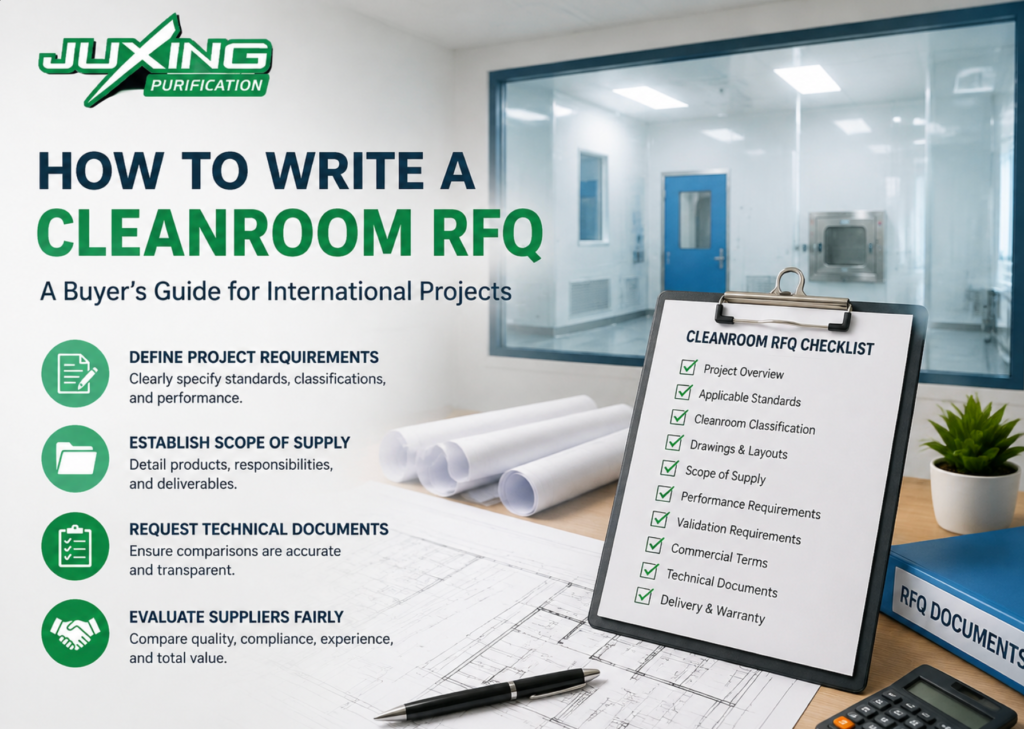
Quick Answer
A cleanroom RFQ (Request for Quotation) is more than a pricing request—it is the technical foundation of a successful cleanroom project. A well-prepared RFQ enables suppliers to provide accurate, comparable quotations while reducing misunderstandings, design revisions, procurement delays, and unexpected costs.
An effective cleanroom RFQ should clearly define the project scope, applicable standards, cleanroom classification, environmental performance requirements, equipment specifications, installation responsibilities, validation requirements, commercial terms, and required technical documentation. The more complete the RFQ, the easier it becomes to evaluate suppliers fairly and deliver a project that meets quality, compliance, budget, and schedule expectations.
Key Takeaways
- A comprehensive cleanroom RFQ improves quotation accuracy and reduces project risk.
- Technical specifications should focus on required performance rather than simply listing products.
- Clearly defining responsibilities prevents gaps between equipment suppliers, HVAC contractors, and installation teams.
- Standardized RFQs make supplier comparisons more objective and transparent.
- A professional RFQ often shortens procurement cycles and reduces costly changes during construction.
Introduction
Whether you are building a pharmaceutical cleanroom, a hospital operating theatre, a biotechnology laboratory, or an electronics manufacturing facility, the success of the project often begins long before construction starts. It begins with a well-written cleanroom RFQ.
Many buyers assume that requesting quotations is simply a matter of sending drawings to several suppliers. In reality, suppliers can only prepare accurate proposals when they fully understand the project’s technical requirements, quality expectations, responsibilities, and commercial conditions.
An incomplete RFQ often leads to inconsistent quotations because each supplier makes different assumptions. As a result, comparing proposals becomes difficult, engineering revisions increase, procurement takes longer, and project costs may rise unexpectedly.
A professionally prepared RFQ serves as a common technical language between the buyer, consultant, EPC contractor, and equipment supplier. Instead of focusing only on price, it ensures that every supplier is quoting for the same scope and performance requirements.
This guide explains what information should be included in a cleanroom RFQ, why each section matters, and how buyers can prepare procurement documents that support successful international cleanroom projects.
What Is a Cleanroom RFQ?
A Request for Quotation (RFQ) is a formal procurement document used to invite suppliers to submit pricing and technical proposals for a clearly defined project.
Unlike a Request for Information (RFI), which gathers preliminary market information, or a Request for Proposal (RFP), which allows suppliers to recommend different technical solutions, an RFQ assumes that the buyer has already established the project’s basic requirements and now requires competitive quotations based on the same specification.
For cleanroom projects, an RFQ typically includes both commercial and technical information, such as:
- Project overview
- Applicable standards
- Required cleanroom classifications
- Architectural drawings
- Mechanical and HVAC requirements
- Equipment specifications
- Installation scope
- Testing and validation requirements
- Delivery schedule
- Commercial terms
The objective is straightforward: ensure that every qualified supplier understands exactly what is required before preparing a quotation.
Why Does the Quality of an RFQ Matter?
One of the biggest challenges in cleanroom procurement is that every project is unique. Room layouts, process requirements, cleanliness classifications, environmental conditions, and regulatory requirements often differ significantly between facilities.
If these requirements are not clearly communicated, suppliers must estimate or make assumptions, which introduces unnecessary risk.
For example, two suppliers may both quote for an ISO Class 7 cleanroom but assume different wall systems, different door specifications, different filtration arrangements, or different validation scopes. Although both quotations appear to meet the basic requirement, they may represent completely different engineering solutions.
A detailed RFQ minimizes these assumptions by defining expectations before suppliers begin preparing quotations.
The benefits include:
- More accurate pricing
- Better technical compliance
- Easier supplier comparison
- Fewer clarification meetings
- Reduced engineering revisions
- Lower risk of change orders
- Improved project scheduling
For international projects involving multiple consultants, contractors, and suppliers, a standardized RFQ also improves communication throughout the entire procurement process.
What Information Should Every Cleanroom RFQ Include?
Although every project has unique requirements, most professional cleanroom RFQs contain several common sections. Each section helps suppliers understand not only what products are required, but also how those products are expected to perform within the overall cleanroom system.
The following elements should be considered essential.
1. Project Overview
Every RFQ should begin with a concise summary of the project.
Typical information includes:
- Project name
- Facility location
- Industry sector
- New construction or renovation
- Expected project schedule
- Building size
- Number of cleanrooms
- Primary manufacturing or medical process
Providing this background helps suppliers understand the operational environment before reviewing detailed specifications.
For example, a pharmaceutical aseptic filling facility has very different design priorities than a semiconductor production cleanroom or a hospital operating theatre, even when similar cleanliness classifications are specified.
2. Applicable Standards and Regulations
One of the first questions every experienced supplier asks is:
Which standards must this project comply with?
The answer affects virtually every aspect of design, manufacturing, testing, and documentation.
Commonly referenced standards include:
- ISO 14644
- EU GMP Annex 1
- FDA cGMP
- WHO GMP
- USP <797>
- USP <800>
Clearly identifying the governing standards prevents suppliers from making different interpretations of project requirements.
For example, an electronics cleanroom designed according to ISO 14644 may have very different design priorities than a pharmaceutical cleanroom designed to comply with EU GMP Annex 1.
3. Define the Required Cleanroom Classification
The required cleanliness level should never be left to interpretation.
Instead of simply stating that the project requires “a cleanroom,” specify the classification for each controlled area.
For example:
| Room | Classification |
|---|---|
| Sterile Filling Room | ISO Class 5 |
| Background Room | ISO Class 7 |
| Material Preparation Room | ISO Class 8 |
If pressure cascades or zoning requirements have already been determined, these should also be identified.
Buyers who have already established room classifications often receive more accurate quotations because suppliers do not need to estimate environmental performance requirements.
Where appropriate, reference existing project specifications or related engineering documents such as Cleanroom Differential Pressure to ensure suppliers understand the intended pressure relationships between adjacent spaces.
4. Include Drawings Whenever Possible
Drawings are often the single most valuable attachment in an RFQ package.
Even preliminary layouts provide suppliers with essential information that cannot be communicated through text alone.
Useful documents include:
- Architectural floor plans
- Ceiling layouts
- Elevations
- HVAC layouts
- Mechanical drawings
- Electrical drawings
- Equipment layouts
- Utility connection diagrams
The more complete the drawing package, the fewer assumptions suppliers need to make during quotation preparation.
Conversely, quotations based only on room dimensions or rough sketches are far more likely to require significant revisions later.
How to Define the Scope of Supply Clearly
One of the most common reasons for quotation discrepancies is an unclear scope of supply.
In many international projects, the cleanroom is delivered by multiple contractors. One company may supply the HVAC system, another installs wall and ceiling panels, while others provide cleanroom equipment, electrical systems, medical gas, or automation. If responsibilities are not clearly assigned, important items may be omitted—or quoted twice.
Your RFQ should explicitly define what the supplier is expected to provide.
For example, instead of writing:
“Provide cleanroom equipment.”
A more effective specification would be:
“Supply, manufacture, and deliver cleanroom wall panels, ceiling systems, hermetic doors, observation windows, pass boxes, air showers, HEPA filter housings, FFUs, LED cleanroom lighting, and related accessories. Installation is excluded.”
This level of clarity allows every supplier to quote against the same scope.
If the project is divided into multiple packages, identify the interface responsibilities between contractors. For example:
- Who supplies embedded steel?
- Who installs electrical wiring?
- Who seals wall penetrations?
- Who commissions the HVAC system?
- Who performs final validation?
Defining these responsibilities early significantly reduces coordination issues during construction.
Should You Specify Products or Performance?
This is one of the most important questions in cleanroom procurement.
Experienced buyers generally specify required performance, not just products.
For example, rather than requesting:
- Stainless steel door
- HEPA filter
- Fan Filter Unit
Define the expected system performance:
- Required cleanliness classification
- Required room pressure
- Air leakage performance
- Fire resistance rating
- Surface finish
- Corrosion resistance
- Acoustic performance
- Energy efficiency
- Expected service life
Performance-based specifications encourage suppliers to recommend technically appropriate solutions while ensuring quotations remain comparable.
For example, instead of requiring a specific door thickness, you may specify:
- Airtight performance
- Opening frequency
- Chemical resistance
- Ease of cleaning
- Durability under hospital operating conditions
This approach gives suppliers flexibility without compromising project objectives.
What Performance Specifications Should Be Included?
Many RFQs describe products in detail but overlook the performance criteria that determine whether the completed cleanroom will function as intended.
Typical environmental performance requirements include:
- Design temperature
- Relative humidity
- Air cleanliness classification
- Room differential pressure
- Air changes per hour (ACH)
- Recovery time
- Illumination level
- Background noise level
- Vibration limits (where applicable)
Depending on the industry, additional process-specific requirements may also apply.
For example:
- Electrostatic discharge (ESD) control
- Chemical resistance
- Microbiological control
- Particle recovery performance
- Material compatibility
When available, include the target values rather than general descriptions.
Instead of writing:
“Maintain positive pressure.”
Specify:
Positive pressure of +15 Pa relative to the adjacent corridor.
Similarly, instead of writing:
“Provide sufficient ventilation.”
State the required Air Changes per Hour (ACH)
Measurable requirements reduce ambiguity and make supplier proposals easier to evaluate.
What Validation Requirements Should Be Included?
Validation requirements are frequently overlooked during procurement, even though they have a direct impact on project acceptance.
If validation expectations are not defined before quotation, suppliers may exclude testing costs or assume a limited scope, resulting in additional expenses later.
Depending on the project, buyers should specify whether the supplier is responsible for supporting or performing validation activities.
Typical requirements include:
- Airflow volume measurement
- Particle count testing
- Room pressure verification
- Airflow visualization (smoke testing)
- Room recovery testing
- Illumination testing
- Noise measurement
- Temperature and humidity verification
- HEPA Filter Integrity Testing
If independent third-party validation is required, this should also be stated clearly.
Buyers should also specify whether validation reports, calibration certificates, and testing records must be included in the final documentation package.
What Technical Documents Should Buyers Request?
A quotation should never be evaluated based on price alone.
Supporting technical documentation often provides valuable insight into a supplier’s engineering capability and manufacturing quality.
A professional RFQ should request documentation such as:
Product Data Sheets
These describe product dimensions, materials, performance, and installation requirements.
Shop Drawings
Detailed fabrication drawings demonstrate how the proposed products will be manufactured and installed.
Material Certificates
Where applicable, suppliers should provide certificates confirming material grades, corrosion resistance, or fire performance.
Quality Certificates
Depending on project requirements, buyers may request certifications such as:
- ISO 9001
- ISO 14001
- ISO 45001
- CE (where applicable)
Installation Manuals
Installation guidance helps contractors understand correct assembly procedures and minimizes installation errors.
Operation and Maintenance Manuals
These documents support long-term facility operation and preventive maintenance.
Previous Project References
Requesting references for similar projects allows buyers to assess whether the supplier has relevant experience.
Where possible, ask for projects with similar industries, cleanroom classifications, or project scales rather than general company portfolios.
How Can Buyers Compare Supplier Quotations Fairly?
Receiving multiple quotations is only valuable if they are genuinely comparable.
Many buyers mistakenly compare only the total price, overlooking significant differences in technical scope.
Instead, quotations should be evaluated using consistent criteria.
Typical comparison categories include:
| Evaluation Item | Considerations |
|---|---|
| Technical Compliance | Does the proposal satisfy the RFQ requirements? |
| Scope of Supply | Are any items excluded? |
| Product Quality | Materials, construction, durability |
| Engineering Capability | Design support, customization |
| Documentation | Drawings, manuals, certifications |
| Manufacturing Capacity | Production capability and lead time |
| Warranty | Duration and coverage |
| After-sales Support | Technical assistance and spare parts |
| Project Experience | Similar completed projects |
| Commercial Terms | Payment, Incoterms, delivery schedule |
Using an evaluation matrix allows procurement teams to make balanced decisions rather than selecting suppliers solely based on the lowest quotation.
A Good RFQ Saves More Than Money
Many organizations focus on reducing procurement costs but underestimate the financial impact of poorly prepared specifications.
An incomplete RFQ often results in:
- Multiple rounds of quotation revisions
- Longer procurement cycles
- Engineering redesign
- Delayed manufacturing
- Increased project management effort
- Construction disputes
- Additional variation orders
By contrast, investing additional time in RFQ preparation typically leads to smoother communication, faster supplier responses, more accurate pricing, and fewer project changes.
For large pharmaceutical plants, hospitals, or semiconductor facilities, these benefits often outweigh the time required to prepare a comprehensive procurement package.
Buyer’s Checklist
Before issuing your cleanroom RFQ, verify that it answers the following questions. A complete RFQ not only improves quotation quality but also reduces procurement risks throughout the project lifecycle.
Project Information
☐ Have you clearly described the project purpose, industry, and location?
☐ Is the project identified as a new build, expansion, or renovation?
☐ Have you specified the expected project schedule and delivery timeline?
Technical Requirements
☐ Have you identified all applicable standards?
- ISO 14644
- EU GMP Annex 1
- WHO GMP
- FDA cGMP
☐ Have you specified the required cleanroom classification for each room?
☐ Have you defined environmental performance requirements, including temperature, humidity, pressure, and cleanliness?
☐ Have you identified any special process requirements such as ESD protection, chemical resistance, or antimicrobial finishes?
Drawings and Documents
☐ Are architectural drawings included?
☐ Are HVAC and mechanical drawings attached?
☐ Are room layouts and equipment locations clearly identified?
☐ Are utility connection requirements available?
Scope of Supply
☐ Have you clearly defined what the supplier is expected to provide?
☐ Have installation responsibilities been assigned?
☐ Have interface responsibilities between contractors been identified?
☐ Are commissioning and validation responsibilities clearly defined?
Commercial Information
☐ Have you specified the quotation currency?
☐ Have you identified the required Incoterms?
☐ Have payment terms been stated?
☐ Have warranty requirements been defined?
☐ Have delivery deadlines been included?
Supporting Documentation
☐ Are suppliers required to submit:
- Product datasheets
- Shop drawings
- Material certificates
- Quality certifications
- Installation manuals
- Maintenance manuals
- Previous project references
Completing this checklist before issuing an RFQ helps eliminate unnecessary clarification during the bidding process and enables suppliers to prepare more accurate proposals.
Common Misconceptions
Misconception 1: “A Short RFQ Saves Time”
A brief RFQ may appear efficient, but it often creates additional work later. Missing technical details usually result in repeated questions, quotation revisions, and project delays.
A comprehensive RFQ requires more preparation upfront but significantly reduces uncertainty throughout procurement and construction.
Misconception 2: “Every Supplier Understands My Requirements”
Even experienced suppliers may interpret vague specifications differently.
For example, the term “airtight door” may refer to different sealing methods, performance levels, materials, or testing standards depending on the supplier’s experience and target market.
Clear, measurable requirements help ensure that all quotations are based on the same expectations.
Misconception 3: “The Lowest Price Is Always the Best Choice”
A lower quotation may exclude important items such as installation accessories, testing, documentation, or after-sales support.
Evaluating quotations based solely on price can lead to higher lifecycle costs and additional expenses after contract award.
A balanced evaluation should consider technical compliance, quality, supplier experience, documentation, warranty, delivery capability, and service support alongside price.
Misconception 4: “Validation Can Be Discussed After Installation”
Validation requirements influence equipment selection, installation methods, documentation, and project scheduling.
If these requirements are introduced only after installation, corrective work may be required, increasing both cost and project duration.
Whenever possible, validation expectations should be defined during the procurement stage.
Expert Tip
Experienced cleanroom consultants often develop the RFQ and the supplier evaluation matrix at the same time.
This approach ensures that every requirement included in the RFQ can be objectively evaluated once quotations are received. For example, if documentation quality, delivery time, warranty, or engineering support are important selection criteria, they should be requested explicitly in the RFQ rather than discussed after quotations are submitted.
A structured evaluation process not only improves supplier selection but also creates a transparent decision-making record for project stakeholders.
Frequently Asked Questions
What is the difference between an RFQ and an RFP for a cleanroom project?
An RFQ is used when the project requirements are already defined and suppliers are expected to provide quotations based on the same specifications. An RFP (Request for Proposal) is more suitable when buyers are seeking alternative technical solutions or conceptual designs.
Should a cleanroom RFQ include HVAC requirements?
Yes. Even if the HVAC system is supplied by another contractor, the RFQ should identify any HVAC-related requirements that affect the cleanroom equipment, such as airflow direction, pressure relationships, filtration interfaces, or ceiling coordination.
Is it necessary to include validation requirements in the RFQ?
Yes. Defining validation expectations during procurement helps suppliers understand the required testing scope, documentation, and project acceptance criteria. This reduces the likelihood of additional costs or delays later in the project.
How many suppliers should receive a cleanroom RFQ?
For most international projects, inviting three to five qualified suppliers provides a good balance between competition and evaluation efficiency. Inviting too many suppliers can increase workload without significantly improving procurement outcomes.
What is the most common mistake buyers make when preparing a cleanroom RFQ?
One of the most common mistakes is providing incomplete technical information. Missing drawings, unclear scope definitions, and undefined performance requirements often result in inconsistent quotations that are difficult to compare fairly.
Can suppliers propose alternative solutions?
Yes. Suppliers may recommend alternative products or engineering solutions, provided they clearly identify how the proposed solution differs from the original specification and demonstrate that it satisfies the project’s performance requirements.
Conclusion
A well-prepared cleanroom RFQ is one of the most effective tools for reducing procurement risk and improving project outcomes. It establishes a common understanding between buyers, consultants, contractors, and suppliers, enabling all parties to work from the same technical and commercial expectations.
Rather than focusing solely on obtaining the lowest price, buyers should use the RFQ to define measurable performance requirements, clarify project responsibilities, and request the documentation needed for a fair technical evaluation.
As cleanroom projects become increasingly complex across pharmaceutical manufacturing, healthcare, biotechnology, electronics, and other high-performance industries, investing time in preparing a comprehensive RFQ can lead to more accurate quotations, smoother project execution, and greater long-term value.
Ultimately, the quality of the procurement process often determines the quality of the finished cleanroom. A clear, complete, and technically sound RFQ is the first step toward a successful project.