
HEPA Filter Integrity Testing: Cleanroom Leak Test Guide
Introduction
HEPA filters are critical components of cleanroom contamination control, but selecting a filter with the correct efficiency rating is only the beginning.
After installation, the complete filter system must perform as intended. Leakage may occur through damaged filter media, an imperfect frame seal, an incorrectly installed gasket, the filter housing, or another part of the installation. A filter may therefore have passed its factory efficiency test but still fail to provide adequate protection after being installed.
HEPA filter integrity testing, also called an installed filter system leakage test or in-situ leak test, is used to identify these problems before they compromise cleanroom performance.
For pharmaceutical manufacturers, cleanroom contractors, EPC teams, consultants and facility owners, the test provides evidence that the installed filtration system has no unacceptable local leakage and is suitable for its intended cleanroom application.
ISO 14644-3 includes the installed filter system leakage test among its cleanroom performance test methods. EU GMP Annex 1 also identifies installed filter leakage and integrity testing as a relevant cleanroom qualification activity for sterile manufacturing facilities.
What Is HEPA Filter Integrity Testing?
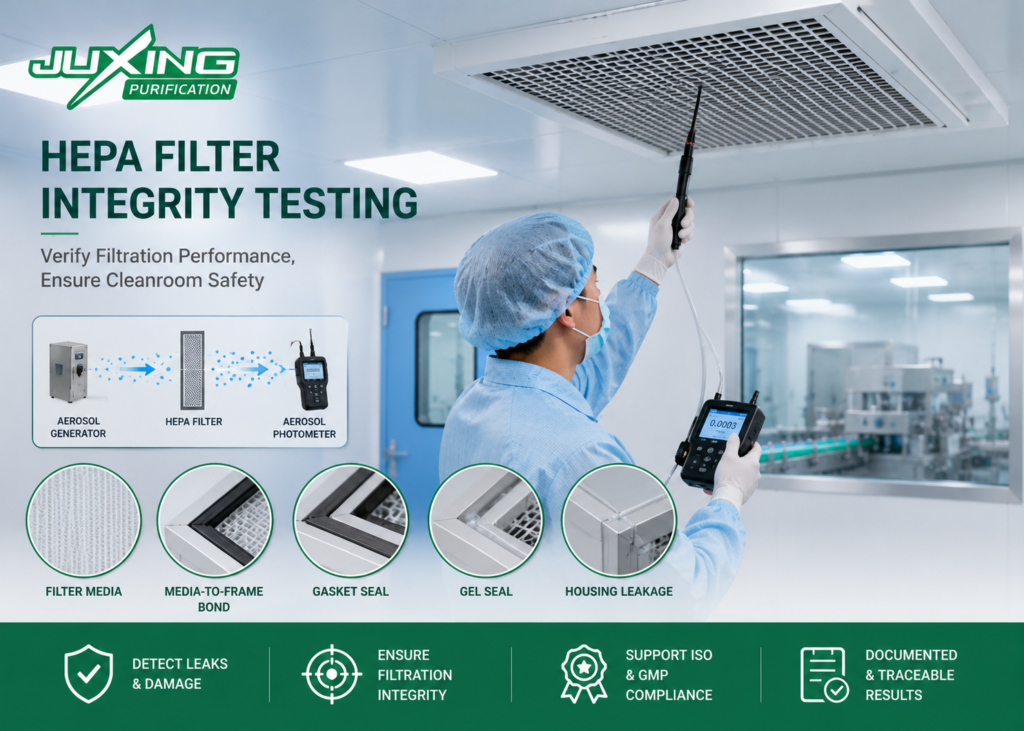
HEPA filter integrity testing is an on-site test used to determine whether an installed filter system contains local leakage.
A controlled test aerosol is introduced upstream of the filter. The downstream face of the filter and relevant installation interfaces are then examined using suitable detection equipment.
The test is intended to evaluate the complete installed system, which may include:
- Filter media
- Filter frame
- Gasket or gel seal
- Filter housing
- Mounting interface
- Accessible joints between the filter and its support structure
The purpose is not simply to confirm that air passes through the filter. It is to determine whether a concentrated local leak allows insufficiently filtered air to bypass the intended filtration path.
Why Is Installed Filter Integrity Important?
A cleanroom may have the correct airflow volume, air change rate and room pressure while still being vulnerable to contamination if a terminal filter system leaks.
Local leakage can allow particles to enter the cleanroom downstream of the HEPA filter. This is particularly important above exposed products, aseptic processing zones, critical workstations and other areas where filtered air is expected to provide direct contamination protection.
Integrity testing helps project teams:
- Detect damaged filter media
- Identify defective or compressed seals
- Find installation and housing leakage
- Confirm the quality of terminal filter installation
- Support cleanroom commissioning and qualification
- Establish a documented baseline for future testing
- Investigate unexplained particle contamination
In sterile manufacturing, filter integrity must be considered together with airflow patterns, room classification, pressure differences, environmental monitoring and the overall contamination control strategy. EU GMP Annex 1 treats installed filter leakage testing as one element of cleanroom qualification rather than as a complete qualification by itself.
Installed Leak Test vs Factory Filter Efficiency Test
These two tests are related but not interchangeable.
| Test | Main purpose | Typical test location | Main question |
|---|---|---|---|
| Factory filter efficiency test | Measures the filtration performance of the filter | Filter manufacturing facility or qualified test laboratory | Does the filter achieve its specified efficiency? |
| Installed filter integrity test | Detects local leakage in the installed system | Cleanroom or controlled facility | Does the installed filter system have an unacceptable leak? |
A factory-certified HEPA filter can still develop problems during:
- Transportation
- Storage
- Handling
- Installation
- Ceiling construction
- Maintenance
- Filter replacement
- Long-term operation
For this reason, a factory certificate does not normally replace appropriate testing of the installed system.
Is an Integrity Test the Same as a Particle Count Test?
No.
A cleanroom particle count test measures airborne particle concentration within the room and is used for cleanroom classification or monitoring.
An installed filter leak test examines the filter system for localized penetration.
| Test | What it evaluates |
|---|---|
| Installed filter integrity test | Local leaks through or around the filter |
| Airborne particle classification | Particle concentration in the cleanroom |
| Airflow volume or velocity test | Quantity or speed of supplied air |
| Airflow visualization | Direction and behavior of airflow |
| Recovery test | Time required to reduce an elevated particle concentration |
| Differential pressure test | Pressure relationship between adjacent rooms |
A room may temporarily meet a particle classification limit even though one filter has a small local leak, particularly when the overall airflow dilutes the released particles. Filter integrity testing and room classification should therefore be treated as complementary tests.
How Is a HEPA Filter Integrity Test Performed?
The exact procedure should follow the approved qualification protocol, applicable standard, equipment instructions and project requirements. A typical test follows the steps below.
1. Review the System and Test Conditions
Before testing, the team confirms:
- Filter identification and location
- Filter type and rating
- Air-handling system operating condition
- Applicable test method
- Required detection equipment
- Approved aerosol
- Sampling and scanning approach
- Acceptance criteria
- Health, safety and contamination controls
The cleanroom state—such as as-built, at-rest or operational—should also be defined where relevant to the qualification plan.
2. Introduce a Test Aerosol Upstream
A suitable aerosol is introduced into the airflow upstream of the filter.
The aerosol should be distributed sufficiently so that the upstream challenge represents the filter area being tested. Poor aerosol mixing can produce unreliable results because different parts of the filter may receive substantially different challenge concentrations.
3. Measure the Upstream Challenge Concentration
The upstream concentration is measured or otherwise established according to the selected test method.
This reference enables downstream readings to be assessed relative to the challenge presented to the filter.
4. Scan the Downstream Filter Face
A sampling probe is moved systematically across the accessible downstream surface.
The scan normally includes:
- Filter media
- Media-to-frame interface
- Perimeter seal
- Filter-to-housing connection
- Accessible housing joints
The probe should be moved at an appropriate and controlled speed, with overlapping scan paths where required by the approved procedure.
5. Identify and Record Suspected Leakage
Any reading above the defined acceptance limit is investigated and documented.
The test record should identify:
- Filter reference number
- Test location
- Equipment used
- Calibration status
- Aerosol or test method
- Upstream challenge
- Test result
- Leak location, if found
- Corrective action
- Retest result
- Tester and reviewer approval
What Equipment Is Commonly Used?
Installed HEPA filter integrity testing commonly requires:
- Aerosol generator
- Aerosol photometer or another suitable detection instrument
- Sampling probe
- Upstream sampling connection
- Tubing and accessories
- Equipment calibration records
- Filter layout and identification drawings
The exact equipment depends on the test method, filter installation, cleanroom application and governing protocol.
An aerosol photometer is widely associated with scan testing because it compares downstream aerosol readings with the upstream challenge. Other methods may be used where permitted and technically appropriate, but the method and acceptance criteria must be clearly defined before testing.
What Is Scanned During the Test?
A common mistake is to scan only the center of the filter media.
The installed filter system should be evaluated as a complete assembly. Potential leak paths include:
Filter Media
The media may be punctured, torn or damaged during handling or installation.
Media-to-Frame Bond
Leakage can occur where the filter media pack is bonded to the frame.
Gasket Seal
An incorrectly compressed, displaced or damaged gasket can create a bypass path.
Gel Seal
A gel seal may be disturbed, contaminated, insufficiently engaged or damaged.
Filter Housing
Housing joints, welds or access components can create unintended leakage.
Installation Interface
Leakage may occur between the filter frame, terminal housing and ceiling support system.
This is why the test is more accurately described as an installed filter system leakage test, not merely a test of the filter media.
Gasket-Seal vs Gel-Seal HEPA Filters
Terminal HEPA filter systems commonly use gasket seals or gel seals.
| Feature | Gasket seal | Gel seal |
|---|---|---|
| Sealing principle | Mechanical compression of a gasket | Knife edge enters a gel-filled channel |
| Installation sensitivity | Requires even and sufficient compression | Requires correct knife-edge engagement |
| Potential problem | Uneven compression, damaged gasket or loose clamping | Disturbed gel, incomplete engagement or contaminated channel |
| Inspection priority | Corners, perimeter compression and mounting hardware | Gel channel, knife edge and perimeter engagement |
Neither design is automatically leak-free. Installation quality and correct testing remain essential.
The appropriate seal arrangement should be selected according to the terminal housing, maintenance strategy, replacement method and project specification.
What Can Cause a HEPA Filter to Fail an Integrity Test?
1. Transportation Damage
Vibration, impact or incorrect packaging may damage the filter media before installation.
2. Improper Handling
Lifting a filter by the media pack or placing pressure on its face can create punctures or seal damage.
3. Incorrect Installation
Uneven clamping, poor alignment or insufficient seal compression may create perimeter leakage.
4. Damaged Gasket or Gel Seal
A deteriorated or displaced seal can allow air to bypass the filter.
5. Housing Leakage
The filter may be intact while the terminal housing or installation joint leaks.
6. Maintenance Damage
Tools, cleaning activities or work above the ceiling can accidentally damage an installed filter.
7. Excessive Pressure or Airflow Stress
Operating conditions outside the intended range may place unnecessary stress on the filter or its sealing system.
8. Poor Test Setup
An apparent failure can also result from unsuitable aerosol concentration, inadequate upstream mixing, contaminated sampling equipment or an incorrect scanning technique.
A failed reading should therefore be investigated carefully before deciding whether the filter itself must be replaced.
What Happens When a Leak Is Found?
The appropriate response depends on the source and extent of the leak.
Possible corrective actions include:
- Repositioning the filter
- Correcting mounting pressure
- Replacing a damaged gasket
- Restoring the gel-seal interface
- Repairing an approved filter-media defect where permitted
- Repairing the housing
- Replacing the filter
- Retesting the complete affected area
Any repair should be controlled by the facility’s approved procedure and assessed for suitability in the intended application.
In high-risk or regulated environments, the investigation may also need to consider:
- Whether the room was used while the leak existed
- Potential impact on products or processes
- Environmental monitoring trends
- Particle excursions
- Maintenance history
- Adjacent filter results
- Need for wider retesting
The filter or installation should not be accepted solely because a repair appears visually satisfactory. Successful retesting is needed to confirm that the problem has been resolved.
When Should Integrity Testing Be Performed?
Testing frequency should be defined according to the cleanroom application, risk assessment, regulatory requirements and qualification program.
Typical test occasions include:
- Initial cleanroom qualification
- After HEPA filter installation
- After filter replacement
- After relevant HVAC modifications
- After ceiling or housing work
- After suspected filter damage
- During scheduled requalification
- Following unexplained contamination or particle excursions
EU GMP Annex 1 sets expectations for periodic requalification of cleanrooms used in sterile medicinal-product manufacturing and includes installed filter leakage testing among the relevant qualification tests. The final program should reflect the cleanroom grade, facility design and documented contamination control strategy.
For FDA-regulated aseptic processing, the FDA’s guidance emphasizes certification and integrity testing of HEPA filtration systems as part of maintaining control over critical clean areas. FDA also cautions that pharmaceutical facilities should not rely solely on ISO particle-classification standards when establishing an appropriate state of control.
Does Every Cleanroom Need the Same Test Program?
No.
The test program should be proportionate to:
- Cleanroom classification
- Product or process risk
- Terminal filter arrangement
- Unidirectional or non-unidirectional airflow
- Pharmaceutical, healthcare or industrial application
- Regulatory requirements
- Previous performance history
- Facility qualification strategy
A non-sterile industrial cleanroom and a Grade A aseptic processing zone do not necessarily require identical documentation, test frequency or risk controls.
However, where HEPA filters are essential to the claimed cleanroom performance, project owners should define how installed filter integrity will be demonstrated and maintained.
Relationship With Other Cleanroom Tests
HEPA filter integrity testing should be coordinated with other qualification activities.
Airflow Volume and Velocity
The test confirms whether each filter supplies the expected airflow quantity or velocity.
Room Air Change Rate
Total supply airflow and room volume are used to determine ACH in non-unidirectional cleanrooms.
Differential Pressure
Room pressure testing confirms the intended pressure cascade between adjacent areas.
Airflow Visualization
Smoke studies evaluate whether filtered air reaches and protects critical areas as intended.
Particle Classification
Particle counting verifies whether the room meets its specified ISO cleanliness class.
Recovery Testing
Recovery testing measures how quickly elevated particle concentrations return to the defined target level.
ISO 14644-3 provides methods supporting several cleanroom performance tests, including installed filter-system leakage, airflow measurement and other controlled-condition assessments.
Buyer and EPC Checklist
When specifying HEPA filter integrity testing in an RFQ, URS or qualification package, include:
- Number and location of HEPA filters
- Filter type and efficiency classification
- Terminal housing and seal design
- Applicable standard or qualification requirement
- Test method
- Approved aerosol or detection method
- Required scanning areas
- Acceptance criteria
- Cleanroom test condition
- Calibration requirements
- Reporting format
- Filter identification system
- Repair and retest procedure
- Responsibility for access panels or upstream aerosol ports
- Required test certificates
- Requalification expectations
This information should be coordinated during design, not left until final commissioning.
For example, terminal HEPA housings may require suitable upstream aerosol introduction and sampling access. If these provisions are omitted, testing can become difficult, disruptive or unreliable.
Design Considerations That Make Testing Easier
Provide Upstream Aerosol Access
The system should allow a controlled aerosol challenge to reach the filter being tested.
Provide Upstream Sampling Access
A suitable point may be needed to confirm the challenge concentration.
Maintain Downstream Scanning Access
Lights, pipes, ceiling structures or equipment should not prevent access to the filter face and perimeter.
Use Clear Filter Identification
Each filter should have a unique reference linked to drawings, certificates and test reports.
Coordinate Ceiling and Equipment Layouts
Large equipment installed directly beneath filters may make scanning difficult and increase downtime.
Plan Safe Access
Testing personnel should be able to reach the filter safely without damaging the cleanroom or introducing unnecessary contamination.
Good design-for-testability reduces commissioning delays and supports more efficient maintenance throughout the facility lifecycle.
Common Specification Mistakes
Specifying Only “HEPA Test Required”
This does not define the method, scope, acceptance criteria or reporting requirements.
Relying Only on Factory Certificates
Factory certification does not prove that the complete installed filter system is leak-free.
Omitting Aerosol Access Ports
Without adequate test access, the system may be difficult to challenge and evaluate.
Testing Only the Filter Media
The frame, perimeter seal and housing interface are also potential leakage points.
Confusing Integrity Testing With Room Classification
The two tests evaluate different aspects of cleanroom performance.
Ignoring Retesting After Repairs
A repaired filter installation must be retested before acceptance.
Failing to Define Responsibility
The contract should clarify whether testing is performed by the filter supplier, cleanroom contractor, commissioning team or independent qualification company.
Best Practices
- Define testing requirements during HVAC and ceiling design.
- Use qualified personnel and calibrated instruments.
- Confirm adequate upstream aerosol distribution.
- Scan the filter media, perimeter seal and housing interface systematically.
- Record every filter using a unique identification number.
- Investigate failures before replacing equipment unnecessarily.
- Retest after all repairs or adjustments.
- Coordinate integrity testing with airflow, pressure and particle testing.
- Maintain test reports as part of the facility qualification record.
- Use risk-based requalification intervals that comply with applicable requirements.
Conclusion
HEPA filter integrity testing verifies whether the installed filtration system provides the protection expected from the cleanroom design.
It is different from factory filter efficiency testing and different from cleanroom particle classification. The test examines the installed filter, seal, frame and housing for localized leakage that could allow unfiltered air to enter the controlled environment.
For procurement managers and EPC contractors, the main lesson is straightforward:
Do not specify only the HEPA efficiency. Specify how the installed filter system will be accessed, tested, documented and maintained.
When filtration equipment, terminal housings, ceiling systems and test access are coordinated from the beginning, qualification becomes more reliable and lifecycle maintenance becomes easier.
FAQ
What is HEPA filter integrity testing?
HEPA filter integrity testing is an on-site test used to detect local leakage through or around an installed HEPA filter system.
Is HEPA integrity testing the same as an efficiency test?
No. An efficiency test evaluates the filter’s particle-removal performance, while an installed integrity test looks for localized leakage in the filter, seal, frame or housing.
Why test a filter that already has a factory certificate?
Transportation, handling and installation can damage the filter or create seal and housing leakage. A factory certificate does not confirm the condition of the complete installed system.
What parts of the filter system should be scanned?
The test should cover the accessible filter media, media-to-frame interface, perimeter seal, filter-to-housing connection and relevant housing joints.
What is used to test an installed HEPA filter?
A typical setup uses a suitable upstream test aerosol, an aerosol generator and calibrated detection equipment such as an aerosol photometer.
Can a cleanroom pass particle classification with a leaking filter?
It is possible for overall room particle concentration to meet a limit while a localized filter-system leak remains. Integrity testing and particle classification answer different questions.
What should happen after a leak is repaired?
The affected filter system should be retested using the approved procedure before it is accepted.
How often should HEPA integrity testing be performed?
The interval should follow the facility’s qualification program, applicable regulations and risk assessment. Testing is also commonly performed after installation, replacement, relevant maintenance or suspected damage.
Does ISO 14644 cover installed filter leak testing?
Yes. ISO 14644-3 includes an installed filter system leakage test among its cleanroom performance test methods.
Is HEPA integrity testing enough to qualify a cleanroom?
No. It is normally one part of a broader qualification program that may also include airflow, pressure, particle classification, airflow visualization and recovery testing.