Quick Answer
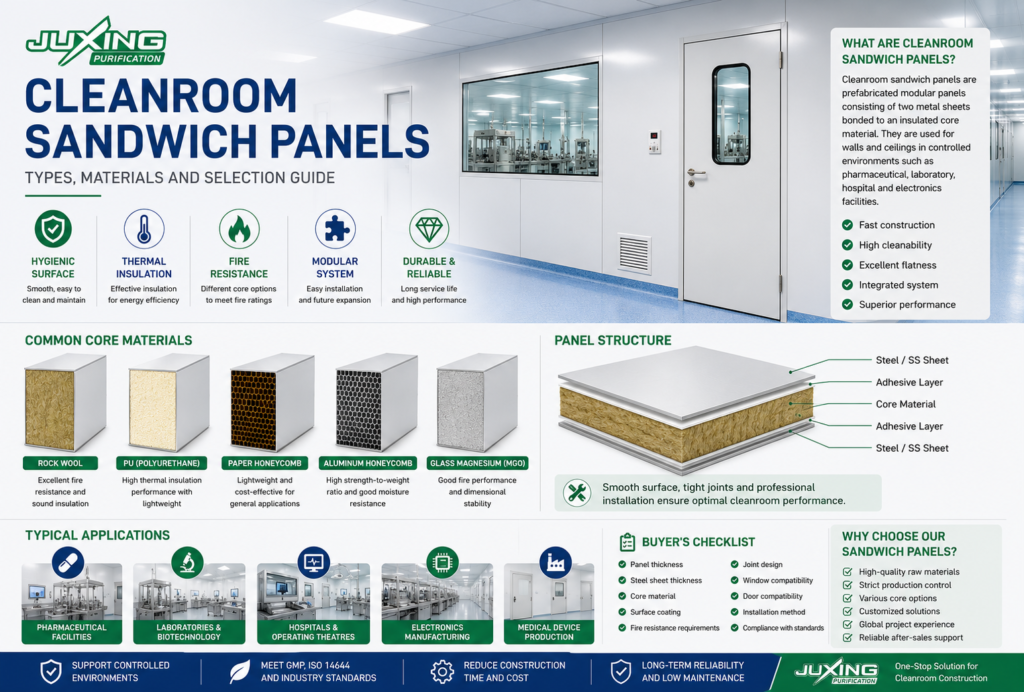
Cleanroom sandwich panels are modular wall and ceiling panels designed for controlled environments such as pharmaceutical manufacturing, biotechnology laboratories, hospitals, and electronics facilities. They combine hygienic surface materials with insulated core materials to provide durability, cleanability, thermal insulation, and compatibility with cleanroom construction. Selecting the right sandwich panel depends on factors such as fire resistance, moisture resistance, structural performance, cleanability, and the specific requirements of the project rather than on core material alone.
Key Takeaways
- Cleanroom sandwich panels form the primary wall and ceiling system in modern modular cleanrooms.
- The core material influences fire performance, strength, weight, moisture resistance, and thermal insulation.
- Pharmaceutical, healthcare, laboratory, and electronics facilities may require different panel specifications.
- Proper joint design and installation are just as important as panel materials for maintaining cleanroom integrity.
- Panel selection should always be based on project requirements, applicable regulations, and long-term maintenance rather than cost alone.
Introduction
Modular cleanroom construction has become the preferred solution for many pharmaceutical, biotechnology, electronics, medical device, and healthcare projects. At the center of these modular systems are cleanroom sandwich panels, which create smooth, hygienic, and durable wall and ceiling surfaces while supporting environmental control.
Unlike conventional building partitions, cleanroom sandwich panels are specifically designed to minimize particle accumulation, withstand frequent cleaning, integrate with cleanroom doors and observation windows, and support controlled airflow and pressure management.
Although sandwich panels may appear similar from the outside, their internal core materials, joint systems, surface finishes, and structural designs can vary significantly. Understanding these differences helps buyers avoid selecting panels based solely on price while ensuring the finished cleanroom meets both operational and regulatory requirements.
What Is a Cleanroom Sandwich Panel?
A cleanroom sandwich panel is a prefabricated modular building panel consisting of two outer metal sheets bonded to an insulated core material.
These panels are used to construct:
- Cleanroom walls
- Cleanroom ceilings
- Pharmaceutical production areas
- Biotechnology laboratories
- Medical device manufacturing facilities
- Hospital operating theatres
- Electronics manufacturing cleanrooms
Compared with traditional masonry construction, sandwich panels offer:
- Faster installation
- Better dimensional consistency
- Easier future modification
- Smooth hygienic finishes
- Improved integration with cleanroom equipment
Why Are Sandwich Panels Widely Used in Cleanrooms?
Modern cleanrooms require more than enclosed spaces. Every construction material should support contamination control and long-term maintenance.
Cleanroom sandwich panels help achieve this through several important characteristics.
Hygienic Surfaces
Smooth steel surfaces reduce dust accumulation and simplify routine cleaning and disinfection.
Modular Construction
Prefabricated panels reduce on-site construction time while allowing future expansion or layout modifications.
Better Environmental Control
Properly installed panel systems help support pressure control, thermal insulation, and controlled airflow by reducing uncontrolled leakage through building partitions.
Easy Integration
Modern sandwich panels are designed to integrate with:
- Cleanroom doors
- Observation windows
- Pass boxes
- Electrical panels
- HVAC terminals
This simplifies installation while maintaining a clean appearance.
What Core Materials Are Commonly Used?
Different projects require different panel cores. No single material is ideal for every application.
Rock Wool
Rock wool provides excellent fire resistance and sound insulation.
It is commonly selected for projects where fire performance is a priority.
Polyurethane (PU)
PU offers high thermal insulation with relatively low weight.
It is widely used where energy efficiency is an important consideration.
Paper Honeycomb
Paper honeycomb cores provide lightweight construction for applications with lower structural requirements.
Aluminum Honeycomb
Aluminum honeycomb combines low weight with good structural rigidity and moisture resistance.
It is frequently used in higher-performance cleanroom systems.
Glass Magnesium (MgO)
Glass magnesium cores provide good dimensional stability and are commonly specified in many pharmaceutical and healthcare projects.
The suitability of MgO panels depends on the product formulation and project specification.
Which Panel Is Best for Pharmaceutical Facilities?
There is no universal answer.
Panel selection depends on:
- Fire requirements
- Cleaning procedures
- Humidity conditions
- Structural requirements
- Regulatory expectations
- Customer specifications
Many pharmaceutical projects specify rock wool or glass magnesium core panels, while others may use alternative materials where permitted by the project design.
The final selection should always be based on engineering requirements rather than material popularity.
What Surface Materials Are Available?
The outer surface is just as important as the internal core.
Common surface materials include:
- Powder-coated galvanized steel
- Stainless steel 304
- Stainless steel 316
The choice depends on:
- Cleaning chemicals
- Corrosion resistance
- Budget
- Application environment
The surface coating should withstand repeated cleaning without peeling or deterioration.
How Do Joint Systems Affect Cleanroom Performance?
Panel joints influence both appearance and contamination control.
Well-designed joints help:
- Reduce dust traps
- Improve cleanability
- Maintain wall alignment
- Support airtight construction
Many modern modular cleanrooms use flush joint systems with concealed fasteners to create continuous smooth wall surfaces.
How Should You Choose a Cleanroom Sandwich Panel?
When evaluating suppliers, consider the complete panel system rather than only the core material.
Important factors include:
Panel Thickness
Common thicknesses include 50 mm, 75 mm, and 100 mm, although project specifications may vary.
Steel Thickness
The thickness of the outer steel sheets affects panel rigidity and durability.
Core Material
Select the core according to fire resistance, insulation, structural requirements, and project specifications.
Surface Finish
The finish should support repeated cleaning while maintaining long-term appearance.
Joint Design
Smooth flush joints generally provide better hygiene than exposed connections.
Compatibility
The panel system should integrate properly with doors, windows, ceilings, and cleanroom equipment.
Buyer’s Checklist
Before requesting quotations, confirm the following:
☐ Panel thickness
☐ Steel sheet thickness
☐ Core material
☐ Surface coating
☐ Fire resistance requirements
☐ Joint design
☐ Window compatibility
☐ Door compatibility
☐ Installation method
☐ Compliance with project specifications
Common Misconceptions
All Sandwich Panels Are Suitable for Cleanrooms
No.
Standard industrial sandwich panels are not necessarily designed for controlled environments. Surface finish, joint design, sealing, and cleanability are equally important.
The Most Expensive Core Material Is Always the Best
Not necessarily.
The appropriate core depends on the project requirements rather than price alone.
Thicker Panels Always Perform Better
Not always.
Panel thickness should be selected according to structural, thermal, acoustic, and project requirements.
Core Material Is the Only Important Factor
Incorrect.
Surface finish, steel thickness, joint design, installation quality, and compatibility with other cleanroom components all influence long-term performance.
Expert Tip
When comparing quotations, ask suppliers to provide the complete panel specification instead of simply stating the core material. Details such as steel sheet thickness, coating type, joint design, panel flatness, installation accessories, and compatibility with doors and windows often have a greater impact on the finished cleanroom than the core material alone.
Frequently Asked Questions
What is the purpose of a cleanroom sandwich panel?
It forms hygienic modular wall and ceiling systems while supporting contamination control, insulation, and cleanroom construction.
Which core material is best?
There is no universally “best” core material. The appropriate choice depends on fire resistance, insulation, structural performance, moisture conditions, and project requirements.
Can sandwich panels be used in hospital operating theatres?
Yes. Modular operating theatres commonly use sandwich panel systems that meet the project’s hygiene, structural, and regulatory requirements.
Are stainless steel panels better than powder-coated steel panels?
Each material has advantages depending on corrosion resistance, cleaning procedures, budget, and application environment.
How long do cleanroom sandwich panels last?
Service life depends on material quality, installation, maintenance, and operating conditions. Properly installed panel systems can provide reliable performance for many years.
Conclusion
Cleanroom sandwich panels are a fundamental component of modern modular cleanroom construction, providing hygienic surfaces, structural support, and compatibility with controlled environments. Although the core material is an important consideration, it is only one part of the overall system. Surface finish, joint design, steel thickness, installation quality, and compatibility with other cleanroom components all contribute to long-term performance.
Selecting the right sandwich panel should therefore be based on the complete project requirements rather than a single specification. A well-designed panel system helps create clean, durable, and maintainable environments for pharmaceutical, laboratory, electronics, medical device, and healthcare facilities.