
Executive Summary
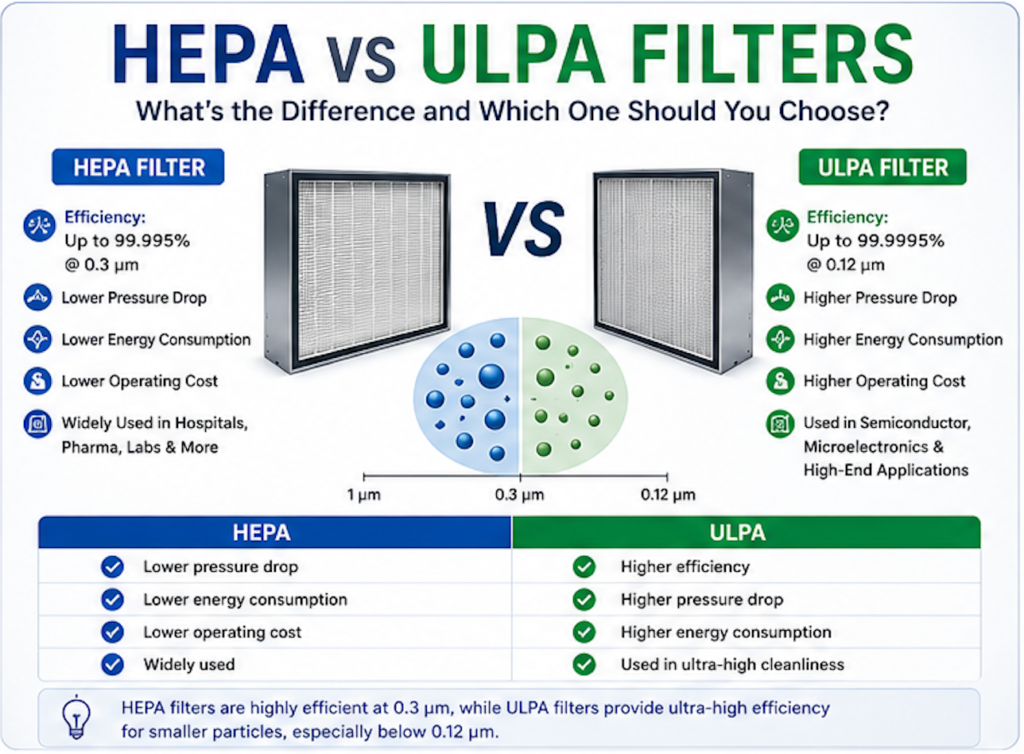
HEPA and ULPA filters are both designed to remove airborne particles, but they are not interchangeable.
Choosing the wrong filter can increase energy consumption, shorten equipment life, and add unnecessary costs without improving cleanroom performance.
This guide compares HEPA and ULPA filters from an engineering and procurement perspective, helping buyers understand when higher filtration efficiency is beneficial—and when it is not.
Who Should Read This Guide?
- Pharmaceutical manufacturers
- Hospital project teams
- Laboratory designers
- Semiconductor engineers
- Electronics manufacturers
- Cleanroom contractors
- HVAC consultants
- Procurement managers
What Is a HEPA Filter?
A High-Efficiency Particulate Air (HEPA) filter is designed to remove airborne particles with very high efficiency.
HEPA filters are widely used in:
- Pharmaceutical cleanrooms
- Hospital operating theaters
- Medical device manufacturing
- Food processing
- Research laboratories
Their balance of filtration performance, airflow, and operating cost makes them the most common choice for cleanroom projects.
What Is a ULPA Filter?
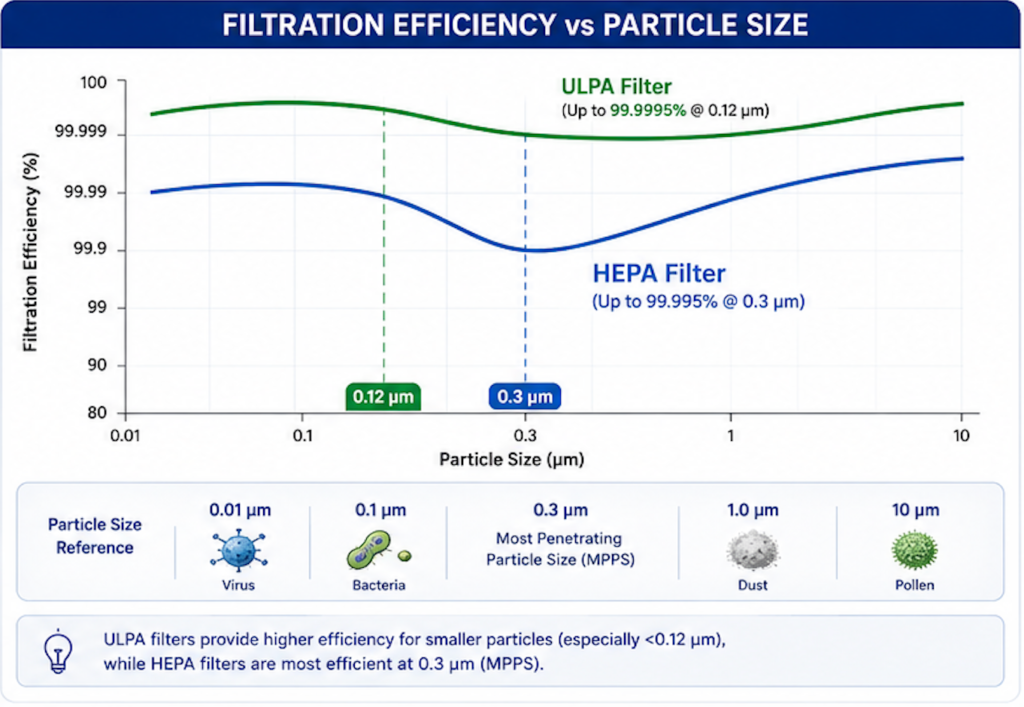
An Ultra-Low Penetration Air (ULPA) filter provides even higher particle removal efficiency than a HEPA filter.
ULPA filters are typically selected for environments where extremely low particle concentrations are essential, such as advanced semiconductor manufacturing or certain nanotechnology applications.
However, the higher efficiency usually comes with greater airflow resistance and increased energy consumption.
HEPA vs ULPA: Side-by-Side Comparison
| Feature | HEPA | ULPA |
|---|---|---|
| Typical Application | Hospitals, Pharma, Labs | Semiconductor, Microelectronics |
| Filtration Efficiency | Very High | Ultra High |
| Airflow Resistance | Lower | Higher |
| Energy Consumption | Lower | Higher |
| Operating Cost | Lower | Higher |
| Maintenance Cost | Lower | Higher |
| Typical Choice | Most Cleanrooms | Specialized Cleanrooms |
Does Higher Efficiency Always Mean Better?
No.
One of the most common misconceptions is that the highest filtration efficiency automatically creates the best cleanroom.
In reality, filter selection should be based on the required cleanroom classification, process sensitivity, airflow design, and lifecycle cost.
Installing ULPA filters in applications where HEPA filters already meet the project requirements may increase operating costs without delivering meaningful benefits.
How Filter Selection Affects Energy Consumption
Every filter creates resistance to airflow.
Higher resistance requires fans to work harder, which increases electricity consumption.
When evaluating filtration options, buyers should consider:
- Initial pressure drop
- Final pressure drop
- Fan capacity
- Energy efficiency
- Replacement frequency
Lifecycle operating cost is often more important than purchase price alone.
Which Industries Typically Use HEPA?
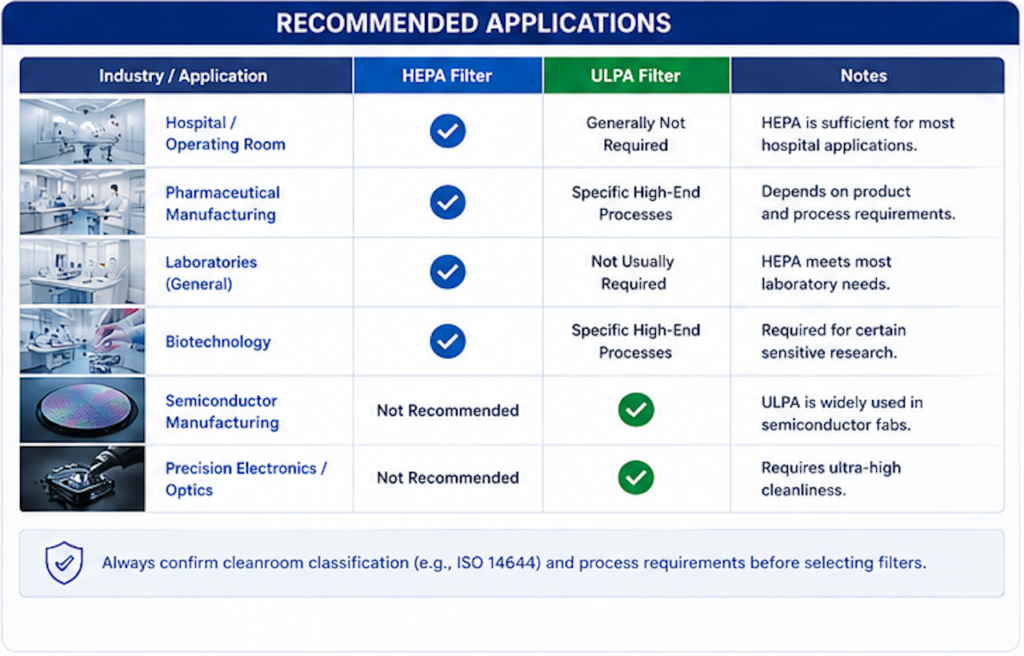
HEPA filters are commonly used in:
- Hospital operating theaters
- Pharmaceutical manufacturing
- Biotechnology
- Medical device production
- Food processing
- Research laboratories
For many of these environments, HEPA filtration fully satisfies the required cleanliness level.
Which Industries Typically Use ULPA?
ULPA filters are generally reserved for applications requiring exceptionally low particle counts, including:
- Semiconductor fabrication
- Precision electronics
- Optical manufacturing
- Nanotechnology research
- Certain aerospace processes
Because these filters impose higher resistance, they should be selected only when justified by process requirements.
Common Buying Mistakes
- Assuming ULPA is always better.
- Comparing only filter efficiency.
- Ignoring pressure drop.
- Forgetting lifecycle operating cost.
- Selecting filters without reviewing the cleanroom design.
Buyer Checklist
Before requesting quotations, confirm:
- Required cleanroom classification
- Industry application
- Airflow requirements
- HVAC capacity
- Target operating cost
- Maintenance strategy
- Filter replacement procedure
- Compliance requirements
Frequently Asked Questions
Is ULPA always better than HEPA?
No. Filter selection should match the cleanroom’s required performance. Higher efficiency is not always the most economical or technically appropriate choice.
Can HEPA filters be upgraded to ULPA?
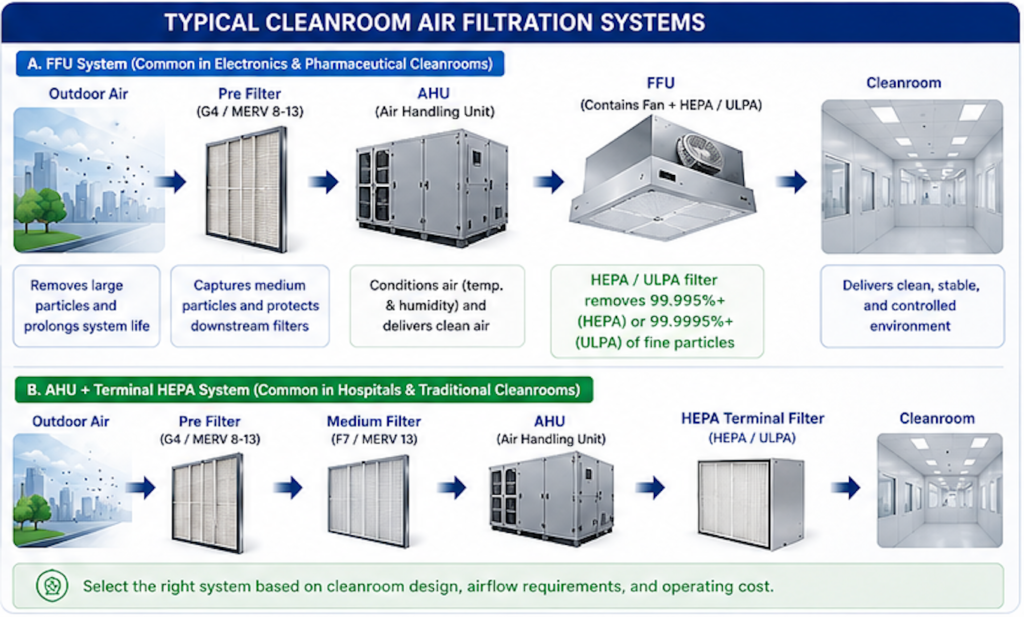
Sometimes, but the HVAC or FFU system must be evaluated to ensure it can handle the increased pressure drop.
How often should filters be replaced?
Replacement depends on operating conditions, pressure drop, and maintenance monitoring rather than a fixed calendar schedule.
Do hospitals need ULPA filters?
In many hospital operating theaters, HEPA filtration is sufficient. Specific requirements depend on local regulations, project specifications, and room function.
Final Thoughts
HEPA and ULPA filters each play an important role in cleanroom engineering. The best choice is not determined by maximum efficiency alone, but by balancing cleanliness requirements, airflow performance, energy consumption, and long-term operating costs.
A professional supplier should help buyers evaluate these factors before selecting a filtration system, ensuring that the cleanroom performs efficiently without unnecessary expense.
Need Help Selecting the Right Filtration Solution?
Juxing Purification Technology supplies HEPA filters, FFUs, modular cleanroom systems, operating theater solutions, pass boxes, and other cleanroom equipment for pharmaceutical, healthcare, laboratory, and industrial projects.
Our engineering team can help evaluate your cleanroom requirements and recommend filtration solutions that balance performance, energy efficiency, and lifecycle cost.