
Introduction
In cleanroom facilities, doors are more than simple access points. Every time a person enters a production area or materials are transferred between rooms, airflow patterns can be disturbed and contaminants may migrate from one controlled zone to another.
To minimize these risks, cleanroom designers commonly introduce airlocks between areas of different cleanliness levels or pressure regimes.
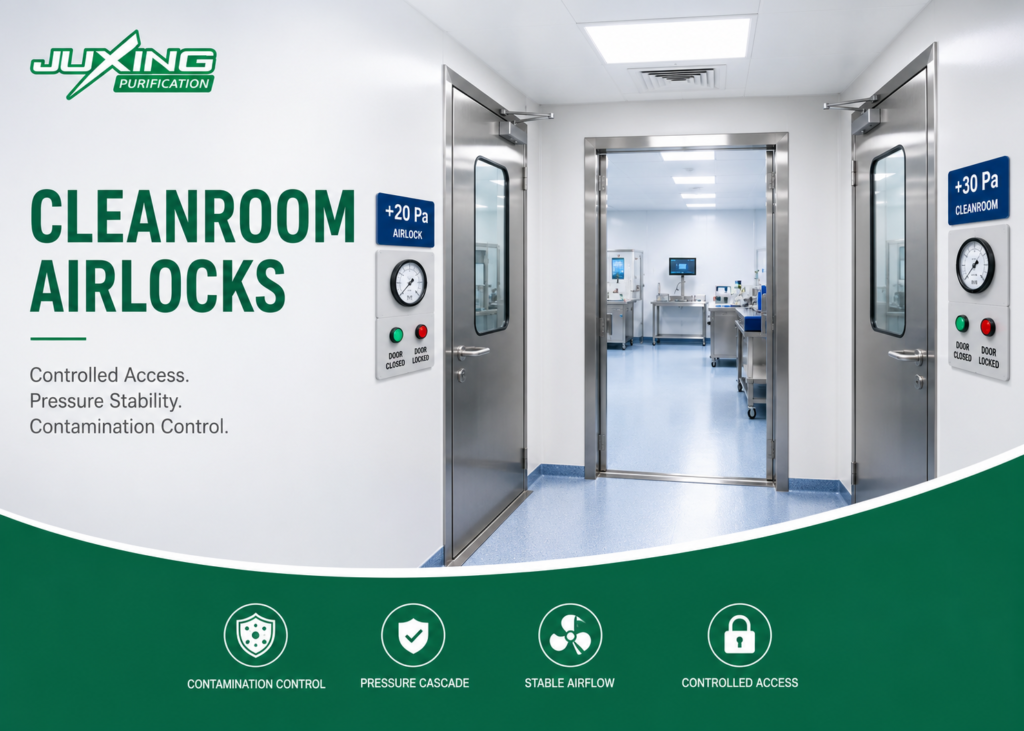
An airlock acts as a controlled transition space. When properly designed, it helps maintain pressure differentials, reduce contamination transfer, and support stable cleanroom operation without unnecessarily interrupting personnel or material flow.
For pharmaceutical manufacturers, medical device facilities, hospitals, laboratories, semiconductor plants, and other controlled environments, airlocks are an essential component of the contamination control strategy rather than simply an additional room.
What Is a Cleanroom Airlock?
A cleanroom airlock is an enclosed transition space located between two adjacent areas with different cleanliness classifications, pressure conditions, or contamination risks.
Instead of allowing a door to open directly between two rooms, personnel or materials first enter the airlock before passing into the next controlled space.
This arrangement helps reduce sudden airflow disturbances and limits the movement of airborne contaminants between adjacent areas.
An airlock may be designed for:
- Personnel movement
- Material transfer
- Waste removal
- Entry to controlled production areas
- Exit from containment areas
Unlike a standard corridor, an airlock forms part of the environmental control system and should be considered together with HVAC design, room pressure cascade, door interlocking, and operational procedures.
Why Are Airlocks Important?
Airlocks provide a controlled buffer between adjacent environments.
Without an airlock, opening a door between two rooms may result in:
- Pressure instability
- Airflow reversal
- Increased particle migration
- Loss of contamination control
- Greater burden on the HVAC system
- Higher risk of product or process contamination
Although the pressure difference between adjacent rooms may only be several pascals, repeatedly opening doors can significantly affect airflow direction if transitions are not properly controlled.
Airlocks help reduce these disturbances by creating an intermediate space where pressure changes can be better managed.
For facilities operating under GMP or other controlled manufacturing standards, airlocks also contribute to a structured personnel and material flow strategy.
Airlocks Are Part of a Contamination Control Strategy
One common misconception is that an airlock alone prevents contamination.
In reality, an airlock is only one element of an integrated contamination control system.
Its effectiveness depends on coordination with:
- HVAC airflow design
- Pressure cascade
- Door sealing performance
- Door interlocking systems
- Personnel procedures
- Material handling procedures
- Cleaning and maintenance programs
For pharmaceutical facilities, this integrated approach aligns with the principles of contamination control described in EU GMP Annex 1, where facility layout, airflow, pressure control, personnel movement, and operational practices are expected to work together rather than independently.
Personnel Airlocks
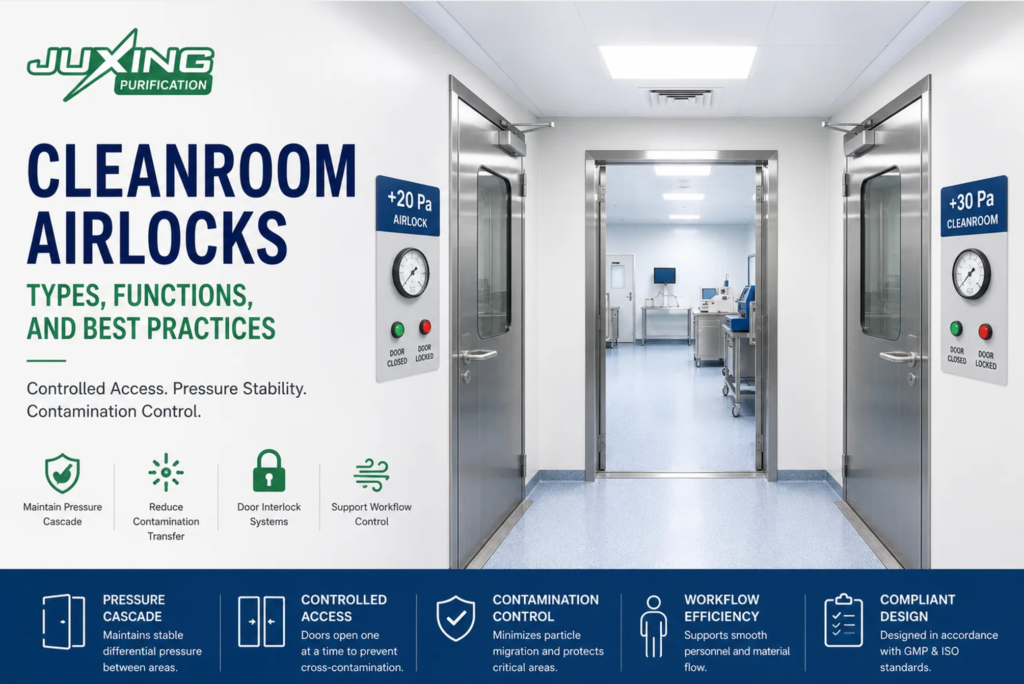
Personnel airlocks are designed to control operator movement between areas with different cleanliness requirements.
These spaces are commonly positioned between:
- General production areas and cleanrooms
- Changing rooms and clean processing areas
- Corridors and sterile preparation rooms
- Support spaces and critical manufacturing zones
Personnel airlocks often include:
- Gowning benches
- Hand hygiene facilities
- Storage for clean garments
- Mirrors
- Waste collection points
- Door interlocking systems
- Pressure monitoring displays
The exact layout depends on the cleanroom classification, process risk, and local regulatory requirements.
The objective is not simply to slow personnel movement, but to reduce the introduction of contaminants carried on clothing, footwear, equipment, or personal items.
Material Airlocks
Material airlocks serve a similar purpose but are intended for transferring equipment, raw materials, packaging components, tools, or finished products.
Typical applications include:
- Pharmaceutical production
- Medical device manufacturing
- Electronics assembly
- Research laboratories
- Hospital sterile supply departments
Material airlocks may include:
- Stainless steel work surfaces
- Pass-through shelving
- Cleaning or disinfection stations
- Barcode or material tracking systems
- Pressure indicators
- Interlocked doors
In many facilities, material airlocks work together with pass boxes to reduce unnecessary personnel movement while maintaining contamination control.
However, an airlock and a pass box are not interchangeable. Their selection depends on the size of transferred items, workflow, process requirements, and facility layout.
Personnel Airlock vs Material Airlock
Although both types are designed to reduce contamination transfer, their primary functions differ.
| Feature | Personnel Airlock | Material Airlock |
|---|---|---|
| Primary purpose | Personnel movement | Material transfer |
| Typical users | Operators, maintenance staff | Raw materials, tools, products |
| Common equipment | Gowning facilities, hand hygiene, interlocked doors | Pass-through surfaces, transfer equipment, pressure display |
| Workflow focus | Personnel contamination control | Material contamination control |
| Integration | Changing procedures and personnel flow | Material logistics and production flow |
Well-designed cleanroom projects often include both personnel and material airlocks to separate human traffic from material movement and reduce cross-contamination opportunities.
Positive Pressure vs Negative Pressure Airlocks
Not all airlocks operate in the same way. Their pressure relationship should always be determined by the process being protected rather than by a fixed design rule.
In general, cleanroom airlocks fall into two broad categories:
- Positive pressure airlocks
- Negative pressure airlocks
The appropriate configuration depends on whether the primary objective is protecting the product or containing hazardous materials.
Positive Pressure Airlocks
Positive pressure airlocks are commonly used in pharmaceutical manufacturing, medical device production, hospital operating suites, and other clean manufacturing environments where preventing contaminants from entering critical areas is the main objective.
The airlock is maintained at a higher pressure than the adjacent lower-classified space so that airflow naturally moves from the cleaner area toward the less clean area whenever leakage occurs.
A typical arrangement may look like this:
| Area | Example Pressure* |
|---|---|
| Critical Cleanroom | +30 Pa |
| Personnel Airlock | +20 Pa |
| Corridor | +10 Pa |
*Pressure values are illustrative only. Actual design pressures should be determined according to project requirements, risk assessment, and applicable standards.
In this arrangement:
- Air moves from the cleanroom toward the corridor.
- Airborne contaminants are less likely to migrate into the critical area.
- Pressure recovery after door operation is generally easier to control.
Negative Pressure Airlocks
Negative pressure airlocks are used when the objective is containment rather than product protection.
Typical applications include:
- Biosafety laboratories
- Isolation facilities
- Cytotoxic drug preparation
- Hazardous pharmaceutical manufacturing
- Certain research laboratories
In these environments, airflow should move into the controlled room to help prevent hazardous particles or aerosols from escaping.
A simplified example is:
| Area | Example Pressure* |
|---|---|
| Corridor | 0 Pa |
| Airlock | -10 Pa |
| Containment Room | -20 Pa |
Again, these values are examples only.
Actual pressure relationships depend on the containment strategy and applicable regulations.
Unlike positive-pressure facilities, the design objective here is protecting personnel and the surrounding environment rather than protecting the product.
Pressure Cascade Through an Airlock
Many people assume that an airlock simply separates two rooms.
From an engineering perspective, however, its more important function is to create a controlled pressure transition.
Instead of having one large pressure difference across a single doorway, designers create several smaller pressure steps.
For example:
Corridor
   ↓
Personnel Airlock
   ↓
Preparation Room
   ↓
ISO 7 Cleanroom
Each transition reduces airflow disturbance and makes pressure control more stable.
This approach also reduces the pressure recovery time after doors are opened during routine operation.
For larger pharmaceutical facilities, several airlocks may form part of a complete pressure cascade extending through multiple production zones.
Why Door Interlocking Is Important
An airlock does not function properly if both doors can be opened at the same time.
If this occurs, the airlock temporarily becomes little more than an open passage, allowing uncontrolled airflow between adjacent rooms.
For this reason, cleanroom airlocks commonly use door interlocking systems.
The purpose of door interlocking is simple:
Only one door may be opened at any given time.
When one door is open:
- The opposite door remains locked.
- Pressure stability is improved.
- Airflow short-circuiting is reduced.
- Contamination migration is minimized.
This principle applies to both personnel and material airlocks.
Many pharmaceutical projects also integrate interlocking with access control, emergency release functions, and building management systems.
Mechanical vs Electrical Door Interlocking
Several interlocking methods are available.
Mechanical Interlocking
Mechanical interlocking uses physical locking mechanisms.
Advantages include:
- Simple construction
- No electrical power required
- Reliable operation
- Lower installation cost
However, it provides limited flexibility for modern building automation.
Electrical Interlocking
Electrical interlocking uses electromagnetic locks and control systems.
It can be integrated with:
- Access control
- Card readers
- PLC systems
- BMS
- Alarm systems
- Pressure monitoring
- Emergency release functions
For modern pharmaceutical and hospital projects, electrical interlocking is generally preferred because it provides greater operational flexibility and easier system integration.
However, the final selection should consider project complexity, maintenance capability, local regulations, and life-safety requirements.
Should Every Airlock Use Interlocked Doors?
In most cleanroom projects, the answer is yes, but not every project requires exactly the same interlocking strategy.
The decision should consider:
- Cleanroom classification
- Process risk
- Product sensitivity
- Pressure cascade
- Personnel flow
- Material flow
- Emergency escape requirements
- Fire and life-safety regulations
For example, an ISO 8 packaging support area may have different operational requirements from a Grade A/B aseptic processing suite.
Similarly, hospital operating departments, pharmaceutical plants, and semiconductor facilities may adopt different interlocking philosophies according to their operational needs.
The important principle is that the door-control strategy should support the overall contamination control concept rather than being treated as an isolated hardware feature.
Can an Air Shower Replace an Airlock?
This is one of the most frequently asked questions during cleanroom planning.
The short answer is:
No. An air shower and an airlock serve different engineering purposes.
An air shower is designed to reduce particles carried on personnel or materials by using high-velocity HEPA-filtered air jets before entry into a controlled area.
An airlock, however, is designed to maintain environmental separation between adjacent spaces through controlled access, pressure management, and operational procedures.
Although some facilities install an air shower inside an airlock, the two systems should not be considered interchangeable.
Airlock vs Air Shower
| Feature | Airlock | Air Shower |
|---|---|---|
| Primary purpose | Separate environments | Remove surface particles |
| Pressure control | Yes | Not necessarily |
| Personnel flow control | Yes | Yes |
| Material transfer | Yes | Limited |
| Door interlocking | Common | Common |
| Airborne contamination control | Supports pressure cascade | Removes loose particles from surfaces |
| HVAC integration | Yes | Limited |
An air shower may improve cleanliness before personnel enter a cleanroom, but it does not replace the need for proper pressure control or controlled room transitions.
Airlock Design Considerations
Designing an airlock involves much more than allocating a small room between two spaces.
Several engineering disciplines—including HVAC, architecture, cleanroom equipment, process engineering, and operations—must work together to achieve reliable contamination control.
The following factors should be evaluated during the design stage.
1. Airflow Direction
Airflow should always support the intended contamination control strategy.
For positive-pressure cleanrooms, airflow should move from cleaner areas toward less clean areas.
For containment facilities, airflow should move toward the hazardous area.
The airflow strategy should remain stable during normal operation and recover quickly after doors are opened.
2. Door Position
Door placement affects both workflow and airflow.
Poorly positioned doors may result in:
- Cross traffic
- Airflow disturbance
- Congestion
- Increased door opening frequency
- Reduced pressure stability
Whenever practical, personnel and material routes should be separated to reduce unnecessary interaction.
3. Airlock Size
An airlock should be large enough for its intended operation.
Designers should consider:
- Number of operators
- Material handling equipment
- Trolleys or carts
- Pallet movement
- Wheelchair access where applicable
- Maintenance activities
- Future production expansion
Oversized airlocks may increase HVAC demand, while undersized airlocks can reduce operational efficiency.
4. Pressure Monitoring
Pressure displays are commonly installed near airlocks to help operators verify that the pressure cascade is functioning as intended.
Some facilities also connect pressure transmitters to the Building Management System (BMS) for:
- Continuous monitoring
- Alarm generation
- Trend analysis
- Historical records
Pressure indication alone does not guarantee correct airflow behavior, but it provides valuable operational information when combined with routine maintenance and qualification.
5. Door Sealing Performance
Even with a properly balanced HVAC system, poor door sealing can reduce pressure stability.
Air leakage around door frames, damaged gaskets, or improperly adjusted doors may increase recovery time and reduce contamination control performance.
For critical cleanrooms, hermetic or airtight doors are commonly selected to improve sealing performance and support pressure control.
Common Airlock Design Mistakes
Many cleanroom performance problems are caused not by the HVAC system itself, but by design decisions made during the planning stage.
The following mistakes are frequently observed during commissioning or qualification.
Mistake 1: Treating the Airlock as Extra Corridor Space
An airlock is part of the cleanroom control system.
Using it as temporary storage or a waiting area can interfere with personnel flow, increase contamination risk, and obstruct door operation.
Mistake 2: Ignoring Workflow
Personnel and materials should follow clearly defined routes.
Crossing clean and dirty traffic within the same airlock increases the risk of cross-contamination and may complicate operational procedures.
Mistake 3: No Door Interlocking
Allowing both doors to remain open simultaneously defeats the purpose of the airlock.
Even a well-designed pressure cascade may become ineffective if airflow can move freely between adjacent rooms.
Mistake 4: Poor HVAC Coordination
An airlock should never be designed independently from the HVAC system.
Supply air, return air, exhaust air, and pressure relationships must all be coordinated during design.
Mistake 5: Incorrect Equipment Layout
Large equipment, storage racks, or carts placed inside an airlock may obstruct airflow, reduce usable space, and interfere with personnel movement.
The airlock should remain as uncluttered as practical to support both contamination control and efficient operation.
Mistake 6: Designing Only for Today’s Process
Production requirements often change over the lifetime of a facility.
Whenever feasible, designers should consider future process modifications, maintenance access, and equipment replacement when determining the size and layout of an airlock.
Buyer & EPC Checklist
When requesting quotations for a cleanroom airlock, it is helpful to define the functional requirements rather than simply specifying “provide an airlock.”
Typical information includes:
- Cleanroom classification
- Room pressure strategy
- Personnel or material airlock
- Required workflow
- Number of users
- Material dimensions
- Door type
- Door interlocking requirements
- Pressure monitoring requirements
- Door sealing requirements
- Finish materials
- Wall panel system
- Ceiling system
- Applicable GMP or project standards
- Integration with HVAC
- Integration with BMS
- Fire and emergency requirements
- Validation and commissioning responsibilities
Providing this information during the RFQ stage helps suppliers develop more appropriate technical proposals and reduces clarification during project execution.
Best Practices for Cleanroom Airlock Design
A well-designed airlock is not defined by its size or the number of doors it contains. Its effectiveness depends on how well it supports the facility’s contamination control strategy throughout the entire operational lifecycle.
The following practices are widely recognized as contributing to reliable airlock performance.
Define the Airlock Function Early
During the conceptual design stage, determine whether the airlock is intended for:
- Personnel movement
- Material transfer
- Waste removal
- Mixed use (only where appropriate)
Each function has different requirements for room layout, door arrangement, equipment, and operating procedures.
Coordinate HVAC and Architectural Design
Airlocks should never be designed independently from the HVAC system.
The following elements should be coordinated during design:
- Supply air
- Return air
- Exhaust air (where applicable)
- Pressure cascade
- Door locations
- Ceiling layout
- Wall systems
- Equipment arrangement
Late design changes often result in unnecessary commissioning adjustments and increased project cost.
Keep Airlock Workflows Simple
Complicated workflows often lead to operational errors.
Whenever practical:
- Personnel routes should be clearly defined.
- Material routes should avoid unnecessary crossings.
- Door operation should be intuitive.
- Instructions should be easy for operators to follow.
Simple workflows generally produce more reliable contamination control than complicated procedures.
Select Appropriate Door Systems
Door performance directly affects airlock performance.
Factors to evaluate include:
- Airtightness
- Opening frequency
- Door size
- Automation requirements
- Maintenance access
- Cleaning requirements
- Interlocking compatibility
The selected door should support both contamination control and operational efficiency.
Verify Performance During Commissioning
Good design should always be confirmed through testing.
Depending on project requirements, commissioning may include:
- Differential pressure verification
- Airflow measurement
- Airflow visualization
- HEPA filter integrity testing
- Particle classification
- Recovery testing
Commissioning should verify that the complete airlock system performs according to the approved design intent rather than relying only on design calculations.
Frequently Asked Questions
What is the purpose of an airlock in a cleanroom?
An airlock provides a controlled transition space between adjacent areas with different cleanliness levels or pressure conditions. It helps reduce contamination transfer and supports stable airflow management.
Is an airlock always required?
Not necessarily.
Whether an airlock is required depends on:
- Process risk
- Cleanroom classification
- Pressure strategy
- Regulatory expectations
- Facility workflow
Some lower-risk applications may not require dedicated airlocks, while critical pharmaceutical or hospital projects often include them as part of the contamination control strategy.
Can one airlock be used for both personnel and materials?
Although possible in some facilities, separating personnel and material movement is generally preferred whenever practical.
Dedicated airlocks help reduce cross-contamination risk and simplify operational procedures.
How many doors should an airlock have?
Most cleanroom airlocks use two doors connecting adjacent spaces.
Larger facilities may include multiple interconnected airlocks depending on the process layout and contamination control strategy.
Should both airlock doors open at the same time?
Under normal operation, interlocked doors are typically designed to prevent simultaneous opening.
This helps maintain pressure stability and reduces uncontrolled airflow between adjacent spaces.
Does an airlock replace a pass box?
No.
A pass box is designed for transferring smaller materials between rooms.
An airlock provides a controlled transition space for personnel or larger material movement.
The two systems often complement each other rather than replacing one another.
Does an airlock need positive pressure?
Not always.
Positive-pressure airlocks are common in product protection applications.
Negative-pressure airlocks are used where containment of hazardous materials is the primary objective.
The pressure strategy should always be determined by the intended process.
Conclusion
Airlocks play an important role in maintaining cleanroom performance, but they should not be viewed as standalone architectural features.
An effective airlock is the result of coordinated design involving HVAC systems, pressure control, door technology, workflow planning, and operational procedures.
For project owners, consultants, EPC contractors, and procurement managers, the most important principle is to define how the airlock should function, rather than simply specifying that one should be provided.
When properly integrated into the overall contamination control strategy, an airlock can help improve pressure stability, reduce contamination transfer, support regulatory compliance, and enhance long-term cleanroom performance.