
Introduction
When planning a cleanroom or hospital project, buyers often encounter two similar terms: hermetic door and cleanroom door. Although they are sometimes used interchangeably in the market, they do not always describe the same type of door.
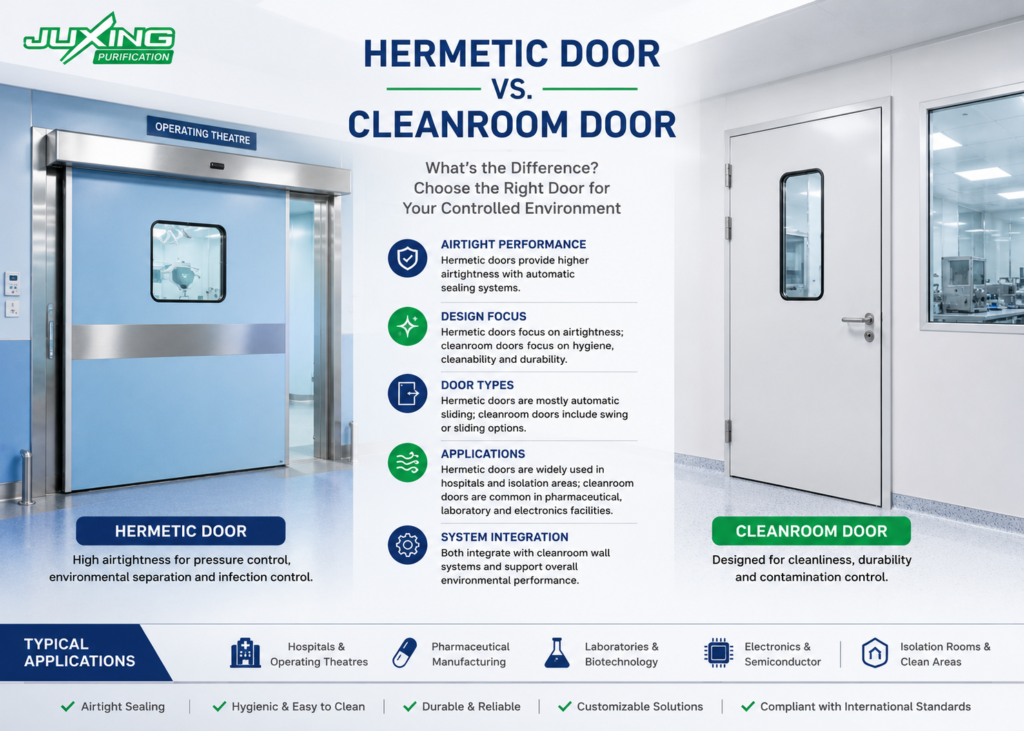
A hermetic door is primarily designed to achieve a high level of airtightness, helping reduce uncontrolled air leakage between adjacent spaces. A cleanroom door, on the other hand, is designed to support contamination control through features such as smooth hygienic surfaces, cleanability, durability, and compatibility with cleanroom wall systems. Depending on the project requirements, a cleanroom door may or may not be hermetic.
Understanding the distinction is important when specifying doors for pharmaceutical manufacturing, biotechnology laboratories, electronics facilities, hospitals, or other controlled environments.
This guide explains the differences, similarities, typical applications, and selection considerations to help engineers and buyers choose the most appropriate solution.
What Is a Hermetic Door?
A hermetic door is an airtight door designed to minimize air leakage around the door perimeter when closed.
Unlike standard doors, hermetic doors use specialized sealing mechanisms that compress perimeter gaskets against the frame during the closing cycle.
Many modern hermetic sliding doors use automatic sealing mechanisms that engage only after the door reaches the fully closed position.
Typical characteristics include:
- Airtight perimeter sealing
- Automatic sliding operation (most common)
- Smooth hygienic surfaces
- Flush construction
- Durable sealing gaskets
- Easy-to-clean materials
- Reliable opening and closing cycles
Hermetic doors are widely used where pressure stability and environmental separation are important.
What Is a Cleanroom Door?
A cleanroom door is designed to support contamination control within controlled environments.
Its primary objectives include:
- Smooth surfaces for easy cleaning
- Minimal particle accumulation
- Chemical resistance
- Compatibility with cleanroom wall systems
- Reliable long-term operation
- Appropriate airtightness for the intended application
Not every cleanroom door is fully hermetic.
Many ISO Class 8 or general industrial cleanrooms use high-quality swing or sliding cleanroom doors without requiring the higher sealing performance associated with hermetic designs.
Similarities Between Hermetic Doors and Cleanroom Doors
Although the two terms describe different design priorities, they share several important features.
Both may provide:
- Hygienic surface finishes
- Flush-mounted construction
- Easy cleaning
- Corrosion-resistant materials
- Durable hardware
- Compatibility with modular cleanroom wall systems
Both are commonly manufactured using stainless steel or powder-coated steel and are designed to withstand frequent cleaning and disinfection.
Key Differences
Design Objective
A hermetic door focuses primarily on reducing air leakage.
A cleanroom door focuses primarily on supporting contamination control and cleanability.
Some doors successfully achieve both objectives.
Airtight Performance
Hermetic doors generally provide a higher level of airtight sealing through specialized gasket systems and sealing mechanisms.
Cleanroom doors may provide adequate sealing for many projects without being fully hermetic.
The required performance should always be determined by the project specification rather than by product name alone.
Door Movement
Hermetic doors are most commonly:
- Automatic sliding doors
Cleanroom doors may include:
- Manual swing doors
- Automatic swing doors
- Manual sliding doors
- Automatic sliding doors
The selection depends on workflow, available space, hygiene requirements, and user preference.
Pressure Control
Where stable pressure differentials are critical, reduced air leakage around the door can help support HVAC performance.
However, pressure stability depends on the entire room design, including:
- HVAC system
- Air supply
- Exhaust system
- Door operation
- Wall system
- Ceiling system
A hermetic door should therefore be viewed as one component of an overall pressure-control strategy rather than the sole solution.
Typical Applications
Hospital Operating Theatres
Hermetic sliding doors are widely used for modern operating theatres.
Their airtight sealing, smooth operation, and hygienic design help support the environmental control strategies commonly used in surgical suites.
Isolation Rooms
Negative-pressure isolation rooms may also specify hermetic doors where reduced air leakage supports the required room performance.
Final requirements should always follow local healthcare standards.
Pharmaceutical Manufacturing
Many pharmaceutical cleanrooms use cleanroom doors.
Whether hermetic performance is required depends on the manufacturing process, room classification, pressure strategy, and project specification.
Electronics Manufacturing
Electronics cleanrooms frequently use cleanroom doors that prioritize cleanliness, durability, and reliable operation.
Full hermetic sealing is not always necessary.
Biotechnology Laboratories
Laboratories may specify either hermetic doors or standard cleanroom doors according to containment level, pressure requirements, and operational needs.
How to Choose the Right Door
When selecting a door for a cleanroom project, consider the following factors.
Room Function
Understand whether the room is intended for pharmaceutical production, semiconductor manufacturing, laboratory research, or healthcare.
Each application has different operational priorities.
Pressure Requirements
If maintaining stable pressure differentials is a critical design objective, evaluate whether hermetic sealing is specified by the project.
Door Configuration
Possible options include:
- Single swing
- Double swing
- Single sliding
- Double sliding
- Automatic operation
- Manual operation
The choice should reflect personnel flow and available space.
Wall System Compatibility
The door frame should integrate properly with the modular wall system to maintain alignment, hygiene, and installation quality.
Maintenance
Consider:
- Gasket replacement
- Door automation maintenance
- Sensor accessibility
- Long-term spare parts availability
These factors influence operating costs throughout the facility lifecycle.
Common Misconceptions
Hermetic Doors Are Required for Every Cleanroom
No.
Many cleanrooms operate successfully using standard cleanroom doors that meet the project’s contamination-control requirements.
Every Sliding Door Is Hermetic
Incorrect.
Many automatic sliding doors do not include airtight sealing mechanisms.
Door appearance alone does not indicate sealing performance.
Hermetic Doors Can Replace HVAC Design
No.
Pressure control depends on the complete ventilation system, room construction, and operational procedures.
Doors contribute to the overall performance but cannot compensate for deficiencies elsewhere.
All Hospital Doors Are Hermetic
Not necessarily.
Hospitals use various door types depending on the function of each room.
Only specific clinical areas may require hermetic doors.
Expert Tip
When requesting quotations, avoid asking simply for a “hermetic door.” Instead, specify the project type, pressure requirements, door size, opening method, wall thickness, automation requirements, and applicable standards. Clear technical specifications reduce misunderstandings and help suppliers recommend the most appropriate solution.
Frequently Asked Questions
Is every cleanroom door hermetic?
No. Many cleanroom doors provide sufficient sealing for contamination control without being fully hermetic.
Are hermetic doors only used in hospitals?
No. Although commonly associated with operating theatres, hermetic doors are also used in pharmaceutical, biotechnology, and other controlled environments where airtightness is required.
Which is better: a hermetic door or a standard cleanroom door?
Neither is universally better. The appropriate choice depends on the room function, contamination risks, pressure-control strategy, and project specifications.
Can a swing door be hermetic?
Yes. While automatic sliding hermetic doors are the most common, hermetic swing doors are also available for certain applications.
Do hermetic doors guarantee pressure stability?
No. They help reduce air leakage, but stable room pressure depends on the overall HVAC design, airflow balance, room construction, and operating procedures.
Conclusion
Although the terms hermetic door and cleanroom door are often used interchangeably, they emphasize different design objectives. Hermetic doors prioritize airtight sealing to help reduce uncontrolled air leakage, while cleanroom doors focus on hygiene, cleanability, durability, and compatibility with controlled environments. In many projects, these characteristics overlap, but they are not identical.
Selecting the right door should be based on the room’s intended use, contamination-control strategy, pressure requirements, applicable standards, and long-term maintenance considerations. By understanding these differences, engineers and buyers can specify door systems that best support both operational performance and project compliance.