
Quick Answer
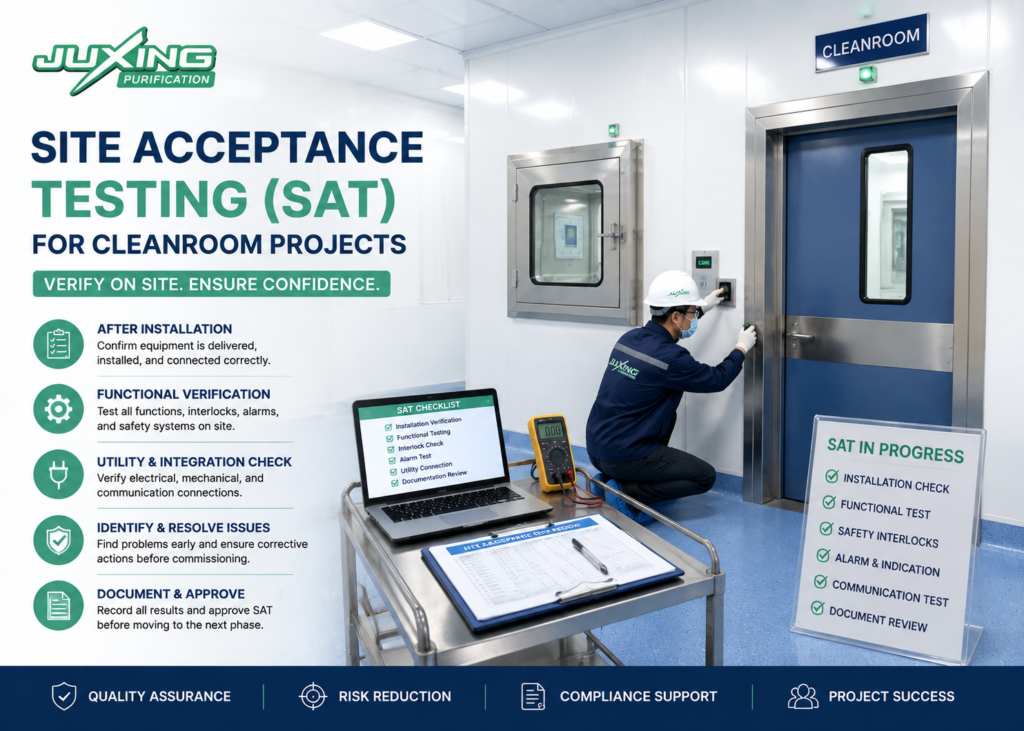
Site Acceptance Testing (SAT) is the documented process of verifying that equipment or systems delivered to the project site have been correctly installed, integrated, and are functioning according to the approved specifications before routine operation, commissioning, or qualification progresses.
Unlike Factory Acceptance Testing (FAT), which is performed at the manufacturer’s facility before shipment, SAT confirms that transportation, installation, utility connections, software integration, and site conditions have not adversely affected system performance.
For cleanroom projects, SAT provides critical evidence that equipment is ready to enter the next project phase. However, SAT is not a substitute for commissioning, qualification (IQ/OQ/PQ), or final cleanroom performance testing.
Key Takeaways
- SAT verifies equipment after delivery and installation at the project site.
- Its primary objective is to confirm that equipment performs correctly under actual site conditions.
- SAT complements, rather than replaces, FAT, commissioning, or qualification.
- A structured SAT reduces commissioning delays and minimizes qualification failures.
- Acceptance criteria should be defined before testing begins and documented in an approved SAT protocol.
- Any deviations identified during SAT should be investigated, corrected, and formally closed before progressing to subsequent project phases.
Introduction
Even after equipment has successfully passed a Factory Acceptance Test (FAT), the project is far from complete.
During transportation, unloading, storage, installation, and system integration, equipment may experience physical damage, software changes, wiring errors, utility mismatches, or installation deviations that were not present during factory testing. These issues often remain hidden until the equipment is energized and operated within its intended environment.
This is precisely why Site Acceptance Testing (SAT) plays such an important role in modern cleanroom projects.
Rather than repeating the FAT, SAT confirms that the delivered equipment has been correctly installed, properly connected to site utilities, and functions as expected within the actual project environment.
For pharmaceutical facilities, biotechnology laboratories, hospitals, semiconductor plants, and other controlled environments, SAT serves as a critical quality gate between equipment installation and the subsequent phases of commissioning, qualification, and operational readiness.
This guide explains what SAT is, why it is necessary, what should be tested, how it differs from FAT and commissioning, and how buyers can conduct a technically meaningful SAT that supports successful project delivery.
What Is Site Acceptance Testing?
Site Acceptance Testing is a structured verification activity performed after equipment has been delivered, installed, and connected at the project site.
Its purpose is to demonstrate that the supplied equipment continues to satisfy the agreed technical and functional requirements under actual site conditions.
Unlike FAT, which evaluates equipment in the manufacturer’s controlled environment, SAT considers factors that cannot be fully assessed until installation has been completed.
Typical examples include:
- Utility connections
- Site electrical supply
- Building interfaces
- Mechanical installation
- Software integration
- Communication with other systems
- Physical alignment
- Environmental conditions
The primary objective is to answer one fundamental question:
Has the delivered equipment been installed correctly and is it ready to proceed to commissioning or qualification?
SAT therefore acts as an important transition between equipment delivery and system integration.
Why Is Site Acceptance Testing Necessary?
Many project teams mistakenly assume that equipment which has passed FAT will automatically perform correctly after arriving on site.
In reality, numerous variables exist between factory shipment and final installation.
Common examples include:
- Transportation vibration
- Mechanical impact during unloading
- Improper storage conditions
- Incorrect installation
- Utility connection errors
- Wiring mistakes
- Software configuration changes
- Calibration drift
- Damage during lifting
- Interface incompatibility with other contractors
These issues may not become apparent until the equipment is energized under actual operating conditions.
SAT identifies these problems before they affect commissioning, qualification, or production.
Finding deficiencies during SAT is generally far less expensive than discovering them during IQ, OQ, or regulatory inspections.
FAT vs. SAT — What Is the Difference?
Although Factory Acceptance Testing and Site Acceptance Testing share similar objectives, they verify equipment at different stages of the project lifecycle.
| Factory Acceptance Testing (FAT) | Site Acceptance Testing (SAT) |
|---|---|
| Conducted at the manufacturer’s facility | Conducted at the project site |
| Before shipment | After delivery and installation |
| Confirms manufacturing quality and functional performance | Confirms installation quality and site functionality |
| Controlled factory environment | Actual operating environment |
| Supplier-led | Jointly performed by supplier, contractor, and owner |
| Verifies equipment before transportation | Verifies equipment after transportation |
A useful way to understand the relationship is:
FAT confirms the supplier has built the equipment correctly.
SAT confirms the equipment still performs correctly after arriving on site.
Neither test replaces the other.
SAT vs. Commissioning
Another frequent misunderstanding is assuming that SAT and commissioning are identical.
They are closely related but serve different purposes.
SAT focuses on confirming that individual equipment has been correctly installed and operates properly after delivery.
Commissioning, however, evaluates how multiple building systems function together as one integrated cleanroom.
For example, SAT may verify that:
- An automatic hermetic door opens correctly.
- A pass box interlock functions properly.
- A control panel communicates with connected devices.
- A fan filter unit operates at the specified speed.
Commissioning goes much further by verifying that:
- HVAC systems maintain pressure relationships.
- Environmental controls operate together.
- Building Management Systems coordinate correctly.
- Room pressurization remains stable.
- Complete operating sequences function as designed.
For this reason, SAT is normally completed before formal Cleanroom Commissioning .
SAT vs. Installation Qualification (IQ)
SAT is sometimes confused with Installation Qualification.
Although both involve inspecting installed equipment, their objectives differ significantly.
SAT is primarily an engineering activity intended to verify correct delivery, installation, and functionality.
IQ is a documented qualification activity demonstrating that installation complies with approved specifications, regulatory requirements, and qualification protocols.
SAT typically supports IQ by resolving installation issues before qualification begins.
A successful SAT often allows IQ activities to proceed more efficiently, but SAT itself should not be considered equivalent to IQ.
When Should SAT Be Performed?
SAT should begin only after several important prerequisites have been completed.
These generally include:
- Equipment has been delivered.
- Installation has been completed.
- Utilities are available.
- Electrical connections are complete.
- Mechanical connections are complete.
- Safety inspections have been performed.
- Required documentation is available.
- FAT deviations have been closed or accepted.
- Test instruments are calibrated.
Performing SAT before these conditions are satisfied often results in incomplete testing and repeated site visits.
Project schedules should therefore allocate sufficient time for installation, utility preparation, and pre-SAT inspections before formal testing begins.
Who Should Participate in SAT?
The exact participants vary depending on project complexity, but SAT commonly involves representatives from several organizations.
Typical participants include:
- Equipment manufacturer
- Project owner
- EPC contractor
- Installation contractor
- Commissioning engineer
- Automation engineer
- Quality Assurance representative
- Engineering consultant
- Independent inspector (when required)
Each participant contributes different technical expertise and helps ensure that acceptance decisions are based on objective evidence rather than assumptions.
What Documents Should Be Available Before SAT?
A successful SAT relies on complete and accurate documentation.
Typical documents include:
- Approved SAT protocol
- FAT report
- Equipment manuals
- Approved drawings
- Electrical schematics
- Mechanical drawings
- Instrument calibration certificates
- Software version records
- Installation records
- Deviation reports
- Punch list
- Project specifications
These documents provide the technical baseline against which site performance is evaluated.
What Should Be Tested During SAT?
Unlike FAT, which primarily focuses on manufacturing quality and factory functionality, SAT verifies whether the installed equipment performs correctly within the completed project environment.
Typical SAT activities include:
- Visual inspection
- Mechanical installation verification
- Electrical verification
- Utility connection checks
- Equipment startup
- Functional testing
- Alarm verification
- Safety interlock testing
- Communication testing
- Operator interface verification
- Emergency stop testing
- Documentation review
Each test should reference predefined acceptance criteria contained within the approved SAT protocol.
Subjective statements such as “equipment operates normally” should be avoided whenever measurable observations can be recorded.
For example:
✔ Correct:
Door opening time measured at 5.2 seconds, meeting the specified operating range.
✘ Less effective:
Door opened correctly.
Objective evidence improves traceability and supports later commissioning and qualification activities.
What Should Be Tested During Site Acceptance Testing?
The scope of SAT depends on the type of equipment, its intended function, and its role within the overall cleanroom system. While FAT verifies manufacturing quality at the supplier’s facility, SAT focuses on confirming that the equipment continues to perform correctly after transportation, installation, and integration into the project site.
Testing should be based on the approved SAT protocol rather than on ad hoc observations during the site visit.
In general, SAT should evaluate the following areas:
- Installation quality
- Mechanical integrity
- Electrical installation
- Utility connections
- Functional performance
- Safety systems
- Control systems
- Communication interfaces
- Documentation
- Outstanding deviations
The extent of testing should always be proportional to the complexity and criticality of the equipment.
Equipment-Specific SAT Considerations
Different cleanroom equipment requires different verification activities. The following examples represent common engineering practices for customized cleanroom projects.
Hermetic Doors
SAT for automatic hermetic doors typically includes:
- Verification of installation dimensions
- Door leaf alignment
- Frame installation
- Floor clearance
- Opening and closing operation
- Safety sensor verification
- Emergency release operation
- Manual override
- Door interlock operation
- Status indication
- Communication with access control systems (if applicable)
Unlike FAT, SAT also confirms that the door operates correctly after installation within the completed wall system.
Even small installation deviations can affect sealing performance, opening forces, or long-term reliability.
Related reading:
Cleanroom Door Specifications Explained
Pass Boxes
For static and dynamic pass boxes, SAT commonly includes:
- Installation inspection
- Door alignment
- Interlock verification
- UV lamp operation (where applicable)
- Fan operation (dynamic models)
- Alarm functions
- Indicator lights
- Control panel operation
- Communication interfaces
- Filter installation confirmation
Dynamic pass boxes should also be checked to ensure that airflow direction corresponds with the installed ductwork and project design.
Air Showers
Typical SAT activities include:
- Mechanical installation inspection
- Door interlock verification
- Fan operation
- Air nozzle performance
- Timer verification
- Lighting
- Emergency stop
- Alarm functions
- Control panel operation
After installation, engineers should also confirm that adequate maintenance access has been maintained.
Fan Filter Units (FFUs)
SAT for FFUs generally includes:
- Installation verification
- Electrical connection inspection
- Fan rotation
- Speed control
- Communication testing
- Alarm verification
- Filter installation
- Basic airflow confirmation
However, final airflow balancing and room performance verification are completed during later commissioning activities rather than SAT.
Control Panels and Automation Systems
For automated cleanroom systems, SAT typically verifies:
- PLC communication
- Human-Machine Interface (HMI)
- Alarm functions
- User permissions
- Sensor inputs
- Output signals
- Data communication
- Network connections
- Backup functions
- Power recovery
Testing under actual site conditions often reveals communication or integration issues that cannot be reproduced at the factory.
Why Can Equipment Pass FAT but Fail SAT?
One of the most common questions from project owners is:
“If the equipment passed FAT, why are additional problems appearing during SAT?”
The answer is that FAT and SAT evaluate equipment under different conditions.
Passing FAT demonstrates that the equipment met the agreed acceptance criteria at the manufacturer’s facility. It does not guarantee that the equipment will continue to perform identically after shipment, installation, and integration.
Several factors may affect performance between FAT and SAT.
Transportation Damage
Although equipment is carefully packaged, vibration, impact, or improper handling during transportation may affect mechanical alignment, electrical components, or sensitive instruments.
Examples include:
- Misaligned doors
- Damaged sensors
- Loose electrical terminals
- Cracked viewing windows
- Damaged control panels
Installation Errors
Equipment that leaves the factory in perfect condition may still be installed incorrectly.
Typical examples include:
- Incorrect leveling
- Improper anchoring
- Damaged seals
- Incorrect cable connections
- Utility connection errors
- Incorrect door clearances
These issues are beyond the manufacturer’s control but directly affect operational performance.
Utility Differences
Factory testing often uses temporary utilities that differ from those available at the project site.
Differences may include:
- Electrical voltage
- Frequency
- Air pressure
- Compressed air quality
- Water pressure
- Network configuration
These variations can influence equipment performance after installation.
Integration with Other Systems
Most cleanroom equipment does not operate independently.
It must interact with HVAC systems, Building Management Systems (BMS), access control systems, fire alarm systems, or environmental monitoring systems.
Integration problems often become visible only after all systems have been connected.
Software Configuration Changes
Control parameters are occasionally modified during installation or commissioning.
Incorrect software versions, parameter changes, or communication settings may introduce unexpected operational issues that were not present during FAT.
How Should Deviations Be Managed?
Finding deviations during SAT should not automatically be viewed as a project failure.
The purpose of SAT is precisely to identify issues before the facility enters commissioning or qualification.
Every deviation should be managed through a documented process.
Typical deviation records include:
- Reference number
- Equipment identification
- Description of the issue
- Date identified
- Related specification
- Risk assessment
- Root cause
- Corrective action
- Responsible organization
- Completion date
- Verification of effectiveness
- Final approval
Depending on the project’s quality management system, deviations may be categorized as:
- Critical
- Major
- Minor
Critical deviations that affect safety, regulatory compliance, or contractual requirements should normally be resolved before the equipment progresses to commissioning.
Minor observations that do not affect safety or functionality may, if contractually acceptable, remain on a controlled punch list with agreed completion dates.
The key principle is traceability. Every observation should have a documented status, an assigned owner, and a defined path to closure.
What Documentation Should Be Produced After SAT?
A properly executed SAT should generate objective evidence demonstrating what was inspected, tested, accepted, and, where applicable, corrected.
Typical SAT documentation includes:
- Approved SAT protocol
- Completed test records
- Inspection checklists
- Instrument calibration records
- Photographic evidence (where appropriate)
- Deviation reports
- Punch-list register
- Corrective action records
- Retest reports
- Final SAT report
- Signed acceptance records
These documents provide an important technical bridge between FAT and the subsequent phases of Cleanroom Commissioning .
They also become part of the project’s permanent quality documentation and may support later qualification activities, regulatory inspections, maintenance planning, and future equipment modifications.
Buyer’s SAT Checklist
Before signing the Site Acceptance Test, buyers should verify that the equipment has been properly installed, tested, documented, and accepted in accordance with the approved project requirements.
The following checklist can serve as a practical reference for owners, EPC contractors, consultants, and quality teams.
Installation Verification
☐ Equipment has been installed according to the approved drawings.
☐ Mechanical installation is complete.
☐ Equipment is level and securely fixed.
☐ Utility connections have been completed.
☐ Required clearances for operation and maintenance are available.
☐ Equipment identification labels match the approved documentation.
Documentation Review
☐ Approved SAT protocol is available.
☐ FAT report has been reviewed.
☐ Equipment manuals have been submitted.
☐ As-built drawings are available where required.
☐ Instrument calibration certificates are valid.
☐ Software version records match the approved configuration.
Functional Testing
☐ Equipment starts and stops correctly.
☐ Operating modes function as specified.
☐ Alarm functions operate correctly.
☐ Safety interlocks function correctly.
☐ Emergency stop has been verified.
☐ Operator interface responds correctly.
☐ Communication with external systems has been confirmed.
Site Integration
☐ Electrical supply matches design requirements.
☐ Utility services are operating normally.
☐ Interface connections with adjacent systems have been verified.
☐ Equipment functions correctly within the installed cleanroom environment.
☐ No abnormal vibration or noise is observed.
Quality Records
☐ All test results have been recorded.
☐ Deviations have been documented.
☐ Corrective actions have been completed or formally accepted.
☐ Required retesting has been performed.
☐ SAT report has been signed by the authorized representatives.
Completing this checklist helps establish confidence that the installed equipment is ready to proceed to the next phase of the project.
Common Misconceptions
Misconception 1: “SAT Is Simply Repeating the FAT”
Although some functional tests may appear similar, the objectives are fundamentally different.
FAT verifies equipment before shipment under controlled factory conditions.
SAT verifies the same equipment after transportation, installation, and integration within the actual project environment.
The site introduces variables that cannot be reproduced during factory testing, including utility connections, installation quality, and interaction with other building systems.
Misconception 2: “If FAT Passed, SAT Is Just a Formality”
A successful FAT significantly reduces project risk, but it does not eliminate the possibility of problems after delivery.
Transportation damage, installation errors, incorrect utility connections, software configuration changes, and interface issues may only become apparent during SAT.
For this reason, SAT should never be treated as a paperwork exercise or contractual formality.
Misconception 3: “SAT Means the Cleanroom Is Ready for Production”
SAT confirms that the installed equipment performs as expected at the project site.
It does not demonstrate that the complete cleanroom satisfies its operational or regulatory performance requirements.
Subsequent activities—such as Cleanroom Commissioning Installation Qualification (IQ), Operational Qualification (OQ), Performance Qualification (PQ), and cleanroom performance testing—are still required before routine operation begins.
Misconception 4: “Only the Equipment Supplier Is Responsible for SAT”
Although the supplier plays a key role, successful SAT is a collaborative activity.
Project owners, EPC contractors, installation teams, automation engineers, consultants, and quality representatives all contribute to verifying that the equipment has been installed correctly and functions within the complete project environment.
Clearly defining responsibilities before SAT begins helps avoid disputes and unnecessary delays.
Expert Tip
One of the most effective ways to improve SAT efficiency is to complete a thorough pre-SAT inspection before the formal witnessed test.
Experienced project teams typically verify installation quality, utility availability, wiring, software configuration, and instrument calibration in advance. By resolving routine issues beforehand, the formal SAT can focus on confirming system performance rather than troubleshooting avoidable installation problems.
Another best practice is to maintain continuity between project stages. Whenever possible, use the same equipment identification numbers, document references, software revisions, and deviation tracking methods established during FAT. Consistent documentation improves traceability, simplifies project handover, and reduces the risk of discrepancies during commissioning and qualification.
Frequently Asked Questions
Who is responsible for organizing a Site Acceptance Test?
The responsibility is usually defined in the project contract. In many cleanroom projects, the equipment supplier prepares the SAT protocol and supports testing, while the project owner, EPC contractor, consultant, or quality representative witnesses and approves the results.
How long does a Site Acceptance Test normally take?
The duration depends on the complexity of the equipment and the scope of testing.
Simple equipment may require only a few hours, while integrated cleanroom systems with automation and multiple interfaces may require several days to complete.
Can SAT be performed before installation is complete?
No.
SAT should only begin after installation, utility connections, and prerequisite inspections have been completed. Attempting SAT before the equipment is fully installed often results in incomplete testing and repeated site visits.
What happens if equipment fails SAT?
If the equipment does not satisfy the agreed acceptance criteria, the deviation should be documented, investigated, corrected, and retested.
Depending on the severity of the issue and the project agreement, commissioning or qualification activities may be postponed until satisfactory corrective actions have been completed.
Is SAT required for every cleanroom project?
Not necessarily.
The need for a formal SAT depends on contractual requirements, equipment complexity, project risk, applicable regulations, and the expectations of the project owner.
For highly customized or automated systems, a documented SAT is generally considered good engineering practice.
Can SAT records support later qualification activities?
Yes.
Although SAT is not a qualification activity, well-documented SAT records may provide useful supporting evidence for subsequent commissioning and qualification, provided that the testing methods, acceptance criteria, and documentation satisfy the project’s quality management requirements.
Conclusion
Site Acceptance Testing is a critical verification activity that bridges equipment delivery and full system integration. It confirms that equipment arriving at the project site has been installed correctly, connected to the required utilities, and continues to operate according to the approved specifications after transportation and installation.
Unlike Factory Acceptance Testing, which verifies equipment under controlled manufacturing conditions, SAT evaluates performance within the actual project environment, where installation quality, utility availability, and system interfaces can significantly influence results.
When supported by a well-defined protocol, objective acceptance criteria, and comprehensive documentation, SAT reduces project risk, identifies installation issues before they affect commissioning or qualification, and improves confidence in the overall quality of the project.
For complex cleanroom facilities—including pharmaceutical manufacturing plants, biotechnology laboratories, hospitals, semiconductor facilities, and advanced research environments—Site Acceptance Testing is an essential step in delivering reliable, compliant, and high-performing controlled environments.