Quick Answer
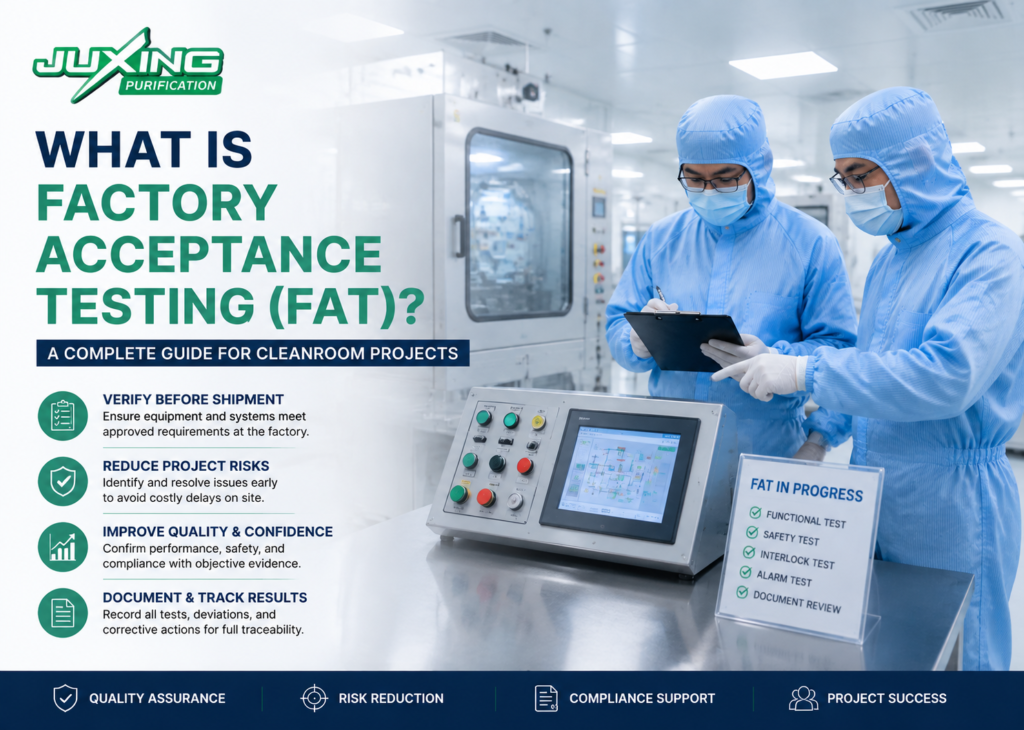
Factory Acceptance Testing, commonly called FAT, is a planned and documented inspection and testing process performed at a supplier’s facility before equipment or prefabricated systems are approved for shipment.
For cleanroom projects, FAT may be used to verify items such as pass boxes, air showers, fan filter units, control panels, air-handling equipment, modular assemblies, automated doors, and other engineered systems. The tests should be based on approved specifications, drawings, purchase requirements, and predefined acceptance criteria.
FAT does not replace Site Acceptance Testing, commissioning, qualification, or final cleanroom classification. Its purpose is to identify manufacturing, functional, documentation, and interface problems while the system is still at the factory, where corrections are generally easier to complete.
Key Takeaways
- FAT verifies selected equipment or systems against approved requirements before shipment.
- A FAT should follow an approved protocol with measurable acceptance criteria.
- The scope must be risk-based and appropriate to the item being tested.
- Not every cleanroom component requires a formal witnessed FAT.
- Factory conditions cannot fully reproduce the final installation environment.
- Open deviations must be documented, assigned, corrected, and formally closed.
- FAT records may support later commissioning or qualification, but only when the testing is suitable, controlled, traceable, and properly reviewed.
Introduction
A professional Factory Acceptance Test (FAT) is much more than a factory visit or a visual inspection of finished equipment. It is a structured verification activity used to determine whether a supplier has manufactured and assembled an item in accordance with the agreed requirements before it leaves the factory.
This matters because cleanroom projects often involve customized equipment, prefabricated assemblies, automation, control systems, and interfaces between multiple contractors. A dimensional error, incorrect material, incomplete control function, missing document, or incompatible connection may be relatively straightforward to correct at the supplier’s workshop. The same problem can become much more expensive after packing, international transport, site installation, and construction coordination.
However, FAT must be applied carefully. A cleanroom is an integrated facility whose final performance depends on site conditions, including installation quality, building leakage, HVAC balancing, utilities, room geometry, operating procedures, and interaction between systems. Therefore, FAT can verify only those characteristics that can realistically be inspected or tested at the factory.
This guide explains how FAT should be planned for cleanroom projects, what should and should not be tested, how acceptance criteria should be established, and how buyers can prevent a ceremonial factory visit from being mistaken for meaningful technical verification.
What Is a Factory Acceptance Test?
A Factory Acceptance Test is a documented series of inspections and static or dynamic tests performed at the manufacturer’s premises before delivery.
Its purpose is to determine whether the item under test satisfies the requirements that can reasonably be verified before shipment. Depending on the project, those requirements may come from:
- User Requirements Specifications
- Approved technical specifications
- Purchase orders and contracts
- Approved drawings
- Equipment datasheets
- Functional descriptions
- Control narratives
- Applicable codes and standards
- Supplier documentation
- Agreed quality plans
Industry guidance commonly distinguishes FAT from SAT by location and purpose: FAT is conducted at the supplier’s facility before shipment, while SAT is performed after delivery and installation in the actual operating environment. FAT and SAT may support later commissioning and qualification, but they are not automatically equivalent to IQ, OQ, or PQ. Vaisala
A successful FAT should provide an evidence-based answer to the following question:
Has the supplier built and tested the specified item sufficiently to justify approval for shipment?
That is more precise than asking whether the finished product “looks acceptable.”
Is FAT Required for Every Cleanroom Product?
No. A formal FAT is not necessary or proportionate for every product in a cleanroom project.
The decision should be based on factors such as:
- System complexity
- Degree of customization
- Impact on product quality or patient safety
- Difficulty of correcting defects after delivery
- Automation and control complexity
- Interface risk
- Project value
- Regulatory expectations
- Previous supplier performance
- Contract requirements
A witnessed FAT is more likely to be justified for:
- Customized air showers
- Dynamic or interlocked pass boxes
- Automated hermetic door systems
- Fan Filter Unit control networks
- HVAC or air-handling equipment
- Control panels and automation systems
- Environmental monitoring panels
- Integrated operating-theatre control systems
- Prefabricated cleanroom modules
- Process equipment installed in controlled environments
By contrast, standard wall panels, simple observation windows, manual doors, loose HEPA filters, or catalogue accessories may be adequately controlled through approved samples, dimensional inspections, certificates, production inspections, and pre-shipment quality checks.
The key principle is proportionality:
The extent of FAT should correspond to the technical and quality risk of the item—not merely its purchase price.
For pharmaceutical and biotechnology systems, ASTM E2500 promotes a science- and risk-based approach to verification, with attention directed toward critical aspects that may affect product quality and patient safety. It is a voluntary consensus standard rather than a universal legal requirement.
What Is the Difference Between FAT and a Pre-Shipment Inspection?
These activities may overlap, but they are not necessarily the same.
Pre-Shipment Inspection
A pre-shipment inspection often focuses on:
- Quantity
- Visible condition
- Dimensions
- Workmanship
- Packaging
- Labels
- Accessories
- Shipping marks
- Document completeness
It may be sufficient for relatively simple or standardized products.
Factory Acceptance Test
A FAT normally includes a broader and more structured verification of:
- Approved requirements
- Construction and materials
- Functional performance
- Control sequences
- Safety functions
- Alarms and interlocks
- Simulated operating conditions
- Documentation
- Deviations and corrective actions
For example, visually inspecting a dynamic pass box and confirming its dimensions would be a pre-shipment inspection. Testing door interlocks, airflow operation, pressure indication, alarms, emergency release, control logic, and recovery after power interruption would form part of a functional FAT.
The RFQ and purchase contract should state clearly which activity is required. Otherwise, the buyer may expect a comprehensive FAT while the supplier prepares only a final visual inspection.
Related reading:
Why Is FAT Important in a Cleanroom Project?
It identifies problems before shipment
FAT creates an opportunity to discover defects while the supplier still has access to its production personnel, tools, components, software engineers, and test facilities.
Typical findings may include:
- Incorrect dimensions
- Wrong material grades
- Poor surface finishing
- Missing accessories
- Incorrect electrical ratings
- Software errors
- Incomplete alarms
- Faulty interlocks
- Unapproved component substitutions
- Missing certificates
- Inadequate maintenance access
Identifying these issues before shipment reduces the likelihood of site modifications, return transport, installation delays, or disputes over responsibility.
It confirms contractual alignment
A FAT compares the manufactured item with approved project requirements rather than with the supplier’s standard product alone.
This distinction is important for customized cleanroom projects. A product may meet the manufacturer’s normal production standard but still fail to meet the specific contract, drawing, material, interface, or control requirements of the project.
It improves coordination between parties
FAT provides a formal point at which the owner, consultant, contractor, supplier, and technical specialists can confirm:
- What has been supplied
- What has been tested
- What remains incomplete
- What must be retested
- What will be verified at the site
- Which documents are still outstanding
It establishes a reference baseline
Recorded dimensions, settings, software versions, alarm functions, instrument readings, and test results can provide a useful baseline for comparison during SAT and commissioning.
However, factory results should not be assumed to represent final site performance. Transport, reassembly, utility conditions, integration, balancing, and installation can all affect the system after FAT.
When Should FAT Be Planned?
FAT planning should begin during procurement—not after manufacturing is complete.
The buyer should define the FAT requirement in the RFQ, technical specification, purchase order, or contract. This allows the supplier to include the necessary assembly, test materials, temporary services, instrumentation, documentation, personnel, and time in its quotation and production programme.
Related reading:
A typical FAT sequence is:
- The buyer defines the requirement and expected scope.
- The supplier prepares a FAT protocol.
- Relevant parties review and approve the protocol.
- Manufacturing and internal testing are completed.
- The supplier confirms readiness for witnessed FAT.
- The FAT is executed and results are recorded.
- Deviations and punch-list items are classified.
- Corrective actions and required retests are completed.
- The FAT report is reviewed.
- Shipment is released only when agreed conditions are satisfied.
A common mistake is scheduling travel before the supplier has completed its own internal inspection and dry run. This can result in an incomplete system, avoidable delays, and a wasted witnessed test.
What Must Be Approved Before FAT Begins?
At minimum, the parties should agree on the following:
- Scope of equipment or systems under test
- Approved FAT protocol
- Reference drawings and specifications
- Test sequence
- Test instruments and calibration status
- Required utilities or simulations
- Test materials
- Acceptance criteria
- Roles and responsibilities
- Recording format
- Deviation-management process
- Retest requirements
- Shipment-release authority
The protocol should identify each requirement being verified and the objective evidence required to demonstrate compliance.
Vague criteria such as “operation is normal” or “quality is acceptable” should be avoided wherever a measurable or observable criterion can be defined.
Better examples include:
- Door interlock prevents both doors from being opened simultaneously.
- Alarm activates within the specified delay after a simulated fault.
- Panel dimensions remain within the agreed drawing tolerance.
- Installed component model numbers match the approved bill of materials.
- Emergency-release function unlocks the door under the defined condition.
- Control system returns to the approved state following restoration of power.
Acceptance criteria should be agreed before testing. They should not be created or relaxed after an unexpected result appears.
What Is a FAT Protocol?
A FAT protocol is the controlled document that describes how the test will be performed, witnessed, recorded, and accepted.
A robust protocol normally includes:
- Document number and revision
- Project and equipment identification
- Purpose and scope
- Responsibilities
- Reference documents
- Preconditions
- Required instruments
- Calibration requirements
- Safety precautions
- Detailed test steps
- Expected results
- Acceptance criteria
- Actual results
- Pass/fail status
- Deviation references
- Signatures and dates
- Attachments and supporting evidence
The document should be specific to the supplied system. A generic checklist can provide a starting framework, but it should not replace equipment-specific tests derived from the approved requirements and risk assessment.
What Should Be Tested During a Factory Acceptance Test?
The scope of a Factory Acceptance Test should be tailored to the specific equipment and the associated project risks. There is no universal FAT checklist that applies to every cleanroom product.
Instead, testing should focus on the characteristics that can be objectively verified before shipment and that have a meaningful impact on installation, operation, safety, maintenance, or regulatory compliance.
A comprehensive FAT typically evaluates five categories:
- Construction quality
- Functional performance
- Electrical and control systems
- Documentation
- Packaging and shipment readiness
The following sections outline typical FAT considerations for common cleanroom equipment.
Architectural and Mechanical Inspection
The first stage of FAT normally involves verifying that the manufactured equipment matches the approved drawings and specifications.
Typical inspection items include:
- Overall dimensions
- Material grades
- Surface finish
- Weld quality
- Joint construction
- Fastener installation
- Door alignment
- Glass installation
- Surface defects
- Protective film
- Labels and identification plates
Dimensions should be measured against the latest approved manufacturing drawings rather than catalogue dimensions.
For stainless steel products, buyers may also verify:
- Material certificates
- Surface finish (for example, No.4 or BA)
- Weld appearance
- Edge treatment
- Corrosion protection
- Drainage details (where applicable)
Although these inspections may appear routine, they often identify manufacturing deviations before the equipment reaches the project site.
Functional Testing
After confirming construction quality, the equipment should be operated under simulated working conditions whenever practical.
The objective is to demonstrate that the equipment performs its intended functions reliably and repeatedly.
Typical functional tests include:
- Start-up and shutdown
- Manual operation
- Automatic operation
- Emergency stop
- Alarm activation
- Indicator lights
- Interlocks
- Control logic
- Fault recovery
- Restart following power interruption
Each function should be tested against predefined acceptance criteria rather than relying on subjective observations.
For example:
Instead of recording:
“Door works normally.”
A better FAT record would state:
“The active door opened and closed smoothly through ten consecutive operating cycles without abnormal noise, obstruction, or loss of sealing.”
Objective descriptions produce more consistent and auditable documentation.
Electrical Verification
Electrical inspections confirm that the equipment has been assembled according to approved electrical drawings and applicable standards.
Typical verification includes:
- Supply voltage
- Phase sequence (where applicable)
- Protective grounding
- Wiring identification
- Terminal numbering
- Fuse ratings
- Circuit breaker selection
- Cable routing
- Electrical enclosure integrity
- Control cabinet layout
Electrical testing may also include insulation resistance measurements, continuity checks, and verification of protective devices where specified by the contract.
Control System Testing
Modern cleanroom equipment increasingly relies on automation and programmable controls.
Consequently, FAT should verify not only that hardware is installed correctly but also that software behaves as intended.
Typical control-system tests include:
- User interface operation
- Password levels
- Alarm management
- Interlock sequences
- Timer functions
- Sensor input verification
- Output signal verification
- Communication with external systems
- Data logging
- Recovery after power failure
If programmable logic controllers (PLCs) or Building Management System (BMS) interfaces are included, software versions should be recorded in the FAT report.
Equipment-Specific FAT Considerations
Different cleanroom products require different FAT activities.
The following examples illustrate typical industry practice.
Hermetic Doors
For automated hermetic doors, FAT commonly includes:
- Opening and closing cycles
- Operating speed
- Safety sensors
- Emergency release
- Door sealing
- Manual override
- Interlock operation
- Limit switch verification
- Control panel functions
Visual inspection alone is not sufficient.
Repeated operating cycles help identify intermittent mechanical or electrical problems before shipment.
Related reading:
Cleanroom Door Specifications Explained
Pass Boxes
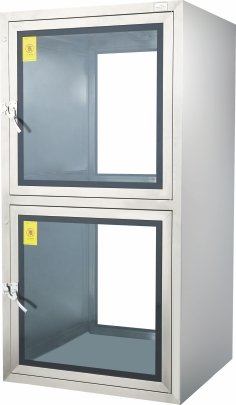
For static or dynamic pass boxes, FAT may include:
- Door interlock verification
- Indicator lights
- UV lamp operation (if applicable)
- Fan operation
- HEPA filter installation
- Differential pressure indication
- Timer functions
- Alarm functions
Where dynamic pass boxes are supplied, airflow direction and fan operation can often be verified at the factory. However, room-to-room pressure relationships cannot be fully evaluated until installation.
Air Showers
Typical FAT activities include:
- Fan operation
- Air velocity measurement
- Door interlock verification
- Nozzle orientation
- Cycle timing
- Emergency stop
- Lighting
- Display functions
- Filter installation
Some manufacturers also perform noise measurements during FAT if required by the specification.
Fan Filter Units (FFUs)
Typical FAT checks include:
- Fan rotation
- Speed adjustment
- Airflow output
- Electrical current
- Vibration
- Noise
- Controller communication
- Filter installation
Final airflow balancing across the cleanroom, however, can only be completed after installation.
Integrated Control Systems
For operating theatres or highly automated cleanrooms, FAT often focuses heavily on software verification.
Typical tests include:
- User permissions
- Alarm priorities
- Screen navigation
- Sensor calibration
- Trend recording
- Communication with third-party equipment
- Fail-safe operation
- Backup and recovery functions
Software issues are significantly easier to resolve before shipment than after commissioning on site.
What Cannot Be Fully Verified During FAT?
One of the most important principles in cleanroom engineering is understanding the limitations of factory testing.
A factory cannot reproduce the actual operating environment of the completed cleanroom.
Consequently, certain performance characteristics should not be considered fully verified during FAT.
Examples include:
- Final room cleanliness classification
- Building pressure cascade
- Whole-room airflow patterns
- Air Changes per Hour (ACH)
- Room recovery performance
- Environmental monitoring performance
- Integrated HVAC balancing
- Final temperature stability
- Final humidity stability
- Building leakage performance
These characteristics depend on the completed facility rather than on individual pieces of equipment.
They are therefore verified later during:
- Cleanroom Commissioning
- Site Acceptance Testing (SAT)
- Installation Qualification (IQ)
- Operational Qualification (OQ)
- Performance Qualification (PQ)
Understanding this distinction prevents unrealistic expectations during factory testing.
How Should Deviations Be Managed?
Very few complex FATs are completed without any observations.
Finding issues during FAT should generally be viewed as a positive outcome because they are identified before shipment.
However, every deviation should be managed through a documented process.
A typical deviation record should include:
- Unique identification number
- Description of the issue
- Requirement not satisfied
- Risk assessment
- Proposed corrective action
- Responsible person
- Target completion date
- Verification of completion
- Retest result
- Final approval
Not every deviation requires the same response.
Critical deviations affecting safety, functionality, or contractual compliance should normally be resolved before shipment.
Minor cosmetic issues may be accepted if both parties formally agree and the decision is documented.
The objective is transparency—not perfection.
A well-managed FAT records problems, resolves them systematically, and provides objective evidence that corrective actions have been completed.
Buyer’s FAT Checklist
Before witnessing or approving a Factory Acceptance Test, buyers should confirm that the FAT is properly planned, documented, and aligned with the project requirements. A structured checklist helps ensure that important verification activities are not overlooked.
FAT Planning
☐ The purchase contract clearly defines FAT requirements.
☐ The equipment under test has been fully manufactured and assembled.
☐ Internal supplier testing has been completed before the witnessed FAT.
☐ A formal FAT protocol has been prepared and approved.
☐ Acceptance criteria are objective, measurable, and agreed upon by all parties.
☐ Required personnel will attend the FAT.
Documentation Review
☐ Approved drawings are available.
☐ Technical specifications are available.
☐ Bill of Materials (BOM) matches the approved design.
☐ Equipment datasheets are complete.
☐ Material certificates are available where required.
☐ Instrument calibration certificates are valid.
☐ Software versions have been documented (if applicable).
Construction Inspection
☐ Dimensions match approved drawings.
☐ Materials comply with project specifications.
☐ Surface finishes meet contractual requirements.
☐ Welding quality is acceptable.
☐ Identification labels are complete.
☐ Safety labels are correctly installed.
☐ Equipment is free from visible damage.
Functional Testing
☐ All operating modes have been verified.
☐ Interlocks function correctly.
☐ Alarm functions have been tested.
☐ Emergency stop operates correctly.
☐ Power failure recovery has been demonstrated.
☐ Control logic performs as specified.
☐ Operator interface functions correctly.
Documentation of Results
☐ All test results have been recorded.
☐ Deviations have been documented.
☐ Corrective actions have been agreed.
☐ Retesting has been completed where required.
☐ FAT report has been signed by all required parties.
☐ Shipment authorization has been formally approved.
A well-executed FAT should conclude with objective evidence—not assumptions—that the equipment is ready for delivery.
Common Misconceptions
Misconception 1: “Passing FAT Means the Cleanroom Is Ready for Operation”
This is perhaps the most common misunderstanding.
A Factory Acceptance Test confirms that equipment performs as intended at the manufacturer’s facility under defined test conditions.
It does not demonstrate that the completed cleanroom will satisfy project requirements after transportation, installation, integration, HVAC balancing, commissioning, and validation.
Final operational performance must still be confirmed on site.
Misconception 2: “Every Product Requires a Full FAT”
Not necessarily.
Applying the same level of testing to every product is neither practical nor cost-effective.
The FAT scope should be determined using a risk-based approach that considers equipment complexity, project criticality, regulatory expectations, and the consequences of failure.
Standard catalogue products may require only routine inspection, while highly customized systems often justify comprehensive witnessed FATs.
Misconception 3: “A Factory Visit Is the Same as a FAT”
A factory tour is not a Factory Acceptance Test.
Watching equipment operate without an approved protocol, documented acceptance criteria, calibrated instruments, recorded results, and formal sign-off does not constitute a valid FAT.
A professional FAT is a controlled engineering activity—not simply a customer visit.
Misconception 4: “Any Problem Found During FAT Means the Supplier Has Failed”
On the contrary, identifying issues during FAT is often a sign that the verification process is working as intended.
The purpose of FAT is to uncover problems before shipment, when corrective actions are generally faster, less expensive, and less disruptive than after installation.
The quality of a FAT should be judged by how effectively deviations are identified, documented, resolved, and verified—not by whether every test passes on the first attempt.
Expert Tip
For complex cleanroom projects, experienced owners often request that the supplier perform a complete internal FAT before inviting customers or third-party inspectors to witness the official FAT.
This “pre-FAT” allows the supplier to identify and correct routine manufacturing issues, reducing unnecessary delays during the witnessed test.
Another best practice is to establish a clear distinction between mandatory acceptance criteria and informational demonstrations. Mandatory tests determine whether the equipment satisfies contractual requirements, while demonstrations help familiarize the buyer with system operation but should not influence acceptance decisions.
Finally, remember that FAT should be viewed as one step in a broader verification strategy. Its value is maximized when it is properly coordinated with Site Acceptance Testing (SAT), Cleanroom Commissioning and subsequent qualification activities.
Frequently Asked Questions
Who should attend a Factory Acceptance Test?
The attendees depend on the project, but they commonly include representatives from the equipment manufacturer, project owner, EPC contractor, engineering consultant, quality assurance team, automation specialists, and, when appropriate, independent inspectors.
How long does a Factory Acceptance Test usually take?
The duration depends on the complexity of the equipment.
Simple equipment may require only a few hours, while highly automated cleanroom systems or integrated modular assemblies may require several days of structured testing.
Can FAT replace Site Acceptance Testing (SAT)?
No.
FAT and SAT serve different purposes.
FAT verifies equipment before shipment, whereas SAT confirms that the equipment performs correctly after transportation, installation, utility connection, and integration at the project site.
Both activities are important components of a comprehensive verification strategy.
What happens if equipment fails a FAT?
If a test does not meet the acceptance criteria, the deviation should be documented, investigated, corrected, and retested.
Depending on the contractual agreement and the severity of the issue, shipment may be delayed until the corrective actions have been verified and accepted.
Should FAT results be included in the final project documentation?
Yes.
The approved FAT report, together with supporting records such as calibration certificates, deviation logs, software versions, and test results, should normally become part of the project’s quality documentation and turnover package.
Is FAT required by ISO 14644?
No.
ISO 14644 provides requirements and guidance for cleanroom classification, testing, monitoring, and operation, but it does not mandate Factory Acceptance Testing for every cleanroom product.
Whether FAT is required depends on the project specification, contractual agreement, industry practices, applicable regulations, and the criticality of the equipment.
Conclusion
Factory Acceptance Testing is one of the most effective opportunities to verify customized cleanroom equipment before it leaves the manufacturer’s facility. When properly planned and executed, FAT helps identify manufacturing defects, functional issues, documentation gaps, and interface problems while corrective actions remain relatively straightforward and cost-effective.
However, FAT should never be viewed as a substitute for commissioning, Site Acceptance Testing, qualification, or final cleanroom performance verification. It confirms only those characteristics that can reasonably be assessed under factory conditions.
For project owners, consultants, and suppliers, the greatest value of FAT lies not in producing a signed checklist, but in establishing confidence that the delivered equipment conforms to the agreed requirements and is ready for the next stage of the project lifecycle.
A disciplined, risk-based FAT process ultimately contributes to smoother installation, more efficient commissioning, fewer project delays, and a stronger foundation for successful cleanroom operation.