
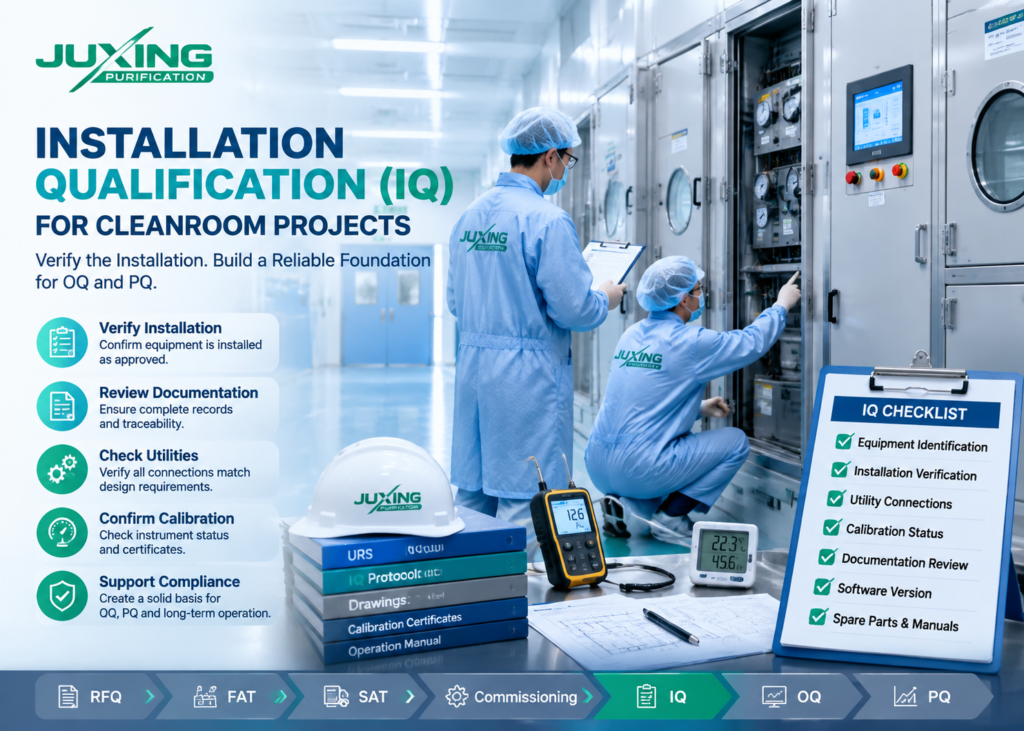
Quick Answer
Installation Qualification (IQ) is the documented process of verifying and recording that equipment, systems, or facilities have been installed according to approved design documents, manufacturer recommendations, engineering specifications, and applicable regulatory requirements.
For cleanroom projects, IQ confirms that critical systems—including HVAC equipment, cleanroom envelope systems, utilities, monitoring devices, and cleanroom equipment—have been correctly installed and are supported by complete documentation before Operational Qualification (OQ) begins.
Importantly, IQ does not verify whether a system performs as intended under operating conditions. Instead, it establishes documented evidence that the installation is complete, correct, traceable, and suitable for subsequent qualification activities.
Key Takeaways
- Installation Qualification (IQ) documents that equipment has been installed correctly according to approved requirements.
- IQ focuses on installation verification rather than operational performance.
- Complete documentation and traceability are essential components of IQ.
- IQ normally follows SAT and commissioning activities and precedes Operational Qualification (OQ).
- Well-executed IQ reduces qualification delays and supports regulatory compliance.
- Every deviation identified during IQ should be investigated, documented, and resolved through an approved quality process.
Introduction
Modern cleanroom projects involve far more than installing walls, HVAC systems, doors, filters, and specialized equipment. Every component must be installed according to approved engineering documents, manufacturer instructions, regulatory expectations, and project specifications.
Even when equipment appears to function correctly, there must be objective evidence demonstrating that it has been installed exactly as intended. Without this evidence, subsequent qualification activities may lack the documented foundation required for regulatory compliance.
This is the primary purpose of Installation Qualification (IQ).
Within pharmaceutical manufacturing, biotechnology, healthcare, medical device production, and other GMP-regulated industries, IQ forms the first formal qualification stage following installation. Rather than evaluating operational performance, IQ verifies that the installed system accurately reflects the approved design and that all supporting documentation has been completed.
A properly executed IQ also improves project traceability. It creates a documented record of equipment identification, installation details, calibration status, utilities, documentation, and configuration before the system proceeds to Operational Qualification (OQ).
This guide explains what Installation Qualification is, why it is necessary, what should be included, how it differs from commissioning and Site Acceptance Testing (SAT), and how organizations can implement an effective IQ process for cleanroom projects.
What Is Installation Qualification (IQ)?
Installation Qualification is the documented verification that equipment, systems, or facilities have been installed in accordance with approved requirements.
The objective is not to determine whether the equipment performs correctly during operation. Instead, IQ confirms that the installation itself complies with:
- Approved engineering drawings
- User Requirements Specification (URS)
- Functional specifications
- Purchase specifications
- Manufacturer recommendations
- Applicable standards
- Regulatory requirements
- Project documentation
Successful IQ provides objective evidence that the installed system is complete and ready to enter Operational Qualification.
Typical systems included within cleanroom IQ may include:
- HVAC systems
- Air Handling Units (AHUs)
- HEPA filter housings
- Fan Filter Units (FFUs)
- Cleanroom wall systems
- Ceiling systems
- Cleanroom Doors
- Pass boxes
- Air showers
- Pressure monitoring systems
- Building Management Systems (BMS)
- Environmental monitoring systems
- Electrical distribution
- Process utilities
- Medical gas systems (where applicable)
Every installed system should be verified against approved documentation rather than visual appearance alone.
Why Is Installation Qualification Important?
Many installation problems remain hidden after construction has been completed.
Examples include:
- Incorrect equipment models
- Missing accessories
- Incorrect material grades
- Incomplete documentation
- Calibration certificates that have expired
- Incorrect software versions
- Utility connections that differ from approved drawings
- Nameplates that do not match project documentation
These issues may not immediately affect equipment operation, but they can create significant problems during qualification, regulatory inspections, maintenance, or future modifications.
IQ identifies these discrepancies before operational testing begins.
By resolving documentation and installation issues early, project teams reduce the likelihood of delays during OQ, PQ, and regulatory audits.
Where Does IQ Fit Within the Project Lifecycle?
One of the most common misunderstandings is assuming that IQ begins immediately after equipment installation.
In practice, several engineering activities usually occur first.
A simplified project sequence is:
Procurement
        ↓
Factory Acceptance Testing (FAT)
        ↓
Delivery
        ↓
Site Acceptance Testing (SAT)
        ↓
Commissioning
        ↓
Installation Qualification (IQ)
        ↓
Operational Qualification (OQ)
        ↓
Performance Qualification (PQ)
Although project-specific sequences may vary, IQ generally begins only after installation has been completed, utilities are available, commissioning activities have progressed sufficiently, and major installation deficiencies have been resolved.
IQ vs. Commissioning
Installation Qualification and commissioning are closely related, but they serve different objectives.
Commissioning is an engineering process that confirms systems have been installed, adjusted, integrated, and are functioning according to the design intent.
IQ is a quality and compliance activity that documents whether those installed systems meet the approved installation requirements.
| Commissioning | Installation Qualification (IQ) |
|---|---|
| Engineering activity | Qualification activity |
| Confirms systems operate correctly | Confirms systems are installed correctly |
| Includes adjustment and optimization | Includes documented verification |
| May involve troubleshooting | Verifies completed installation |
| Supports project startup | Supports regulatory compliance |
Commissioning may involve balancing airflow, adjusting control loops, calibrating sensors, and optimizing system performance.
IQ records that the final installed configuration matches the approved documentation.
The two processes complement one another but should not be considered interchangeable.
IQ vs. Site Acceptance Testing (SAT)
SAT and IQ also have distinct objectives.
SAT confirms that delivered equipment performs correctly after transportation and installation.
IQ documents that the installed equipment complies with approved specifications.
For example:
During SAT, engineers may verify that an automatic hermetic door opens correctly.
During IQ, the qualification team verifies:
- Correct model number
- Equipment identification
- Approved installation location
- Installation dimensions
- Utility connections
- Material certificates
- Installation documentation
- Maintenance manuals
- Nameplate information
SAT answers:
Does the equipment function correctly?
IQ answers:
Has the equipment been installed exactly as approved and properly documented?
Although related, they should never be considered the same activity.
When Should Installation Qualification Be Performed?
IQ should begin only after several prerequisites have been satisfied.
Typical prerequisites include:
- Equipment installation completed
- Utilities connected
- Construction activities substantially complete
- Commissioning activities completed or sufficiently progressed
- Major SAT observations resolved
- Calibration completed
- Documentation available
- Approved IQ protocol issued
- Qualified personnel assigned
Starting IQ before installation is complete often results in unnecessary deviations, repeated inspections, and duplicated documentation.
Proper planning significantly improves qualification efficiency.
What Is Included in Installation Qualification?
Although the exact scope varies between projects, most IQ protocols evaluate similar categories of installation evidence.
Typical verification includes:
- Equipment identification
- Model numbers
- Serial numbers
- Installation location
- Approved drawings
- Utility connections
- Material verification
- Component verification
- Safety devices
- Nameplate information
- Calibration status
- Software versions
- Documentation review
- Spare parts verification
- Maintenance documentation
- Cleaning instructions
- Manufacturer manuals
- Installation records
- Deviation review
Each verification activity should reference an approved requirement and record objective evidence demonstrating compliance.
Subjective statements such as “installation looks acceptable” should be avoided.
Instead, observations should be linked directly to approved drawings, specifications, certificates, or inspection records.
What Documentation Is Required for Installation Qualification?
One of the defining characteristics of Installation Qualification is its emphasis on documented evidence.
Regulatory authorities do not simply expect organizations to state that equipment has been installed correctly—they expect objective records demonstrating that every critical installation requirement has been verified.
For this reason, IQ documentation is often as important as the physical inspection itself.
A complete IQ package typically includes:
- Approved IQ protocol
- User Requirements Specification (URS)
- Functional Specification (FS), where applicable
- Design specifications
- Approved drawings
- Equipment datasheets
- Equipment manuals
- Installation records
- Calibration certificates
- Material certificates
- Electrical schematics
- Piping and Instrumentation Diagrams (P&IDs), where applicable
- Software and firmware version records
- Preventive maintenance recommendations
- Spare parts lists
- Deviation records
- Change control records (if applicable)
- Completed IQ report
Each document should be controlled under the project’s document management system to ensure traceability throughout the equipment lifecycle.
Equipment Identification and Traceability
One of the primary objectives of IQ is to establish complete traceability for every critical system.
Each major piece of equipment should be uniquely identified using information such as:
- Equipment ID
- Asset number
- Manufacturer
- Model number
- Serial number
- Equipment location
- Drawing reference
- Purchase order reference
- Equipment tag number
These identifiers should remain consistent across all project documentation, including:
- Drawings
- Maintenance records
- Calibration records
- Spare parts documentation
- Change control records
- Future qualification reports
Consistent identification reduces confusion during maintenance, audits, equipment replacement, and future expansion projects.
Utility Verification
Many cleanroom systems depend on external utilities to operate correctly.
IQ should therefore verify that all required utilities have been installed according to approved engineering documentation.
Typical utility verification includes:
- Electrical supply voltage
- Electrical frequency
- Phase configuration
- Protective grounding
- Compressed air supply
- Chilled water connections
- Hot water connections
- Steam connections (where applicable)
- Medical gas connections
- Process gas connections
- Network communication
- Drainage connections
The purpose is not to evaluate operational performance, but rather to confirm that the installed utilities match the approved design.
Instrument Calibration Verification
Many cleanroom systems rely on calibrated instruments to support environmental control.
Examples include:
- Pressure transmitters
- Differential pressure gauges
- Temperature sensors
- Relative humidity sensors
- Airflow measuring devices
- Particle counters
- Environmental monitoring sensors
During IQ, the qualification team typically confirms:
- Calibration has been completed.
- Calibration certificates are available.
- Calibration dates remain valid.
- Calibration labels are correctly attached.
- Instrument identification matches project documentation.
Actual instrument accuracy is generally evaluated during subsequent qualification activities rather than Installation Qualification.
Software and Firmware Verification
Modern cleanrooms increasingly incorporate programmable controllers and software-based automation.
IQ should therefore verify software configuration in addition to physical installation.
Typical verification activities include:
- PLC model identification
- PLC firmware version
- Human-Machine Interface (HMI) software version
- Network configuration
- Controller identification
- Software backup availability
- Password management
- User access levels
- Approved software revision
Recording software versions during IQ provides an important reference for future troubleshooting, maintenance, cybersecurity management, and change control.
Spare Parts and Maintenance Documentation
Although often overlooked, maintenance readiness is an important part of installation verification.
Typical IQ documentation includes confirmation that the supplier has provided:
- Operation manuals
- Maintenance manuals
- Spare parts lists
- Recommended spare parts
- Lubrication requirements (if applicable)
- Cleaning procedures
- Preventive maintenance schedules
- Troubleshooting guides
These documents support long-term operation and should be reviewed before the system enters routine service.
Typical IQ Protocol Structure
Although formats differ between organizations, most IQ protocols contain similar sections.
A typical protocol includes:
General Information
- Project name
- Equipment identification
- Protocol number
- Revision number
- Equipment description
Scope
Defines which equipment and systems are covered by the protocol.
Responsibilities
Identifies personnel responsible for:
- Execution
- Review
- Approval
- Witnessing
Reference Documents
Examples include:
- URS
- Specifications
- Approved drawings
- Equipment manuals
- Calibration procedures
Prerequisites
Examples include:
- Installation completed
- Utilities available
- Safety approvals completed
- Calibration completed
- Documentation available
Installation Verification
Individual verification steps with predefined acceptance criteria.
Examples include:
- Equipment identification
- Installation location
- Utility connections
- Safety devices
- Labels
- Documentation
Deviations
Records any observations that differ from approved requirements.
Approval
Final signatures confirming successful completion of IQ.
A standardized protocol promotes consistency across multiple projects and simplifies future audits.
Common Deviations Identified During IQ
Installation Qualification frequently identifies documentation and installation issues that were not detected during construction.
Examples include:
Documentation Mismatch
Examples:
- Incorrect equipment serial numbers
- Missing manuals
- Drawing revisions not updated
- Missing certificates
Utility Connection Differences
Examples:
- Incorrect cable identification
- Wrong utility labeling
- Incorrect pipe identification
- Missing grounding labels
Equipment Configuration Issues
Examples:
- Incorrect firmware versions
- Missing software backup
- Incorrect controller settings
- Wrong network addresses
Missing Identification
Examples:
- Missing equipment tags
- Missing calibration labels
- Missing safety labels
- Incorrect nameplate information
Installation Deviations
Examples:
- Equipment installed at an incorrect location
- Insufficient maintenance clearance
- Incorrect mounting hardware
- Unapproved installation modifications
All deviations should be assessed through the project’s quality management process.
Some may require corrective action before OQ begins, while others may be addressed through approved change control procedures.
Change Control During IQ
Occasionally, installation changes become necessary during project execution.
Examples include:
- Alternative components
- Equipment relocation
- Revised software versions
- Utility modifications
- Mechanical design improvements
Whenever these changes affect approved documentation, they should be managed through the project’s formal change control process.
A properly implemented change control system ensures that:
- The reason for the change is documented.
- Risks are assessed.
- Appropriate approvals are obtained.
- Supporting documents are updated.
- Qualification records remain accurate and traceable.
Maintaining this level of control is particularly important in GMP-regulated industries, where undocumented changes may affect product quality, compliance, and audit readiness.
Buyer’s IQ Checklist
Before approving Installation Qualification, project owners, quality teams, and engineering personnel should verify that the installation is complete, documented, and fully traceable.
The following checklist provides a practical reference for cleanroom projects.
Documentation
☐ The approved IQ protocol is available.
☐ User Requirements Specification (URS) is approved.
☐ Approved engineering drawings are available.
☐ Equipment datasheets have been reviewed.
☐ Manufacturer manuals have been received.
☐ Material certificates are complete where required.
☐ Calibration certificates are available and valid.
☐ Software and firmware versions have been recorded.
Equipment Identification
☐ Equipment ID matches project documentation.
☐ Model number matches the approved specification.
☐ Serial number has been verified.
☐ Nameplate information is correct.
☐ Equipment location matches the approved layout.
☐ Asset identification labels have been installed.
Installation Verification
☐ Equipment has been installed according to approved drawings.
☐ Installation dimensions have been verified.
☐ Required maintenance access is available.
☐ Mechanical supports are correctly installed.
☐ Safety guards are installed where required.
☐ Protective grounding has been verified.
☐ Required warning labels are present.
Utility Verification
☐ Electrical connections match the approved drawings.
☐ Utility piping has been installed correctly.
☐ Compressed air connections have been verified (where applicable).
☐ Medical gas connections have been verified (where applicable).
☐ Drainage connections are complete.
☐ Communication cables have been correctly installed.
Supporting Documentation
☐ Preventive maintenance instructions are available.
☐ Spare parts list has been provided.
☐ Cleaning procedures are available.
☐ Operating manuals have been received.
☐ Outstanding deviations have been documented.
☐ Required change controls have been approved.
Completing these verification activities helps establish documented evidence that the installed system is ready to proceed to Operational Qualification (OQ).
Common Misconceptions
Misconception 1: “IQ Confirms That the Equipment Works Properly”
This is one of the most common misunderstandings.
Installation Qualification confirms how the equipment has been installed, not whether it performs correctly during operation.
Operational performance—including control logic, alarms, environmental stability, and process functionality—is normally evaluated during Operational Qualification (OQ).
Misconception 2: “If SAT Is Complete, IQ Is Unnecessary”
SAT and IQ have different objectives.
SAT verifies that equipment functions correctly after transportation and installation.
IQ provides documented evidence that the installation complies with approved specifications, manufacturer recommendations, and project requirements.
Even when SAT has been successfully completed, IQ remains an essential qualification activity in GMP-regulated projects.
Misconception 3: “IQ Is Only About Equipment”
Although equipment is a major focus, IQ also covers many supporting elements that influence regulatory compliance and long-term operation.
These include:
- Installation documentation
- Utility connections
- Calibration status
- Software versions
- Equipment identification
- Material certificates
- Safety devices
- Maintenance documentation
A complete IQ verifies the entire installed system—not just the physical equipment.
Misconception 4: “Minor Documentation Errors Can Be Corrected Later”
Incomplete or inaccurate documentation can delay qualification, complicate audits, and reduce traceability.
Examples include:
- Missing calibration certificates
- Incorrect equipment identification
- Outdated drawings
- Missing manuals
- Inconsistent software version records
Resolving documentation issues during IQ is generally far more efficient than correcting them after OQ or during regulatory inspections.
Expert Tip
Experienced qualification teams begin collecting IQ documentation long before formal qualification starts.
Rather than waiting until installation is complete, they progressively organize drawings, certificates, calibration records, manuals, equipment registers, and software information throughout the project.
This approach significantly reduces the workload during IQ execution and minimizes the risk of missing documentation at project handover.
Another effective practice is to assign each major piece of equipment a unique identification number from the beginning of the project. Using the same identifier consistently across drawings, purchase records, FAT reports, SAT reports, commissioning records, IQ protocols, maintenance logs, and future change controls greatly improves traceability throughout the equipment lifecycle.
Frequently Asked Questions
Who performs Installation Qualification?
IQ is usually executed by qualified engineering or validation personnel. Depending on the project, the work may involve the equipment supplier, EPC contractor, project owner, quality assurance representatives, and validation specialists. The final approval is typically granted by the organization responsible for the facility’s quality system.
Is Installation Qualification required for every cleanroom project?
Not necessarily.
The extent of IQ depends on factors such as regulatory requirements, project complexity, equipment criticality, and the applicable quality management system.
For GMP-regulated pharmaceutical and biotechnology facilities, IQ is generally considered an essential qualification activity.
Can IQ begin before commissioning is completed?
In most projects, major commissioning activities should be completed before IQ begins.
Starting IQ too early often results in repeated inspections because installation adjustments or system modifications may still be in progress.
Project-specific execution sequences may vary, but the installation should be sufficiently stable before formal qualification starts.
What happens if deviations are found during IQ?
All deviations should be documented, evaluated, and managed according to the project’s quality management procedures.
Critical deviations affecting compliance or installation integrity are typically corrected before OQ begins, while minor issues may be resolved through approved corrective actions or change control procedures.
Does IQ include calibration?
IQ generally verifies that required instruments have been calibrated and that valid calibration certificates are available.
The purpose is to confirm the status of calibration rather than to perform or repeat the calibration itself.
What comes after Installation Qualification?
Once IQ has been successfully completed and approved, the project typically proceeds to Operational Qualification (OQ).
During OQ, the focus shifts from installation verification to demonstrating that the equipment and systems operate consistently according to predefined operational requirements under controlled conditions.
Conclusion
Installation Qualification establishes the documented foundation for the entire qualification process. By confirming that equipment, systems, and supporting documentation comply with approved requirements, IQ provides the objective evidence needed before operational testing begins.
Unlike commissioning or Site Acceptance Testing, IQ does not focus on optimizing performance or demonstrating operational capability. Its purpose is to verify that the installed configuration accurately reflects the approved design and that all critical documentation, utilities, identification, calibration status, and supporting records are complete and traceable.
For pharmaceutical manufacturing facilities, biotechnology laboratories, hospitals, and other regulated cleanroom environments, a well-executed IQ reduces qualification delays, improves audit readiness, and strengthens confidence in the integrity of the installation.
When integrated with Factory Acceptance Testing (FAT), Site Acceptance Testing (SAT), commissioning, and subsequent Operational Qualification (OQ) and Performance Qualification (PQ), Installation Qualification forms an essential link in a structured lifecycle approach to delivering compliant, reliable, and high-performing cleanroom systems.