
Introduction
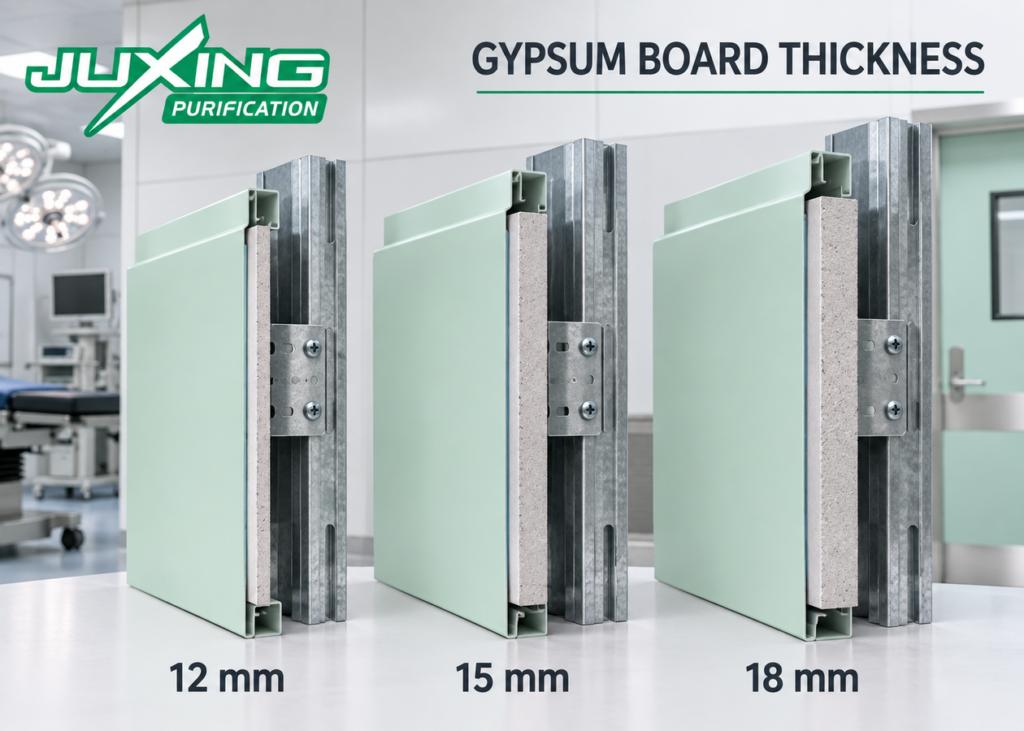
Gypsum board thickness affects the weight, rigidity, handling, fixing design, and overall construction of metal operating theater wall panels. Thicknesses such as 12 mm, 15 mm, and 18 mm may all be proposed, but they are not automatically interchangeable.
A thicker board can add mass and stiffness, yet it also increases panel weight, transport requirements, rear-hook loads, and installation effort. A thinner board may make the panel easier to handle, but it must still provide adequate support to the metal facing and perform correctly around joints, openings, and concealed fixings.
Thickness alone is not enough to determine performance. Board type, density, composition, edge strength, moisture behavior, fire classification, reinforcement, panel dimensions, and the attachment method must all be considered.
This guide compares 12 mm, 15 mm, and 18 mm gypsum-based backing boards for modular operating theater wall panels and explains what buyers should verify before approving a substitution.
Quick Answer
There is no universal international standard requiring every modular operating theater wall panel to use 12 mm, 15 mm, or 18 mm gypsum board.
In general:
- 12 mm board can reduce panel weight and may be suitable for smaller or well-reinforced panels when the selected product provides adequate performance.
- 15 mm board may provide a balance between rigidity, weight, handling, and availability.
- 18 mm board can offer greater mass and potentially higher rigidity, but it creates heavier panels and greater loads on hooks, frames, packaging, and installers.
These are general engineering tendencies, not guaranteed performance levels. A 12 mm high-density gypsum fiberboard may perform differently from an 18 mm standard paper-faced plasterboard.
The final selection should be based on actual product data and the complete wall-panel design.
Key Takeaways
- Gypsum board thickness is only one part of backing-board selection.
- Nominally thicker board is not automatically stronger in every relevant property.
- Board type and density can be as important as thickness.
- Standard paper-faced plasterboard and gypsum fiberboard should not be treated as equivalent.
- Panel width, height, facing thickness, and support spacing influence the required backing.
- Thicker backing increases the load on rear hooks and supporting steel frames.
- Service openings may reduce panel stiffness and require local reinforcement.
- Moisture resistance and fire performance cannot be determined from thickness alone.
- Heavy cabinets and clinical equipment normally require reinforced or independent support.
- Substitution should be approved through a documented technical comparison.
- A representative sample panel should be fabricated when the proposed construction is new.
- Project specifications and applicable test evidence take precedence over general recommendations.
How Should Gypsum Board Thickness Be Specified?
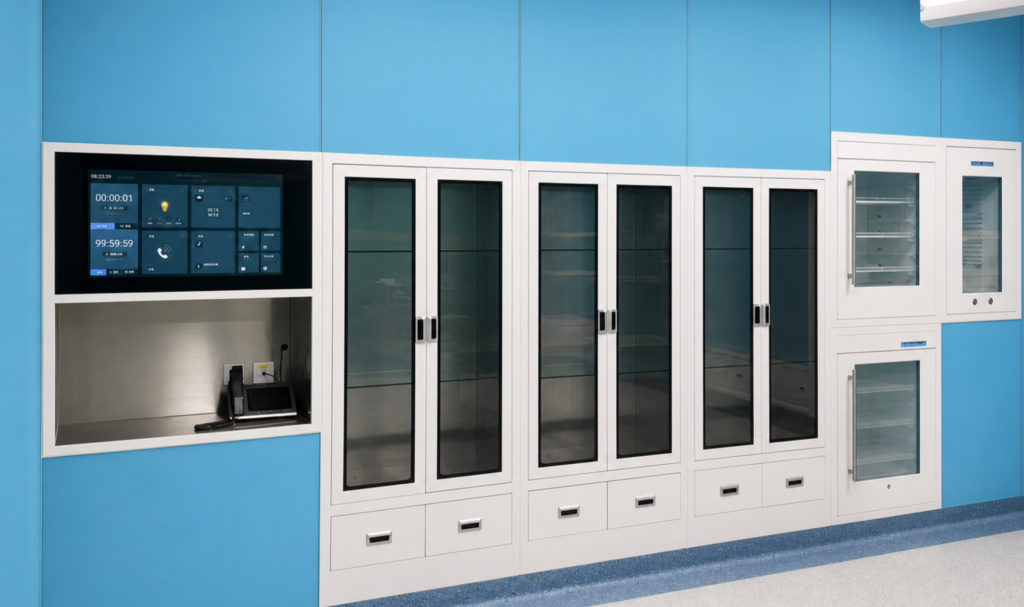
A complete backing-board specification should include more than a nominal thickness.
At minimum, it should state:
- Board category
- Manufacturer
- Product name or reference
- Nominal thickness
- Nominal density
- Mass per square meter
- Board dimensions
- Edge type
- Applicable product standard
- Moisture-related classification
- Fire-related classification
- Relevant mechanical properties
- Surface condition
- Permitted tolerances
- Intended method of attachment to the metal facing
For example, “12 mm standard gypsum board” still leaves several unanswered questions:
- Is it paper-faced plasterboard or gypsum fiberboard?
- Is the actual standard commercial thickness 12 mm or 12.5 mm?
- What is its density?
- Does it have moisture-resistant properties?
- What are its flexural and fixing characteristics?
- Is it compatible with the selected adhesive?
- Is the proposed product supported by the wall assembly’s fire documentation?
The manufacturer should resolve these points before approving material procurement or panel production.
Are 12 mm, 15 mm, and 18 mm Standard Requirements?
No.
These dimensions are common product or project choices, but no universal operating theater standard requires one of them for every wall system.
Available thicknesses vary by:
- Country
- Board manufacturer
- Product family
- Board type
- Production process
- Local building practice
- Project specification
Some markets commonly use 12.5 mm plasterboard rather than exactly 12 mm. Other manufacturers may offer 12 mm gypsum fiberboard or project-specific boards.
The specification should therefore distinguish between:
- Required exact thickness
- Permitted nominal thickness
- Minimum thickness
- Performance-based requirement
- Named proprietary product
- Approved equivalent product
If the tender states exactly 12 mm, the supplier should not silently substitute 12.5 mm, 15 mm, or another material. Any difference should be declared and approved, even when the supplier believes the alternative performs better.
What Is the Difference Between Board Thickness and Board Density?
Thickness describes the distance between the two board faces. Density describes the board’s mass per unit volume.
Both influence the panel.
The approximate mass of the board can be calculated as:
Board mass per m² = board thickness in meters × board density in kg/m³
For illustration, if three boards all had a density of 800 kg/m³:
| Nominal thickness | Illustrative board mass |
|---|---|
| 12 mm | 9.6 kg/m² |
| 15 mm | 12.0 kg/m² |
| 18 mm | 14.4 kg/m² |
These figures are only mathematical examples. Actual product densities and masses must be taken from the manufacturer’s technical datasheet.
A high-density 12 mm board can be heavier than a low-density 15 mm board. It may also provide different:
- Screw-holding capacity
- Edge strength
- Flexural behavior
- Impact resistance
- Surface hardness
- Moisture performance
- Fire behavior
Comparisons should therefore use actual product values instead of thickness alone.
How Do 12 mm, 15 mm, and 18 mm Boards Generally Compare?
| Selection factor | 12 mm board | 15 mm board | 18 mm board |
|---|---|---|---|
| Panel weight | Lowest of the three when board type and density are equal | Moderate | Highest |
| Manual handling | Generally easier | Moderate | More demanding |
| Potential panel rigidity | Lower unless compensated by density or reinforcement | Moderate | Potentially higher |
| Load on rear hooks | Lower | Moderate | Higher |
| Load on the steel frame | Lower | Moderate | Higher |
| Transport payload | Lower | Moderate | Higher |
| Cutting effort | Generally lower | Moderate | Generally higher |
| Space within panel construction | Lowest | Moderate | Highest |
| Suitability for large panels | Requires engineering review | Often practical | May help rigidity but adds weight |
| Need for reinforcement | Project-dependent | Project-dependent | Still project-dependent |
| Availability | Market-dependent | Market-dependent | May be less common in some markets |
| Cost | Often lower | Moderate | Often higher |
This table assumes comparable board composition and density. It should not be used as proof that one thickness meets a specific project requirement.
When Can 12 mm Board Be Considered?
A 12 mm board may be considered when the wall-panel design limits weight while providing adequate support to the metal facing.
Potential applications include panels with:
- Moderate dimensions
- Closely spaced rear supports
- Suitable metal-facing thickness
- Reinforced folded edges
- Limited large openings
- Verified bonding
- Proper hook reinforcement
- Controlled handling conditions
Possible advantages include:
- Reduced panel weight
- Lower loads on rear hooks
- Easier manual handling
- More panels per transport load
- Reduced overall wall thickness in some systems
- Lower material consumption
However, a thinner board may be more sensitive to:
- Large unsupported areas
- Handling damage
- Poor adhesive distribution
- Weak edges
- Concentrated fixing loads
- Large equipment openings
- Inadequate framing
- Local impact
A 12 mm board should not be approved simply because the finished panel appears flat immediately after production. The panel should also remain stable through curing, packing, transport, installation, cleaning, and maintenance.
When Can 15 mm Board Be Considered?
A 15 mm board may provide a practical intermediate option between lower panel weight and increased backing stiffness.
It may be considered where:
- Panel dimensions are relatively large
- Additional mass is acceptable
- More support is desired behind a thin metal facing
- The selected product is readily available
- Rear hooks and framing are designed for the added weight
- Service openings require a more substantial backing
- The complete assembly has appropriate supporting documentation
Potential advantages include:
- Greater backing thickness than a 12 mm option
- Moderate increase in panel mass
- Potentially improved handling rigidity
- More material around some mechanical connections
- A useful balance for certain panel dimensions
Potential disadvantages include:
- Increased transport weight
- More demanding manual handling
- Higher hook and frame loads
- Possible incompatibility with an existing panel-edge profile
- Different adhesive curing or fabrication conditions
A 15 mm board is not automatically the “best compromise.” Its suitability depends on the specific product and panel system.
When Can 18 mm Board Be Considered?
An 18 mm board may be proposed for larger panels, high-density panel constructions, increased mass, or systems originally designed around a substantial backing board.
Potential advantages may include:
- Greater panel-body thickness
- Potentially increased stiffness
- Additional mass
- More robust handling in some constructions
- Improved fixing conditions when used with appropriate reinforcement
- Greater support behind thin metal facing
Potential limitations include:
- Significantly increased panel weight
- Higher loads on rear hooks and receiving rails
- Greater steel-frame loading
- Reduced ease of removal
- Increased installation manpower
- More difficult handling in confined corridors
- Higher transport payload
- Greater risk of injury if manual handling is poorly planned
- Possible incompatibility with existing panel profiles
Even with an 18 mm board, rear hooks should not rely on unverified screw engagement in gypsum alone. Concentrated loads may still require metal plates, reinforcement profiles, or mechanically formed panel edges.
Can a 12 mm Board Replace an 18 mm Board?
Possibly, but it should be treated as a technical substitution rather than a simple thickness change.
The proposed 12 mm board should be compared with the specified 18 mm board for:
- Board type
- Density
- Mass per square meter
- Flexural properties
- Edge strength
- Surface hardness
- Fixing capacity
- Moisture-related characteristics
- Fire classification
- Available dimensions
- Dimensional tolerances
- Adhesive compatibility
- Panel-flatness performance
- Impact behavior
The complete panel should also be reviewed for:
- Facing support
- Rear-hook attachment
- Reinforcement
- Joint alignment
- Openings
- Handling
- Transport
- Removability
- Fire performance
- Acoustic requirements
A thinner high-density gypsum fiberboard may provide some advantages over a thicker standard plasterboard, but equivalence cannot be assumed without evidence.
The buyer, consultant, fire engineer, or other responsible project authority should approve the proposed substitution before production.
Can an 18 mm Board Replace a 12 mm Board?
A thicker board may seem like a conservative upgrade, but substitution can still create problems.
Changing from 12 mm to 18 mm may affect:
- Finished panel thickness
- Folded metal-edge dimensions
- Rear-hook projection
- Joint geometry
- Door-frame interfaces
- Window-frame depth
- Cabinet flanges
- Service-box positions
- Panel weight
- Shipping quantity
- Installation sequence
- Fire documentation
The existing panel profiles may not accommodate an additional 6 mm of backing thickness. If the metal facing is already manufactured, the thicker board may not fit within its folded edges.
The added weight may also exceed the original assumptions for hooks, rails, or manual handling.
Therefore, “thicker” should not automatically be treated as “equal or better.”
How Does Gypsum Board Thickness Affect Metal-Facing Flatness?
A backing board supports the metal facing and can reduce visible waviness, but thickness is only one influence on flatness.
Other important factors include:
- Board flatness before assembly
- Board moisture content
- Metal-sheet thickness
- Stainless-steel surface finish
- Adhesive type
- Adhesive coverage
- Bond-line thickness
- Curing pressure
- Curing temperature
- Reinforcement plates
- Panel-edge folding
- Storage orientation
- Transport support
- Frame alignment
A thicker but warped backing board may produce a less satisfactory panel than a thinner, flatter, correctly bonded board.
Uneven adhesive application can also create localized high points that become visible on stainless-steel or coated-steel surfaces.
The manufacturer should inspect completed panels under appropriate lighting and measure flatness according to agreed acceptance criteria.
Does a Thicker Board Always Improve Impact Resistance?
Not necessarily.
Impact behavior depends on:
- Board type
- Density
- Metal-facing thickness
- Bond quality
- Distance between supports
- Panel dimensions
- Edge restraint
- Reinforcement
- Location and type of impact
A thicker backing can support the metal facing over a larger depth, but it may still crack or crush if the board is brittle, poorly supported, or locally overloaded.
The intended impact should also be defined. A wall may be exposed to:
- Cleaning equipment
- Instrument trolleys
- Mobile imaging equipment
- Beds
- Storage carts
- Staff contact
- Maintenance activities
If impact resistance is a project priority, the complete metal-faced panel should be assessed rather than relying on board thickness as a proxy.
How Does Thickness Affect Rear-Hook Fixings?
Thicker boards create heavier wall panels. This increases the load transferred through:
- Rear hooks
- Hook fasteners
- Reinforcement plates
- Receiving rails
- Steel framing
- Frame anchors
The panel design should establish a continuous load path from the finished panel to the building structure.
Rear-hook design should account for:
- Complete panel mass
- Hook quantity
- Hook spacing
- Engagement depth
- Adjustment range
- Anti-lift protection
- Fastener capacity
- Reinforcement
- Panel-removal forces
- Safety factors
- Project-specific lateral or seismic loads
The gypsum board itself should not automatically be treated as the sole material retaining a load-bearing hook.
Further information is available in removable operating theater wall panels and rear-hook systems.
How Does Thickness Affect Panel Removal?
Thicker boards increase both panel thickness and weight. This can make removal more difficult, especially for full-height or wide panels.
The maintenance plan should consider:
- Number of workers required
- Panel lifting points
- Use of suction lifters
- Temporary support
- Required lifting clearance
- Hook disengagement direction
- Gasket removal
- Anti-lift lock access
- Connected services
- Storage of the removed panel
- Protection of finished surfaces
- Safe reinstallation
A removable panel should not be considered maintainable merely because its hooks can theoretically disengage.
If an 18 mm backing makes a large panel too heavy for the intended maintenance method, the design may require:
- Smaller panel dimensions
- More horizontal sections
- Mechanical lifting assistance
- A lower-density approved board
- Alternative reinforcement
- A different removal strategy
Panel size and thickness should therefore be selected together.
How Does Board Thickness Affect Three-Section Walls?
Three-section walls divide the elevation into lower, middle, and upper panel zones. This can reduce individual panel height and make thicker backed panels easier to manufacture and handle.
However, the middle service band often contains many openings for:
- Medical-gas outlets
- Electrical sockets
- Control panels
- Writing desks
- Cabinets
- Displays
- Return-air grilles
These openings may reduce panel stiffness, even when the backing board is relatively thick.
The design should coordinate:
- Horizontal joint positions
- Board dimensions
- Hook positions
- Local reinforcement
- Service openings
- Panel-removal direction
- Cabinet supports
- Door and window interfaces
A thicker board cannot replace missing reinforcement around a large opening.
For further guidance, see three-section modular operating theater walls.
How Should Service Openings Be Reinforced?
Cutouts remove part of the backing board and interrupt the panel’s continuity.
The effect depends on:
- Opening size
- Opening position
- Distance from panel edges
- Number of openings
- Distance between openings
- Panel width and height
- Facing thickness
- Board type
- Hook positions
Local reinforcement may include:
- Folded metal returns
- Reinforcement plates
- Perimeter frames
- Additional rear profiles
- Extra hooks
- Independent equipment supports
The reinforcement should be shown on the panel’s rear elevation before production.
Unplanned site cutting should be minimized because it can remove backing, expose gypsum edges, damage coatings, generate dust, and conflict with concealed hooks or services.
Does Thickness Determine Fire Performance?
No.
Thicker gypsum board may contribute to the fire behavior of a wall assembly, but thickness alone does not establish a reaction-to-fire classification or fire-resistance period.
Fire performance depends on the complete construction, including:
- Board type
- Board thickness
- Number of layers
- Metal facing
- Steel framing
- Insulation
- Adhesives
- Fasteners
- Panel joints
- Perimeter seals
- Openings
- Penetrations
- Fire stopping
- Doors and access panels
A fire-resistant 12.5 mm product may have different declared properties from a standard 18 mm product.
Where fire performance is required, the project should review test reports, classifications, or engineering assessments applicable to the exact proposed assembly.
Changing the backing thickness may invalidate or limit the applicability of existing evidence.
Does Thickness Determine Moisture Resistance?
No.
Moisture resistance depends primarily on product formulation, facing, absorption characteristics, and exposure conditions.
An 18 mm standard paper-faced board is not automatically more moisture-resistant than a 12 mm board specifically manufactured for increased moisture resistance.
The wall cavity should remain dry regardless of board thickness.
Moisture risks include:
- Wet storage
- Rain during transport
- Construction humidity
- Condensation
- Water leaks
- Damaged panel joints
- Plumbing or service leakage
- Closing cavities before drying
Wet, swollen, softened, stained, or mold-affected boards should not be concealed behind finished metal panels without appropriate assessment.
How Does Thickness Affect Fire and Acoustic Documentation?
Thickness is often one of the defining characteristics in tested wall assemblies.
If the project relies on a tested or classified construction, the documentation may specify:
- Board manufacturer
- Product type
- Thickness
- Number of layers
- Fastener spacing
- Stud dimensions
- Stud spacing
- Insulation
- Joint treatment
- Perimeter details
Changing from 18 mm to 12 mm—or even from one 12 mm product to another—may mean that the installed system no longer matches the documented assembly.
Acoustic performance is similarly affected by the complete wall construction. Greater board mass may contribute to sound insulation, but doors, windows, joints, penetrations, cavities, and flanking paths also influence the result.
Fire or acoustic performance should not be claimed from a thickness comparison table alone.
How Does Thickness Affect Panel Transportation?
The total shipping weight of a modular operating theater package can be substantial.
Increasing the backing thickness affects:
- Individual panel weight
- Packing-frame design
- Container payload
- Number of panels per package
- Handling equipment
- Loading sequence
- Unloading method
- Site storage
- Installation manpower
The supplier should calculate panel mass using the actual board datasheet rather than a generic density estimate.
Packing should also support panels in a way that prevents:
- Bending
- Edge damage
- Hook distortion
- Surface scratching
- Board cracking
- Moisture exposure
- Permanent panel deformation
The lightest board is not automatically the most economical if it requires additional reinforcement or produces more damage. The heaviest board is not automatically the most durable if it becomes difficult to handle safely.
How Should a Thickness Substitution Be Evaluated?
A controlled substitution process should include:
- Review the original specification.
- Identify the exact specified board.
- Identify the proposed alternative.
- Compare technical datasheets.
- Calculate the change in panel weight.
- Review hooks, rails, framing, and anchors.
- Review panel-edge geometry.
- Review doors, windows, cabinets, and service interfaces.
- Review fire and acoustic evidence.
- Fabricate a representative sample if necessary.
- Record the technical assessment.
- Obtain approval before production.
The comparison should clearly identify differences rather than using vague statements such as “equivalent quality.”
Any cost or schedule benefit should be presented separately from the technical comparison.
What Should Be Checked on a Sample Panel?
A representative sample can show whether the selected gypsum board thickness performs correctly within the actual panel construction.
The sample should include:
- Proposed metal facing
- Actual backing board
- Specified adhesive
- Folded panel edges
- Rear reinforcement
- Rear hooks
- A typical vertical joint
- A horizontal joint where applicable
- A representative service opening
Inspection may include:
- Panel dimensions
- Surface flatness
- Visible waviness
- Bond quality
- Edge condition
- Hook attachment
- Panel stiffness
- Handling behavior
- Joint alignment
- Removal and reinstallation
- Damage after controlled handling
A successful sample does not replace required regulatory testing, but it can identify manufacturing and installation problems before mass production.
Buyer’s Checklist
Material Identification
- Board type is stated.
- Board manufacturer and product reference are provided.
- Nominal thickness is confirmed.
- Actual commercial thickness is clarified.
- Density and mass per square meter are documented.
- Board dimensions and availability are confirmed.
- Applicable product standards are identified.
Panel Design
- Metal-facing material and thickness are specified.
- Panel width and height are defined.
- Finished panel weight is calculated.
- Board-to-metal attachment is documented.
- Panel edges are properly closed.
- Rear-hook reinforcement is shown.
- Openings have suitable reinforcement.
- Finished flatness tolerances are agreed.
Performance
- Fire requirements apply to the complete assembly.
- Moisture resistance is based on board type, not thickness alone.
- Acoustic requirements are evaluated at system level.
- Impact requirements are defined where necessary.
- Airtightness is assessed across the complete enclosure.
- Cleaning compatibility relates to the exposed surface and joints.
Installation and Maintenance
- Panel weight is suitable for the planned installation method.
- Required manpower and lifting equipment are identified.
- Hooks and rails are designed for the panel mass.
- Removal clearance is available.
- Connected services can be safely disconnected.
- Replacement panels can be manufactured from retained records.
- A sample or mock-up is required for a new construction.
Substitution Control
- Original and proposed products are compared.
- Differences are clearly declared.
- Fire documentation has been reviewed.
- Door, window, and cabinet interfaces remain compatible.
- Cost and technical comparisons are presented separately.
- Approval is obtained before production.
Common Misconceptions
Misconception 1: “18 mm Board Is Always Better Than 12 mm Board”
A thicker board may increase mass and potential rigidity, but board type, density, reinforcement, panel dimensions, and fixing design also determine performance.
Misconception 2: “12 mm and 12.5 mm Are the Same”
They may be treated similarly in casual conversation, but they are different nominal dimensions. The approved specification and available product should be confirmed.
Misconception 3: “A Thicker Board Can Support Any Cabinet”
Cabinets and clinical equipment may require steel reinforcement or independent support regardless of board thickness.
Misconception 4: “A Thicker Board Automatically Provides Better Fire Resistance”
Fire performance applies to a defined complete wall assembly. Thickness is only one component of that assembly.
Misconception 5: “Reducing Thickness Only Changes the Price”
It can also affect weight, rigidity, hooks, panel edges, openings, transport, handling, fire documentation, and maintenance.
Misconception 6: “If the Finished Panel Looks Flat, the Substitution Is Proven”
Appearance immediately after fabrication does not establish long-term performance, fixing strength, fire compliance, or suitability after transport and installation.
Expert Tip
Before deciding between 12 mm, 15 mm, and 18 mm boards, calculate the weight of one complete representative wall panel.
Include:
- Metal facing
- Gypsum board
- Rear reinforcement
- Hooks
- Edge profiles
- Adhesive
- Integrated components
Then check whether the planned installers can safely handle and remove that panel under actual site conditions.
This simple exercise often reveals that the best backing is not the thickest available product. A slightly thinner but properly reinforced panel may be easier to transport and maintain, while a larger heavy panel may need redesign even if its surface rigidity is excellent.
For a new configuration, combine the weight calculation with a representative mock-up and documented technical comparison.
Frequently Asked Questions
Which gypsum board thickness is best for operating theater wall panels?
There is no universal best thickness. Selection depends on board type, density, panel dimensions, metal-facing thickness, support spacing, fixing method, openings, fire requirements, and handling strategy.
Is 12 mm standard gypsum board sufficient?
It may be sufficient for a properly designed panel, but the manufacturer should verify the actual board properties, panel flatness, reinforcement, hook attachment, openings, and project requirements.
Is 15 mm board a safer choice than 12 mm?
Not automatically. It is thicker and usually heavier, but actual performance depends on the product and complete wall-panel design.
Why would a project specify 18 mm board?
Possible reasons include panel rigidity, increased mass, established manufacturer construction, impact considerations, fire or acoustic documentation, or a project-specific requirement.
Can gypsum fiberboard be thinner than standard plasterboard?
Potentially. A denser or stronger product may provide suitable performance at a different thickness, but equivalence must be demonstrated through actual data and system assessment.
Does thicker board improve rear-hook strength?
It may provide more material around some connections, but rear-hook strength depends on reinforcement, fasteners, board properties, hook design, and the complete load path.
Should walls without a middle equipment band still use gypsum backing?
That depends on the selected panel construction. The absence of an equipment band does not by itself eliminate the need for backing. Panel size, facing support, rigidity, fixing, fire strategy, and project requirements remain relevant.
Can the backing-board thickness vary within the same project?
It can, but variations should be intentional, documented, and coordinated with panel profiles, hooks, doors, windows, joints, and performance requirements. Uncontrolled mixing should be avoided.
Does the gypsum board need to extend above the operating theater ceiling?
That depends on the wall system, fire strategy, acoustic requirements, pressure boundary, structural arrangement, and project specification. The finished room ceiling level and the full wall construction should be clearly distinguished.
Who should approve a thickness change?
Approval may involve the project owner, architect, consultant, fire engineer, contractor, wall-system manufacturer, or other responsible authority, depending on the project’s contractual and regulatory structure.
Conclusion
Gypsum board thickness influences the weight, rigidity, handling, fixing loads, and construction of metal operating theater wall panels, but it does not determine performance by itself.
A 12 mm, 15 mm, or 18 mm board should be evaluated using actual information about board type, density, dimensions, strength, moisture behavior, fire classification, and compatibility with the proposed panel system.
The assessment should also consider metal-facing thickness, adhesive, folded edges, reinforcement, rear hooks, support rails, steel framing, openings, transport, installation, removal, and replacement.
For broader wall-system selection guidance, see modular operating theater wall and ceiling systems.
The correct choice is not necessarily the thickest or lightest board. It is the documented construction that meets the approved project requirements and can be manufactured, transported, installed, and maintained safely and consistently.