Introduction
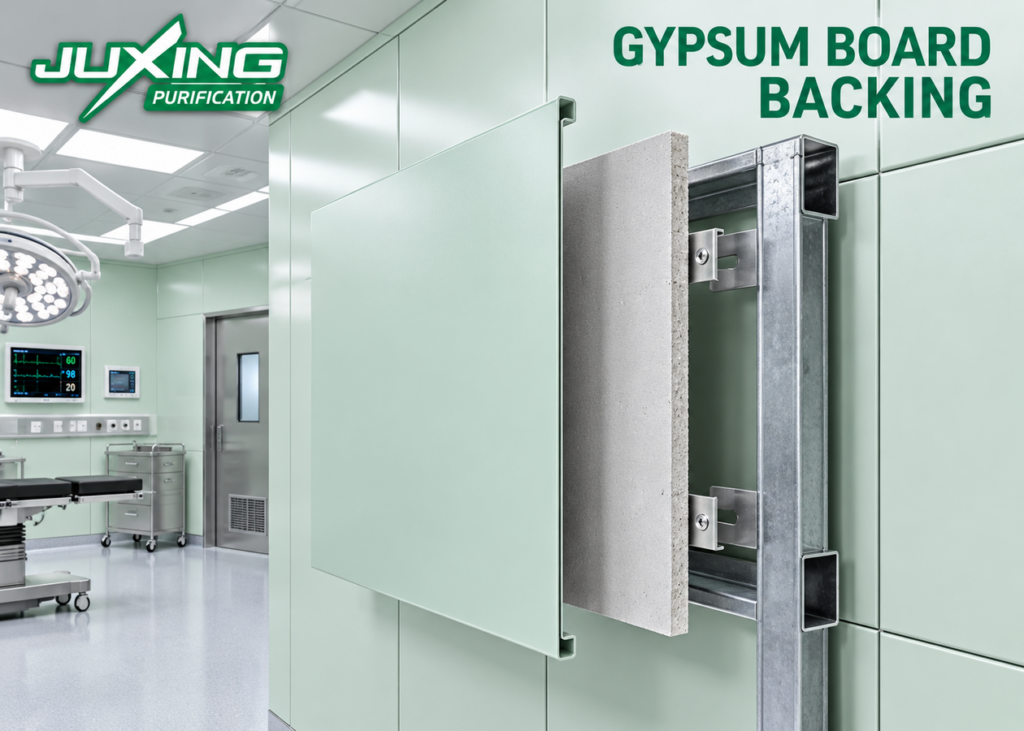
Behind metal operating theater wall panels, gypsum board backing improves rigidity and provides a continuous substrate. In some modular systems, a stainless-steel facing is bonded to a gypsum-based board before mounting the finished panel.
Although the gypsum board is hidden after installation, its properties can affect the wall panel’s weight, impact behavior, dimensional stability, fixing strength, moisture resistance, fire performance, and removability.
The term “gypsum board” is also easily misunderstood. Standard paper-faced plasterboard, moisture-resistant gypsum board, fire-resistant board, and gypsum fiberboard are different products. A specification that states only “12 mm gypsum board” may not provide enough information for the manufacturer to select the correct material.
Additionally, this guide explains why gypsum board backing is used. It covers how different board types compare. It explains how the board coordinates with metal facings, rear hooks, wall frames, services, and project performance requirements.
Quick Answer
Gypsum board backing can serve several functions in a modular operating theater wall panel:
- Increase panel stiffness
- Help maintain a flat finished surface
- Support the thin metal facing
- Reduce local deformation
- Improve impact behavior
- Provide a substrate for bonding or mechanical attachment
- Contribute to the mass and acoustic behavior of the wall
- Support certain fixings when appropriately reinforced
- Form part of a tested or assessed fire-performing wall assembly
- Make factory fabrication and panel handling more consistent
However, gypsum backing does not automatically make a wall hygienic, airtight, fire-rated, moisture-resistant, structurally load-bearing, or suitable for an operating theater.
The correct board must be selected according to the complete wall design, environmental conditions, facing material, fixing method, fire strategy, cleaning regime, service openings, and applicable project requirements.
Key Takeaways
- “Gypsum board” is a general term and should not be used as the complete product specification.
- Paper-faced gypsum plasterboard and gypsum fiberboard have different construction and performance characteristics.
- Board thickness alone does not determine strength, fire performance, moisture resistance, or fixing capacity.
- The metal facing provides the exposed hygienic surface; the gypsum board normally remains concealed.
- The compatibility of the facing, adhesive, backing board, hooks, and edge construction must be verified.
- Cut edges and service openings require careful protection and detailing.
- Built-in cabinets and heavy equipment normally need reinforced framing or independent support.
- Moisture-resistant board is not the same as waterproof board.
- Fire performance must be established for the complete wall assembly.
- Panel weight, transport, manual handling, and removal must be considered before selecting a thick or dense backing board.
- Substituting one gypsum-board type or thickness may affect the complete panel design.
- Approved samples and representative mock-ups can identify bonding, flatness, joint, and removal problems before mass production.
Why Is Gypsum Board Backing Used Behind Metal Wall Panels?
Thin metal sheets can provide durable and cleanable finishes, but they may not remain sufficiently rigid over large panel areas without support.
A gypsum-based backing board creates a continuous surface behind the metal facing. This can help prevent:
- Visible waviness
- Local denting
- Oil-canning effects
- Vibration
- Uneven bonding
- Distortion during handling
- Excessive flexing during cleaning
- Inconsistent alignment at panel joints
The backing can also make the wall panel easier to manufacture as a stable cassette or composite component.
Depending on the system, the metal facing may wrap around the board edges, bond to the front surface, connect to rear reinforcement, or form a folded tray containing the backing material.
The backing board should therefore be selected as part of the complete panel construction—not as an isolated filler.
For an overview of different wall constructions, see operating theater wall panels: single-skin steel vs sandwich panels.
Is Gypsum Board Exposed Inside the Operating Theater?
Normally, no.
In a metal-faced modular wall system, the gypsum board is usually concealed behind stainless steel, coated steel, or another approved finish. The visible clinical surface is the metal facing and its joint system.
The concealed board should not be directly exposed at:
- Panel joints
- Floor junctions
- Ceiling junctions
- Door openings
- Observation-window openings
- Cabinet openings
- Medical-gas outlets
- Electrical boxes
- Return-air grilles
- Access panels
- Service penetrations
Exposed gypsum edges may absorb moisture, release dust, become damaged during installation, or create surfaces that are difficult to clean.
Panel edges and openings should therefore be closed, folded, framed, sealed, or otherwise protected according to the approved system detail.
What Types of Gypsum Board Can Be Used?
Several gypsum-based products may be considered, depending on the project.
Standard Paper-Faced Gypsum Plasterboard
This board normally has a gypsum core enclosed by paper liners.
Potential advantages include:
- Wide availability
- Relatively low cost
- Familiar installation methods
- Multiple thickness options
- Established use in conventional interior construction
Potential limitations include:
- Paper-faced edges may be vulnerable if left exposed.
- Standard board may have limited moisture resistance.
- Fixing strength may be lower than denser board types.
- Edge damage can occur during cutting and handling.
- It may not suit every composite-panel manufacturing process.
Standard plasterboard may be acceptable in some concealed, dry applications, but suitability should be confirmed for the actual panel design and project specification.
Moisture-Resistant Gypsum Board
Moisture-resistant gypsum board is formulated and faced to perform better than standard board under limited moisture exposure.
It may be appropriate where:
- Construction humidity is difficult to control
- Condensation risk requires additional consideration
- The wall cavity may experience occasional elevated humidity
- The project specification explicitly requires moisture-resistant backing
However, moisture-resistant board is not waterproof. It should not be used to justify uncontrolled water exposure, persistent condensation, wet wall cavities, or defective building envelopes.
Fire-Resistant Gypsum Board
Fire-resistant gypsum board contains a modified core or reinforcement intended to improve behavior when exposed to fire.
It may form part of a wall assembly designed to achieve a specified fire performance. However, using fire-resistant board does not automatically make the finished modular wall fire-rated.
The complete assembly must be considered, including:
- Metal facing
- Board type and thickness
- Number of board layers
- Framing
- Fasteners
- Adhesives
- Insulation
- Panel joints
- Perimeter connections
- Openings
- Service penetrations
- Fire stopping
The project should refer to applicable test reports, classifications, engineering assessments, and local fire regulations.
Gypsum Fiberboard
Gypsum fiberboard generally combines gypsum with distributed cellulose fibers to form a dense, relatively homogeneous board without conventional paper facings.
Depending on the product, potential advantages may include:
- Higher density
- Improved mechanical strength
- Better screw-holding capacity
- Increased edge strength
- Greater impact resistance
- More uniform composition through the board thickness
Possible disadvantages may include:
- Higher material cost
- Greater panel weight
- More difficult cutting
- Increased tool wear
- More dust during machining
- Reduced availability in some markets
- Different bonding behavior
Gypsum fiberboard should not be assumed superior in every application. Its added density and strength may be beneficial, but they also affect transport, panel handling, rear-hook loads, and installation manpower.
How Do Paper-Faced Gypsum Board and Gypsum Fiberboard Compare?
| Criterion | Paper-faced gypsum plasterboard | Gypsum fibreboard |
|---|---|---|
| Basic construction | Gypsum core with paper liners | Gypsum reinforced with distributed fibres |
| Typical density | Generally lower | Generally higher |
| Panel weight | Usually lighter | Usually heavier |
| Screw-holding capacity | Product-dependent; reinforcement may be required | Often higher, depending on product |
| Edge strength | Can be vulnerable when cut or damaged | Often stronger and more homogeneous |
| Cutting | Generally easier | May require more robust tools |
| Manufacturing dust | Moderate | Can be higher during machining |
| Moisture performance | Depends on board type | Depends on product formulation |
| Fire performance | Depends on grade and assembly | Depends on grade and assembly |
| Availability | Widely available | May be less widely available |
| Cost | Usually lower | Often higher |
| Suitability for metal-faced panels | Possible with correct design | Possible with correct design |
This comparison represents general product tendencies. Actual performance should be verified from the selected manufacturer’s technical data and the requirements of the complete wall-panel assembly.
Does Board Thickness Determine Performance?
Thickness is important, but it is only one selection factor.
Common board thicknesses may include 12 mm, 12.5 mm, 15 mm, and 18 mm, depending on the country, manufacturer, and selected product. These are commercial or project-specific options, not universal operating theater requirements.
Two boards with similar thicknesses can have different:
- Density
- Mass
- Flexural strength
- Screw-holding capacity
- Edge strength
- Water absorption
- Dimensional stability
- Fire classification
- Surface characteristics
- Manufacturing tolerances
A thicker standard plasterboard is not necessarily stronger at fixing points than a thinner but denser gypsum fiberboard.
The required thickness should be selected after considering:
- Metal-facing thickness
- Panel width and height
- Distance between supports
- Rear-hook arrangement
- Panel edge construction
- Openings and cutouts
- Expected impact
- Required panel weight
- Fire strategy
- Acoustic requirements
- Manufacturing method
- Installation and removal process
A detailed comparison of 12 mm, 15 mm, and 18 mm boards should be made using actual product data rather than nominal thickness alone.
How Does the Backing Board Affect Panel Flatness?
The backing board can help stabilize a thin metal facing, but it can also introduce distortion if the materials and manufacturing process are not properly controlled.
Possible causes of uneven panels include:
- Board thickness variation
- Uneven adhesive application
- Moisture differences across the board
- Asymmetric panel construction
- Uneven curing pressure
- Local reinforcement plates
- Warped boards
- Incorrect storage
- Thermal expansion differences
- Folding or bonding stresses
- Inadequate support during transport
Stainless steel, coated steel, gypsum board, adhesives, and reinforcement components may respond differently to temperature and humidity.
If the metal facing is bonded to only one side of the board, the panel construction may be unbalanced. The manufacturer should evaluate whether rear reinforcement, balancing layers, mechanical restraint, or controlled bonding conditions are needed.
Panel flatness should be checked after fabrication—not only before the facing and backing are assembled.
How Is the Metal Facing Connected to the Gypsum Backing?
The connection method depends on the wall-panel design.
Possible methods include:
- Full-surface adhesive bonding
- Intermittent adhesive bonding
- Perimeter mechanical fixing
- Folded metal edges around the board
- Rear reinforcement profiles
- Mechanical fasteners
- A combination of bonding and folded construction
When adhesives are used, the manufacturer should evaluate:
- Adhesive compatibility with stainless steel or coated steel
- Compatibility with the board surface
- Surface preparation
- Application thickness
- Coverage
- Open time
- Curing conditions
- Temperature and humidity during production
- Long-term aging
- Fire behavior
- Volatile emissions, where relevant
- Resistance to panel-handling stresses
- Compatibility with cleaning temperatures and room conditions
The adhesive should not cause visible telegraphing, surface waviness, staining, corrosion, or coating damage.
Changing the adhesive brand or application process may affect the panel’s flatness, bond strength, fire behavior, and durability. Such substitutions should therefore be controlled.
Does Stainless Steel Require a Special Backing Board?
Stainless steel does not automatically require one particular type of gypsum board, but its properties influence the panel design.
The manufacturer should consider:
- Stainless-steel grade
- Sheet thickness
- Surface finish
- Directional grain, where applicable
- Thermal movement
- Surface preparation
- Adhesive compatibility
- Risk of visible waviness
- Edge folding
- Panel size
- Protective film
- Handling method
Austenitic stainless-steel grades such as 304 or 316L may be specified for different project reasons, but the grade alone does not determine the correct backing.
For powder-coated stainless steel, the entire coating process must also be coordinated with the panel assembly. Pretreatment, coating chemistry, curing temperature, color, film thickness, and adhesion should be confirmed with the coating supplier.
If the metal sheet is coated before bonding, the adhesive must be compatible with the coated rear surface. If coating occurs after some panel components are assembled, the curing temperature must not damage the backing, adhesive, protective layers, or other materials.
Can Gypsum-Backed Panels Be Removable?
Yes, if the complete panel is designed as a removable component.
The gypsum board increases panel stiffness but also adds weight. The fixing system must therefore accommodate the complete panel mass.
A removable gypsum-backed panel may require:
- Rear hooks or cleats
- Reinforced fixing locations
- Receiving rails
- Adjustable brackets
- Anti-lift devices
- Removable joint gaskets
- Adequate lifting or withdrawal clearance
- Suitable handling tools
- A defined removal sequence
The board itself should not be expected to retain rear hooks unless the fixing method and local reinforcement have been verified.
For heavier or frequently removable panels, metal reinforcement plates or edge profiles may be incorporated between the board and the rear fixing components.
The principles are explained further in removable operating theater wall panels.
How Does Gypsum Backing Affect Rear-Hook Fixings?
Rear hooks transfer loads from the panel to the supporting steel frame. Their attachment to the panel must therefore be carefully detailed.
The fixing should consider:
- Complete panel weight
- Board density
- Pull-out resistance
- Edge distance
- Fastener type
- Reinforcement plate thickness
- Hook spacing
- Hook engagement
- Panel-removal forces
- Repeated handling
- Impact and vibration
- Required safety factors
Fixing screws directly into gypsum board without verified capacity may not provide a reliable load path.
A stronger arrangement may connect the hook to:
- A concealed metal plate
- A folded metal panel edge
- An internal reinforcement profile
- A perimeter metal frame
- A mechanically connected rear rail
The load path should continue from the hook into the receiving rail, steel frame, and supporting building structure.
Adhesive and joint gaskets should not be treated as substitutes for mechanical panel support.
How Should Openings Be Formed in Gypsum-Backed Panels?
Operating theater walls frequently include openings for:
- Medical-gas terminal units
- Electrical sockets
- Data outlets
- Control panels
- Built-in cabinets
- Writing desks
- Observation windows
- Return-air grilles
- Access panels
- Medical displays
Each opening interrupts the board and may reduce panel stiffness.
Before production, the drawing should define:
- Opening dimensions
- Finished cutout dimensions
- Corner radius
- Metal-edge return
- Board-edge protection
- Local reinforcement
- Equipment flange or trim
- Service clearance
- Fixing method
- Sealing method
- Fire stopping
- Radiation shielding, where required
Factory-made openings are generally easier to control than unplanned site cutting.
Site cutting can create:
- Unprotected board edges
- Damaged coatings
- Metal debris
- Gypsum dust
- Incorrect openings
- Loss of reinforcement
- Misalignment with concealed services
- Compromised fire or shielding details
Where site modification is unavoidable, an approved cutting, edge-protection, cleaning, and sealing procedure should be followed.
Can Cabinets and Equipment Be Fixed Directly to the Board?
They should not automatically be fixed directly to the gypsum backing.
Built-in cabinets, control panels, displays, writing desks, and other equipment may impose:
- Vertical dead loads
- Pull-out forces
- Eccentric loads
- Repeated operational loads
- Door-opening forces
- Impact
- Maintenance loads
Depending on the equipment, support may be provided by:
- Reinforced steel framing
- Independent floor supports
- Concealed metal plates
- Structural rails
- Framed wall openings
- Manufacturer-designed brackets
The gypsum backing may help distribute limited surface forces, but it should not be assumed to provide structural support without verified performance.
Heavy equipment—including surgical lights, ceiling pendants, booms, laminar airflow ceilings, and large medical monitors—normally requires independently engineered structural support.
How Does the Board Affect Fire Performance?
Gypsum contains chemically bound water, which can contribute to fire resistance under certain conditions. However, this material characteristic should not be confused with a fire rating for the complete wall.
Required fire performance may include:
- Reaction-to-fire classification
- Fire resistance
- Surface spread-of-flame requirements
- Smoke-related requirements
- Cavity-barrier requirements
- Fire stopping at penetrations
- Fire performance of doors and access panels
The relevant requirements depend on the project jurisdiction and building fire strategy.
Standards such as EN 520, EN 15283-2, ASTM C1396, or ASTM C1278 may apply to particular gypsum products, depending on the market and material type. These product standards do not by themselves certify the complete operating theater wall.
The buyer should request documentation that clearly identifies:
- Board manufacturer
- Product name
- Board type
- Nominal thickness
- Tested or declared characteristics
- Applicable standard
- Complete assembly configuration
- Limitations of the test or classification
Substitution should not be approved solely because the replacement board has the same nominal thickness.
Is Moisture Resistance Necessary?
The required moisture resistance depends on the wall location, construction conditions, and environmental risk.
Operating theaters are normally conditioned spaces, but concealed moisture can still arise from:
- Wet construction materials
- High humidity during installation
- Condensation
- Water leaks
- Incomplete building envelopes
- Cleaning water entering defective joints
- Leaking medical or plumbing services
- Storage in damp conditions
- Transport exposure
The wall cavity should remain dry. Moisture-resistant backing provides additional protection but does not solve uncontrolled water exposure.
The manufacturer should establish requirements for:
- Board storage
- Maximum acceptable moisture condition
- Protection during transport
- Site acclimatization
- Installation environment
- Closing wall cavities
- Treatment of wet or damaged boards
Boards showing swelling, softening, mold, delamination, staining, or significant edge damage should be evaluated before installation rather than concealed behind the metal facing.
How Should the Boards Be Stored and Handled?
Gypsum boards and completed wall panels should be stored in dry, protected conditions.
Recommended controls may include:
- Keep boards off the floor.
- Protect them from rain and condensation.
- Store boards flat where required by the manufacturer.
- Prevent edge and corner damage.
- Avoid excessive stacking loads.
- Maintain suitable ventilation.
- Separate damaged material.
- Follow the board manufacturer’s handling instructions.
- Protect completed metal-faced panels from bending.
- Keep identification labels visible.
- Use suitable lifting methods for heavy panels.
Long boards may be vulnerable to cracking or bowing during manual handling. Completed stainless-steel-faced panels can also be difficult to carry safely because of their weight and finished surface.
Panel dimensions should therefore be coordinated with factory doors, transport frames, containers, building entrances, lifts, corridors, and installation access.
What Happens When the Board Is Shorter Than the Wall Panel?
Commercial gypsum boards may not always be available in the full height required for a wall panel.
For example, a project may require panels approaching 3 m in height while the selected board is available only in shorter standard lengths.
Possible responses include:
- Source longer boards
- Divide the wall into horizontal panel sections
- Introduce a controlled backing-board joint
- Use a different approved backing material
- Modify the panel reinforcement
- Align the joint with an equipment band
- Redesign the panel size
A concealed board joint should not be located arbitrarily.
The design should consider:
- Joint support
- Panel stiffness
- Facing flatness
- Adhesive continuity
- Differential movement
- Crack risk
- Hook positions
- Visible surface telegraphing
- Panel lifting
- Fire performance
- Manufacturing repeatability
In three-section wall systems, the horizontal division may allow separate boards to be used within each panel section. This can simplify manufacturing, but the visible and concealed joints still need coordinated support.
See three-section modular operating theater walls for more information about horizontal wall zoning.
How Does Backing Choice Affect Panel Weight?
Gypsum-based boards can add substantial weight to a metal wall panel, particularly when dense or thick products are used.
The manufacturer should calculate the complete panel weight from:
- Metal-facing area and thickness
- Board density and thickness
- Rear reinforcement
- Hooks and brackets
- Edge profiles
- Adhesive
- Integrated components
Panel weight affects:
- Hook design
- Steel-frame loading
- Packing
- Container payload
- Manual handling
- Installation manpower
- Lifting equipment
- Removal procedures
- Worker safety
- Replacement strategy
A stronger or thicker board may improve rigidity but make the panel more difficult to transport and remove.
The best selection is therefore not necessarily the thickest board. It is the board that provides the required panel performance while remaining practical to manufacture, transport, install, and maintain.
Does Gypsum Backing Improve Acoustic Performance?
The additional mass of gypsum backing can contribute to acoustic performance, but the result depends on the complete wall construction.
Relevant factors include:
- Number and thickness of board layers
- Board density
- Metal framing
- Cavity depth
- Insulation
- Panel joints
- Perimeter sealing
- Doors and windows
- Service penetrations
- Flanking paths
A sound-insulation value should not be claimed from board thickness alone.
If acoustic performance is important, the complete wall assembly should be evaluated using applicable test data or project-specific engineering analysis.
Doors, observation windows, transfer openings, and unsealed penetrations may significantly reduce the performance of an otherwise well-designed wall.
Does the Backing Board Make the Wall Airtight?
No.
The backing board can create a more continuous panel body, but operating theater airtightness depends on the complete enclosure.
Potential leakage paths include:
- Vertical panel joints
- Horizontal panel joints
- Corners
- Floor junctions
- Ceiling junctions
- Door frames
- Observation windows
- Cabinets
- Medical-gas outlets
- Electrical boxes
- Return-air grilles
- Service penetrations
A gypsum-backed metal panel should not be described as airtight unless the claim refers to a defined assembly and is supported by an appropriate test or project verification.
Room pressure is also not proof that every panel joint is sealed. A ventilation system may maintain positive pressure while compensating for leakage through the enclosure.
How Does Backing Choice Affect Cleanability?
The concealed board is not normally cleaned during clinical operation. Cleanability primarily depends on the exposed facing, joints, corners, penetrations, and integrated components.
Nevertheless, the backing can indirectly affect cleanability by influencing:
- Surface flatness
- Resistance to denting
- Joint alignment
- Stability around openings
- Seal durability
- Panel movement
- Edge condition
If the backing allows excessive movement, the visible joints may crack, open, or become misaligned.
Cleaning compatibility should still be assessed for the exposed metal finish and joint materials using the actual hospital disinfectants, concentrations, contact times, and cleaning methods.
The backing should not be used to compensate for an unsuitable exposed finish.
What Information Should Buyers Request?
The technical proposal should clearly identify the backing board rather than using a generic description.
At minimum, buyers should request:
- Board manufacturer
- Product name or reference
- Board category
- Applicable product standard
- Nominal thickness
- Nominal density
- Nominal mass per square meter
- Board dimensions
- Edge type
- Moisture-related classification
- Fire-related classification
- Mechanical properties relevant to the design
- Technical datasheet
- Safety documentation where applicable
- Recommended storage conditions
- Compatibility with the proposed adhesive
- Confirmation of availability for the production quantity
If the specified product is unavailable in the manufacturing country, any proposed alternative should be submitted for approval with a comparison table.
The comparison should address more than thickness and price.
Buyer’s Checklist
Board Identification
- The specification identifies the board type.
- The manufacturer and product reference are stated.
- Standard plasterboard and gypsum fiberboard are not treated as identical.
- Nominal thickness and density are provided.
- Board dimensions and availability are confirmed.
- Applicable product standards are identified.
Panel Construction
- Metal-facing grade and thickness are defined.
- The method of connecting the facing to the board is documented.
- Adhesive compatibility is verified where applicable.
- Panel edges are closed or protected.
- Local reinforcement is included around hooks and openings.
- Finished panel weight has been calculated.
- Panel-flatness requirements are defined.
Performance
- Moisture exposure has been assessed.
- Fire requirements apply to the complete assembly.
- Acoustic claims are supported by relevant assembly data.
- Fixing capacity is verified for the actual board and reinforcement.
- Air-tightness is evaluated at system level.
- Cleaning requirements apply to the exposed finish and joints.
Services and Equipment
- All factory openings are shown on approved elevations.
- Cut edges are protected.
- Cabinets have suitable structural support.
- Rear hooks do not conflict with services.
- Medical-gas and electrical penetrations are sealed appropriately.
- Heavy equipment uses independent structural support.
Manufacturing and Installation
- Board storage conditions are controlled.
- Wet or damaged boards are rejected or formally assessed.
- Adhesive application and curing conditions are documented.
- Representative panels are checked for flatness.
- Panel dimensions suit transport and site access.
- Safe handling methods are established.
- Removal and re-installation are demonstrated where required.
Common Misconceptions
Misconception 1: “All Gypsum Boards Are the Same”
Standard plasterboard, moisture-resistant board, fire-resistant board, and gypsum fiberboard have different compositions and properties. “Gypsum board” alone is not a complete specification.
Misconception 2: “An 18 mm Board Is Always Better Than a 12 mm Board”
A thicker board may provide additional rigidity or mass, but performance also depends on density, board type, reinforcement, panel dimensions, and fixing design. It also increases panel weight.
Misconception 3: “Moisture-Resistant Means Waterproof”
Moisture-resistant gypsum board is not intended for persistent wet conditions or uncontrolled water exposure.
Misconception 4: “Fire-Resistant Board Makes the Wall Fire-Rated”
Fire performance must be established for the complete wall assembly, including joints, framing, fixings, adhesives, openings, and penetrations.
Misconception 5: “Cabinets Can Be Screwed Anywhere into the Backing”
Cabinets and equipment may require reinforced steel framing, concealed support plates, or independent supports. The board should not be assumed to carry unspecified loads.
Misconception 6: “The Backing Board Determines Whether the Wall Is Hygienic”
The exposed finish, joints, penetrations, corners, and maintenance condition primarily determine cleanability. The backing board remains concealed.
Expert Tip
When comparing gypsum-board proposals, request one table containing the actual properties of each proposed product.
Do not compare only:
- 12 mm versus 15 mm
- Standard board versus fiberboard
- Price per sheet
Instead, compare:
- Board type
- Density
- Panel weight
- Flexural properties
- Fixing strength
- Edge strength
- Moisture classification
- Fire classification
- Available sheet dimensions
- Adhesive compatibility
- Machining method
- Replacement availability
Then manufacture at least one representative metal-faced panel containing the proposed backing, rear hooks, a horizontal or vertical joint, and a typical service opening.
The sample should be checked for flatness, bond quality, edge condition, hook strength, lifting behavior, surface appearance, and removal. This provides more useful evidence than reviewing isolated material samples.
Frequently Asked Questions
Is standard paper-faced gypsum board acceptable behind stainless steel?
It may be acceptable in some concealed, dry, correctly detailed applications. Suitability depends on the complete panel design, project specification, fire requirements, moisture risk, fixing method, and manufacturing process.
Is gypsum fiberboard always preferable?
No. It may offer higher density, edge strength, and fixing capacity, but it is also heavier, more expensive, and potentially more difficult to fabricate. The project should compare actual product data.
What thickness should be used?
There is no universal thickness for operating theater wall panels. The manufacturer should select the thickness based on board properties, panel size, facing thickness, fixing arrangement, required performance, and project specification.
Can 12 mm board replace 18 mm board?
Possibly, but not solely because both products are gypsum-based. The revised panel should be assessed for rigidity, flatness, impact behavior, fixing strength, fire performance, acoustics, weight, and compatibility with the approved wall design.
Can gypsum board be used behind 316L stainless steel?
Yes, subject to suitable panel design, material compatibility, moisture control, bonding or mechanical fixing, reinforcement, and project approval. The use of 316L does not establish the required backing type.
Should the gypsum board extend behind the middle equipment band?
That depends on the panel construction and equipment arrangement. Openings, boxes, rails, and reinforcement may interrupt the board. The approved rear elevation should show where backing and reinforcement are required.
Can two short boards be joined inside one tall metal panel?
It may be possible, but the concealed joint needs support and should be evaluated for panel flatness, stiffness, handling, and fire performance. A controlled horizontal panel division may be more practical in some systems.
Does gypsum backing prevent dents?
It can reduce local deformation by supporting the metal facing, but resistance to denting also depends on metal thickness, board density, bond quality, reinforcement, impact energy, and support spacing.
Can gypsum-backed panels be repaired?
Minor damage to the exposed finish may be repairable, depending on the coating or surface. Significant damage may require complete panel replacement. Removable systems can simplify replacement when matching materials and fabrication records remain available.
Should the board be included in the panel schedule?
Yes. The wall-panel schedule should identify the facing, backing, nominal thickness, finished panel size, weight where required, fixing method, openings, finish, and panel identification number.
Conclusion
Using gypsum board backing can improve the rigidity, flatness, handling, and overall construction of metal operating theater wall panels. It provides support behind thin stainless-steel facings and contributes to the wall’s mechanical, acoustic, and fire behavior.
However, “gypsum board” is not a sufficiently precise specification. Paper-faced plasterboard, moisture-resistant board, fire-resistant board, and gypsum fiberboard have different characteristics. Even boards with the same nominal thickness may differ substantially in density, strength, moisture behavior, fire classification, and fixing capacity.
The backing should therefore be selected together with the metal facing, adhesive, reinforcement, rear hooks, frame, joints, openings, and installation method. Panel weight, transport, handling, removability, and long-term replacement must also be considered.
JUXING can manufacture coordinated wall and ceiling components within its modular operating theater systems supply scope. Final material selection and performance requirements should be confirmed through approved technical data, coordinated drawings, samples, project-specific assessments, and any testing required by the applicable regulations.
A well-selected backing board remains invisible after installation, but its influence can be seen in the finished wall’s flatness, durability, alignment, and maintainability.