
Introduction
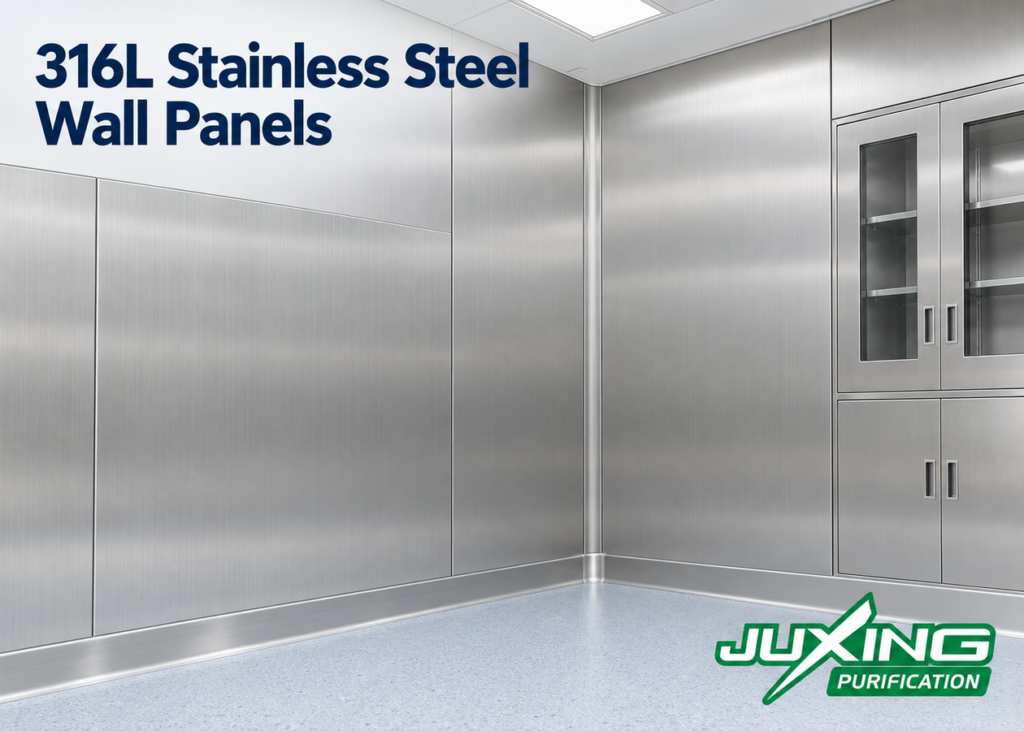
316L stainless steel wall panels are frequently specified for operating theaters where corrosion resistance, cleanability, impact tolerance, and long service life are important. However, the material grade alone does not determine whether the finished wall will perform successfully.
Designers and buyers must also consider sheet thickness, surface finish, backing construction, fabrication quality, joint details, cleaning chemicals, service penetrations, and interfaces with doors, ceilings, floors, and built-in equipment.
A 316L stainless steel facing does not automatically make the complete wall system airtight, fire-rated, structurally load-bearing, radiation-protective, or compliant with a particular healthcare standard. These properties must be evaluated at system level and documented against the project specification.
Quick Answer
316L stainless steel is an austenitic stainless-steel grade containing molybdenum and having a lower carbon content than conventional 316. It generally offers better resistance to localized corrosion than 304 stainless steel, particularly in environments where chlorides or aggressive cleaning agents may be present.
For operating theater walls, 316L can be used as:
- An exposed single-skin metal wall panel
- A fabricated facing bonded to a gypsum or other approved backing board
- Part of a framed modular wall assembly
- A removable access panel
- A protective finish around scrub areas, equipment zones, and other demanding locations
Successful specification requires more than writing “316L stainless steel panel.” The tender documents should define the material standard, sheet thickness, surface finish, grain direction, backing construction, edge treatment, joint design, fabrication method, cleaning compatibility, and required inspection records.
Key Takeaways
- 316L generally provides greater resistance to chloride-related localized corrosion than 304, but it is not corrosion-proof.
- The exposed finish can be brushed, satin, polished, bead-blasted, mill-finished, or coated, depending on project requirements.
- A finish description such as “brushed stainless steel” is incomplete unless the required appearance, direction, sample, and acceptance criteria are defined.
- Sheet thickness alone does not determine panel stiffness or impact resistance; panel size, folds, backing, reinforcement, and fixing method are also important.
- Fabrication can reduce corrosion resistance if surfaces are contaminated by carbon steel or if heat tint and residues are not properly treated.
- Cleaning chemicals must be checked against the actual surface condition and manufacturer recommendations.
- 316L facing is not a substitute for structural support, fire testing, airtight joint design, or radiation shielding.
- A physical finish sample is often more useful than relying only on an abstract finish designation.
Why Are 316L Stainless Steel Wall Panels Specified?
316L stainless steel wall panels may be selected when an operating theater project requires a durable, non-porous, and corrosion-resistant exposed surface.
Typical reasons include:
- Frequent cleaning and disinfection
- Possible exposure to chloride-containing substances
- High humidity or condensation risk
- Greater resistance to impact and abrasion than some decorative coatings
- Compatibility with fabricated corners, closures, and equipment interfaces
- A long service life where damaged finishes would be difficult to repair
- Project-specific hygiene or architectural requirements
The use of 316L should nevertheless be based on an environmental and lifecycle assessment. It may not be necessary for every wall surface in every operating theater.
Some projects use 304 stainless steel in general areas and reserve 316L for scrub zones, lower wall sections, wet areas, door protection, or locations exposed to more aggressive cleaning. Other projects specify one grade throughout to simplify appearance and procurement.
The final decision should reflect the cleaning regime, chemical exposure, expected damage, project budget, hospital maintenance practices, and applicable specification.
For a broader review of system arrangements, see the modular operating theater wall and ceiling systems guide.
What Is the Difference Between 304 and 316L Stainless Steel?
Both 304 and 316L are commonly used austenitic stainless steels. The principal practical distinction is that 316L contains molybdenum, which normally improves resistance to localized corrosion such as pitting and crevice corrosion in chloride-containing environments.
The “L” indicates a low-carbon grade. Lower carbon content helps reduce the risk of sensitization and intergranular corrosion associated with certain welding and high-temperature fabrication conditions.
| Selection factor | 304 stainless steel | 316L stainless steel |
|---|---|---|
| General indoor corrosion resistance | Good in many controlled environments | Good |
| Resistance to chloride-related pitting | Lower than 316L | Generally higher |
| Molybdenum content | Normally not intentionally added | Normally included |
| Welded fabrication | Widely used | Low carbon content is advantageous for welded work |
| Typical cost | Usually lower | Usually higher |
| Suitability for every hospital chemical | Must be verified | Must still be verified |
| Corrosion-proof | No | No |
This comparison does not mean that 316L is universally superior. Surface condition, fabrication contamination, chloride concentration, temperature, contact time, deposits, rinsing, and maintenance can affect corrosion performance.
Material names must also be coordinated with the applicable product standard. EN 1.4404 and UNS S31603 are commonly associated with 316L, but the purchase specification should identify the required standard rather than assuming all designations and product forms are automatically interchangeable.
How Should the Stainless-Steel Grade Be Specified and Verified?
A clear procurement specification should state more than the commercial name “316L.”
Depending on the project and purchasing standard, the documents may define:
- Stainless-steel grade and recognized standard
- Product form, such as cold-rolled sheet
- Nominal thickness and permitted tolerance
- Surface finish
- Required flatness and appearance
- Protective film requirements
- Fabrication and edge treatment
- Documentation and traceability requirements
- Inspection certificate type, where required
An EN 10204 type 3.1 inspection certificate may be requested for material traceability, but it is not automatically mandatory for every operating theater project. The contractual requirement should be stated before procurement.
Positive material identification may also be required for selected projects or critical components. PMI should be treated as a project-specific quality-control measure, not as a universal requirement for every wall panel.
Buyers should confirm whether certificates relate to the actual production batch supplied, rather than accepting a generic technical data sheet as proof of material grade.
Which Surface Finish Is Suitable for an Operating Theater?
The surface finish influences cleanability, appearance, glare, scratch visibility, fabrication consistency, and maintenance. There is no single stainless-steel finish that is internationally mandatory for all operating theater walls.
| Surface option | Possible advantages | Points requiring attention |
|---|---|---|
| 2B mill finish | Smooth, economical, readily available | Appearance may vary between coils or batches |
| Brushed or satin finish | Controlled architectural appearance; minor marks may be less noticeable | Grain direction and finish consistency must be specified |
| Fine polished finish | Smooth appearance and potentially easier visual cleaning inspection | Can show fingerprints, reflections, or fabrication variation |
| Mirror finish | Highly reflective decorative appearance | Glare and image reflection may be unsuitable for clinical rooms |
| Bead-blasted finish | Uniform low-reflectance appearance when controlled correctly | Cleaning behavior and batch consistency require evaluation |
| Powder-coated 316L | Allows selected colors and reduces metallic appearance | Coating adhesion, damage repair, and chemical resistance must be specified |
Terms such as “No. 4,” “satin,” and “hairline” may be interpreted differently by different suppliers. The design team should approve a physical sample that represents the proposed sheet, grain, gloss, color, and fabrication method.
If a numerical surface roughness value is required, the specification should state how and where it will be measured. A generic roughness limit should not be presented as a universal operating theater requirement unless it is supported by the relevant project standard.
Powder coating over 316L is possible, but it creates a coated surface whose performance depends on pretreatment, coating formulation, curing, adhesion, and resistance to hospital cleaning chemicals. The coating should be specified and evaluated separately rather than assuming that the underlying stainless-steel grade guarantees the performance of the exposed finish.
How Do Sheet Thickness and Panel Construction Affect Performance?
The selected sheet thickness affects forming, dent resistance, weight, cost, and handling. However, thickness must be considered together with the complete panel construction.
For example, a relatively thin stainless-steel sheet bonded continuously to a stable backing board may feel stiffer than a thicker unsupported sheet over a large span. Conversely, poor bonding, excessive panel width, weak perimeter folds, or insufficient reinforcement can result in oil-canning, drumming, or visible distortion.
Relevant variables include:
- Sheet thickness and manufacturing tolerance
- Panel height and width
- Fold depth and edge-return geometry
- Backing-board type and thickness
- Adhesive coverage and curing
- Intermediate stiffeners
- Frame spacing
- Joint location
- Openings for services and built-in equipment
- Transportation and installation handling
A nominal thickness such as 0.8 mm, 1.0 mm, or 1.2 mm may be selected by a manufacturer or project consultant, but these figures are not universal international requirements for operating theater walls.
Where metal facings are combined with gypsum backing, the backing should be selected as part of the complete wall design. The operating theater wall panel comparison explains the distinction between single-skin metal facings and prefabricated sandwich constructions.
Why Does Fabrication Quality Matter?
Stainless steel can arrive at the factory with appropriate corrosion resistance and still be damaged by poor fabrication practices.
Common fabrication risks include:
- Contact with carbon-steel dust or grinding particles
- Use of contaminated tools or worktables
- Scratches beneath damaged protective film
- Heat tint around welded areas
- Rough or unsealed cut edges
- Inconsistent grain direction
- Excessive deformation during bending
- Adhesive marks or residues on the exposed face
- Uncontrolled repair polishing
- Storage in wet or chemically contaminated conditions
Fabrication areas should separate stainless-steel work from carbon-steel operations where practical. Dedicated or properly cleaned tools should be used to reduce embedded iron contamination.
Welded or heat-affected surfaces may require appropriate cleaning, pickling, passivation, or mechanical finishing, depending on the fabrication process and specified appearance. Passivation is a controlled treatment, not a substitute for removing weld scale, heat tint, grease, or embedded contaminants.
Any chemical treatment must be carried out using a documented procedure, with suitable safety controls and final rinsing.
How Should Grain Direction and Visual Consistency Be Controlled?
Directional finishes are particularly sensitive to inconsistent fabrication. Adjacent panels with different grain directions can appear to have different colors even when manufactured from the same stainless-steel grade.
The production drawings should therefore indicate:
- Required grain direction
- Orientation of panels around doors and windows
- Direction on horizontal closures and corner trims
- Treatment of replacement and removable panels
- Whether sheets should come from the same production batch
- Acceptance criteria for gloss and shade variation
Vertical grain direction is frequently selected for full-height wall panels, but this is an architectural and manufacturer-specific choice rather than a universal technical rule.
The approved sample should be viewed under lighting similar to the completed operating theater. Reflections from luminaires, laminar airflow ceilings, monitors, and colored finishes can change the apparent shade of stainless steel.
Are 316L Stainless Steel Walls Resistant to All Cleaning Chemicals?
No. Stainless steel is corrosion-resistant, but it is not resistant to every chemical at every concentration and contact time.
Cleaning and disinfection performance can be affected by:
- Chloride concentration
- Hypochlorite concentration
- Solution temperature
- Surface deposits
- Contact duration
- Frequency of use
- Rinsing procedure
- Water quality
- Scratches and crevices
- Residues from incompatible cleaning products
Concentrated or improperly used chloride-containing cleaners may cause staining or pitting, including on 316L. The hospital should use cleaning agents and concentrations approved for the actual wall finish and follow the chemical supplier’s instructions.
The wall supplier should provide reasonable care and maintenance guidance, but the final cleaning protocol should be coordinated with the hospital’s infection-control and environmental-services teams.
A small-area compatibility trial may be appropriate before introducing a new chemical across the completed room.
How Should Joints and Edges Be Detailed?
The exposed sheet material is only one part of a hygienic wall system. Joint performance depends on edge geometry, seals, gaskets, fasteners, backing, movement allowance, and workmanship.
The design should address:
- Vertical panel joints
- Horizontal joints in multi-section walls
- Internal and external corners
- Door-frame interfaces
- Window frames
- Cabinet openings
- Medical gas and electrical penetrations
- Wall-to-ceiling junctions
- Wall-to-floor junctions
- Removable access panels
Folded edges should avoid uncontrolled sharp projections and inaccessible dirt traps. Sealant or removable gasket joints should be selected according to the intended maintenance and access strategy.
Using stainless steel does not eliminate the need to coordinate intersecting joints. In three-section wall arrangements, horizontal and vertical joint intersections must be detailed so that seals remain continuous and panels can be installed or removed in the intended sequence.
See the three-section modular operating theater wall guide for further information about panel zoning and interface coordination.
Can Stainless-Steel Wall Panels Be Removable?
Yes. Stainless-steel panels can be incorporated into removable wall systems, provided that the fixing method, panel weight, joint seals, and access sequence are designed accordingly.
A removable system may use:
- Rear-hook fixing
- Concealed clips
- Mechanical retainers
- Demountable trims
- Removable gasket joints
- Project-specific framed access panels
The design must allow the panel to be removed without uncontrolled bending or damage to adjacent finishes. Large stainless-steel panels may require lifting handles, suction tools, multiple installers, or a planned removal sequence.
Service access should not be assumed merely because the panel uses concealed fixings. The location of frames, equipment, cabinets, and ceiling closures may prevent removal unless coordinated during design.
More detail is available in the removable operating theater wall panel guide.
Do 316L Panels Make the Wall Airtight or Fire-Rated?
No. A metal facing may have very low air permeability, but room airtightness depends on the complete enclosure.
Potential leakage paths include:
- Panel joints
- Door and window perimeters
- Ceiling interfaces
- Floor junctions
- Service penetrations
- Medical gas boxes
- Electrical outlets
- Cabinet openings
- Access panels
- Unsealed void connections
Room pressure can be maintained even when some enclosure leakage exists. Positive pressure therefore does not prove that every panel joint is completely airtight.
Fire performance must also be assessed for the complete wall assembly. Relevant components can include the stainless-steel facing, backing board, insulation or core, framing, adhesive, gasket, sealant, fasteners, service penetrations, and fire-stopping materials.
The fact that stainless steel is non-combustible does not establish a fire-resistance rating for the assembled wall.
Can 316L Stainless Steel Provide Radiation Protection?
A normal stainless-steel wall facing should not be treated as diagnostic radiation shielding.
Where an operating theater includes mobile or fixed imaging equipment, a qualified radiation-protection specialist should determine:
- Required shielding locations
- Design workload and occupancy assumptions
- Required lead equivalence
- Shielding continuity
- Door and observation-window protection
- Treatment of penetrations
- Inspection and testing requirements
Lead sheet or another calculated shielding material may be installed behind a stainless-steel facing, but its continuity must be coordinated through joints, corners, doors, windows, and service openings.
The decorative stainless-steel layer and the radiation barrier should be specified as separate functional components.
What Should Be Included in the Tender Specification?
A practical specification for 316L stainless steel wall panels should define the complete requirement rather than leaving critical decisions until production.
The schedule may include:
| Specification item | Information to define |
|---|---|
| Material | Grade, reference standard, and required certification |
| Sheet | Nominal thickness and tolerance |
| Finish | Finish designation, grain direction, gloss, color, and approved sample |
| Panel construction | Single skin, bonded backing, sandwich construction, or framed assembly |
| Backing | Board type, thickness, moisture classification, and fixing method |
| Panel dimensions | Module widths, heights, and permitted variation |
| Edges | Folded returns, corner treatment, and exposed-edge restrictions |
| Joints | Width, gasket or sealant type, color, and removability |
| Reinforcement | Requirements for cabinets, equipment, and accessories |
| Interfaces | Doors, windows, ceilings, floors, and service penetrations |
| Cleaning | Approved chemical limitations and care instructions |
| Documentation | Drawings, samples, certificates, and inspection records |
| Protection | Factory film, packaging, transport, and removal procedure |
| Acceptance | Flatness, scratches, dents, shade variation, and joint alignment |
The specification should also establish who coordinates openings and interfaces. JUXING can manufacture modular wall systems and associated operating theater components, while complete AHUs, main ductwork, cooling plants, central HVAC controls, and complete HVAC installation are not normally included in JUXING’s supply scope.
Buyer’s Checklist
Before approving a stainless-steel wall package, confirm the following:
- Is 316L required throughout the room or only in selected zones?
- Is the material standard clearly identified?
- Are batch-specific material certificates required?
- Has the sheet thickness been coordinated with panel size and backing?
- Is the surface finish defined by both designation and approved sample?
- Is the grain direction shown on production drawings?
- Have reflection and glare been reviewed under representative lighting?
- Are cleaning chemicals compatible with the proposed finish?
- Are all cut edges, folds, welds, and corners properly detailed?
- Are stainless-steel fabrication tools protected from carbon-steel contamination?
- Are removable panels genuinely accessible after other components are installed?
- Have door, window, cabinet, and service interfaces been coordinated?
- Are heavy accessories independently supported or locally reinforced?
- Has any required fire performance been assessed for the complete assembly?
- Has radiation shielding been separately designed where imaging is present?
- Are packaging, protective film, and site handling procedures defined?
- Are visual acceptance criteria agreed before mass production?
Common Misconceptions
“316L stainless steel can never corrode.”
Incorrect. It offers strong corrosion resistance, but inappropriate chemicals, chlorides, deposits, contamination, crevices, or poor fabrication can still cause staining or localized corrosion.
“A thicker sheet always produces a better wall panel.”
Not necessarily. Panel dimensions, folds, backing, reinforcement, bonding, and fixing methods can be equally important.
“A brushed finish is a complete specification.”
No. Grain size, direction, gloss, consistency, sample approval, and fabrication repair methods may also need to be defined.
“Stainless steel automatically creates an airtight operating theater.”
No. Airtightness depends on the complete enclosure, including every joint, opening, interface, and penetration.
“A stainless-steel wall is automatically fire-rated.”
No. Fire resistance is determined by the tested or assessed complete wall assembly.
“316L wall panels can replace lead shielding.”
No. Radiation shielding must be calculated and detailed separately by a qualified specialist.
“Powder-coated 316L retains all the surface benefits of exposed stainless steel.”
The substrate remains 316L, but the exposed surface performance is governed primarily by the coating until that coating is damaged or removed.
Expert Tip
Approve a full-size fabricated sample rather than a small flat sheet alone. The sample should include at least one joint, a folded edge, a corner or frame interface, the proposed backing, and the final surface finish.
This allows the project team to review flatness, grain direction, reflections, joint alignment, edge quality, color consistency, cleaning behavior, and removal method before mass production. The approved sample can then serve as a practical reference during factory inspection and site acceptance.
Frequently Asked Questions
Is 316L mandatory for operating theater walls?
No universal international rule requires 316L for every operating theater wall. The required grade depends on the project specification, cleaning regime, environmental exposure, risk assessment, and local healthcare requirements.
Is 316L always better than 304?
It generally offers better resistance to localized corrosion in chloride-containing conditions, but it costs more and may not provide a meaningful lifecycle advantage in every controlled indoor environment.
What sheet thickness should be used?
There is no universal thickness. The appropriate value depends on panel dimensions, backing, folds, reinforcement, fixing method, impact requirements, and manufacturer engineering.
Is brushed stainless steel easy to clean?
It can provide a cleanable surface when properly fabricated and maintained. Cleaning should normally follow the grain direction, and the specified disinfectants must be compatible with the finish.
Can the panels be installed over gypsum board?
Yes. Stainless-steel facings can be bonded or mechanically integrated with an appropriate gypsum-based backing, provided the board type, adhesive, moisture conditions, panel dimensions, and fire requirements are correctly evaluated.
Should all panels come from the same coil or batch?
Using material from the same coil or controlled batch can help reduce visual variation, particularly with directional finishes. This should be stated in the specification if appearance consistency is critical.
Can operating theater equipment be fixed directly to the panel?
The thin stainless-steel facing should not be treated as the primary structural support. Equipment loads should transfer to suitable reinforcement, framing, or independent building structure.
When should material certificates be requested?
Certificates should be requested when the contract requires traceability or verification of material grade. The required certificate type and relationship to the supplied batch should be defined before ordering.
Conclusion
316L stainless steel wall panels can provide a durable and corrosion-resistant finish for modular operating theaters, but their performance depends on much more than the stainless-steel designation.
A reliable wall package requires coordinated decisions covering grade verification, sheet thickness, backing, finish, grain direction, fabrication, cleaning compatibility, joint design, service openings, and interface details. Fire resistance, airtightness, structural support, and radiation protection must each be assessed as separate system-level requirements.
By defining these requirements in the tender documents and approving representative fabricated samples before production, project teams can reduce visual inconsistencies, installation conflicts, premature surface damage, and unsupported performance assumptions.