
Introduction
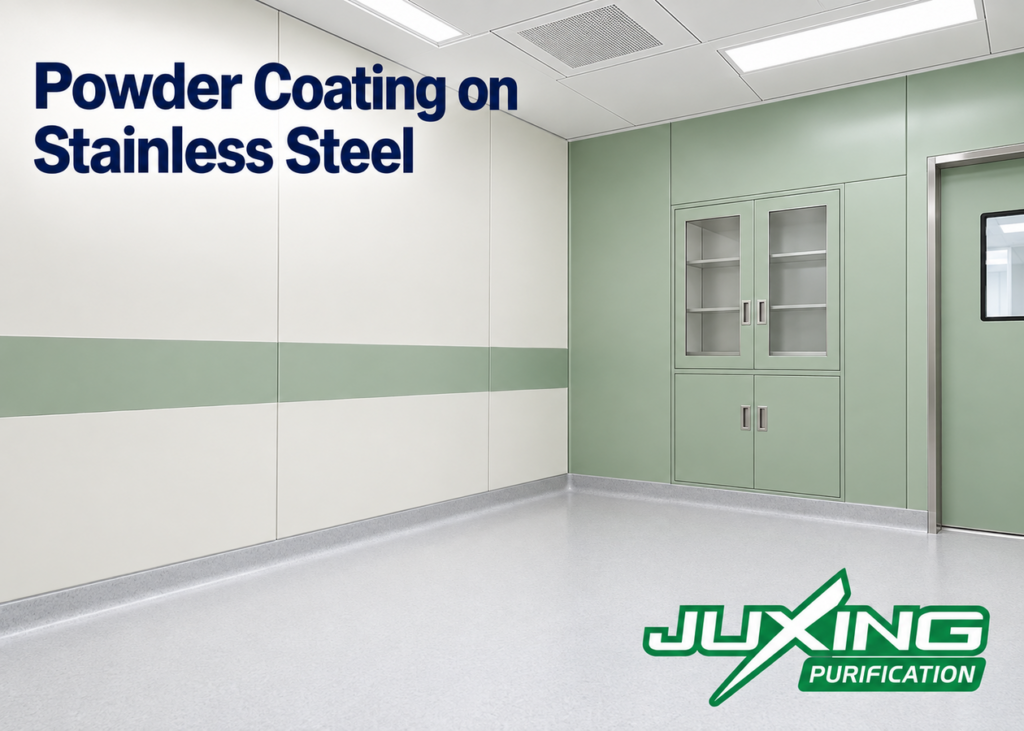
Powder coating on stainless steel allows modular operating theater wall panels to combine a stainless-steel substrate with a controlled color, gloss, and surface appearance. When 316L is specified, the underlying metal retains its material characteristics, but the exposed surface becomes a coating system whose performance depends on preparation, application, curing, and maintenance.
This distinction matters in procurement. A specification stating only “0.8 mm 316L stainless steel with powder coating” does not define coating adhesion, disinfectant resistance, finish consistency, edge coverage, or compatibility with removable panel joints.
This article explains how to specify and evaluate powder-coated stainless-steel wall panels, with particular attention to thin 316L facings used in modular operating theaters.
Quick Answer
Stainless steel can be powder-coated, but a production process suitable for galvanized or carbon steel should not automatically be assumed suitable for 316L.
A reliable coating package requires:
- A verified stainless-steel substrate
- A preparation process approved for that substrate
- A defined powder product and finish
- A curing schedule based on the selected product’s technical data
- Controlled coating thickness and coverage
- Representative adhesion and cleaning-compatibility tests
- Coordination with folds, gasket grooves, backing materials, and fixing components
The stainless-steel grade does not guarantee coating performance. Equally, a successful coating test does not establish that the complete wall is airtight, fire-rated, antimicrobial, or compliant with operating theater ventilation requirements.
Key Takeaways
- Powder-coated 316L presents a coated surface—not an exposed stainless-steel finish.
- Surface preparation must be selected for stainless steel rather than copied from another substrate.
- Oven air temperature alone does not demonstrate correct curing; the component must meet the powder supplier’s specified time–temperature conditions.
- Thin stainless-steel facings require careful handling and support to control distortion.
- Coating thickness must be coordinated with gasket grooves, hooks, slots, and mating parts.
- Chemical resistance must be checked against the hospital’s actual cleaning products and procedures.
- Color codes alone do not define gloss, texture, shade tolerance, or repair appearance.
- Factory coating should be coordinated with the subsequent bonding and assembly process.
Why Use Powder Coating on Stainless Steel?
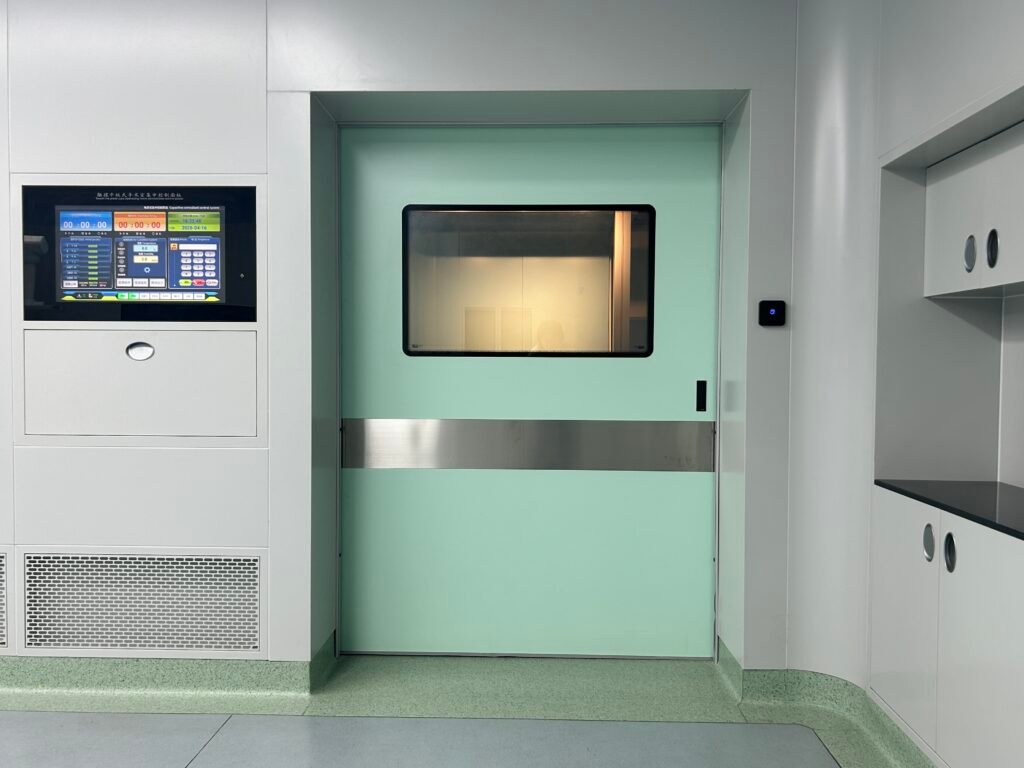
Powder coating on stainless steel may be selected when a project requires colored metal wall panels while retaining a stainless-steel substrate.
Potential reasons include:
- Architectural color coordination
- Reduced metallic reflections
- Consistent appearance across wall panels, trims, and cabinets
- A specified stainless-steel material beneath the finish
- Project-specific maintenance or corrosion-resistance considerations
However, the additional material cost should have a clear justification. If the coating remains intact, cleaning staff interact primarily with the coating rather than the underlying metal.
The substrate becomes particularly relevant at exposed edges, uncoated rear areas, openings, or damaged locations. Even there, performance depends on the actual exposure and fabrication quality.
Buyers should therefore ask two separate questions:
- Why is stainless steel required?
- What must the exposed coating withstand?
For the wider choice of wall construction, see the operating theater wall panel comparison.
How Does Powder-Coated 316L Differ from Other Wall Finishes?
The following comparison separates substrate performance from exposed-surface performance.
| Wall finish | Exposed surface | Main specification concern |
|---|---|---|
| Uncoated 316L stainless steel | Stainless steel | Grade, finish, fabrication condition, and cleaning compatibility |
| Powder-coated 316L | Powder coating | Coating performance plus stainless-steel substrate verification |
| Powder-coated galvanized steel | Powder coating | Coating performance, pretreatment, and protection of the underlying steel |
| Powder-coated aluminum | Powder coating | Aluminum preparation, coating performance, and panel construction |
A common powder product may be suitable for more than one substrate, but that does not make the preparation procedures interchangeable.
Test results obtained on pretreated galvanized steel also do not automatically prove performance on stainless steel. The substrate and preparation used for testing should be identified.
What Surface Preparation Does Stainless Steel Need?
Stainless steel forms a passive surface film that supports corrosion resistance. That does not, by itself, establish reliable adhesion for a particular coating.
Before application, the surface must be free from contamination that could interfere with bonding, including:
- Oil and grease
- Protective-film adhesive
- Fingerprints
- Polishing compounds
- Fabrication residues
- Embedded carbon-steel particles
- Cleaning-agent residues
Depending on the selected coating system, preparation may involve controlled mechanical abrasion, blasting, chemical treatment, or a combination of processes.
The correct route should be agreed with the powder and pretreatment suppliers. Requirements should address the actual grade, initial finish, panel geometry, and intended service conditions.
Avoid specifying “sandblast before coating” without defining the process. Excessive or uneven blasting can distort thin sheet, create inconsistent surface profiles, or introduce contamination if unsuitable media is used.
Likewise, a phosphate process intended for carbon steel should not be assumed effective on stainless steel without confirmation.
Which Powder Formulation Should Be Selected?
“Powder coating” describes a finishing process, not one universal material.
Common thermosetting powder families include epoxy, polyester, and epoxy–polyester hybrids. Their properties vary by formulation, additives, pigment, cure conditions, and intended application.
For operating theater walls, selection should consider:
- Resistance to the specified detergents and disinfectants
- Repeated wiping and abrasion
- Color and gloss stability
- Flexibility where fabrication or movement is relevant
- Resistance to impact damage
- Intended indoor exposure
- Compatibility with sealants and gasket materials
- Repair and replacement strategy
A generic statement such as “polyester powder is suitable for hospitals” is insufficient. The specific product should be identified and supported by relevant technical information.
If antimicrobial properties are requested, the specification should identify the test method, organisms, exposure conditions, and supporting evidence. An antimicrobial additive does not replace routine cleaning or demonstrate a reduction in hospital infection rates.
How Should Curing Be Controlled?
Curing must follow the selected powder product’s technical data sheet.
An important distinction is the difference between oven air temperature and component temperature. The metal takes time to heat, and the required curing period must be interpreted according to the powder supplier’s instructions.
For example, an official Interpon technical data sheet expresses curing schedules at object temperature and gives a product-specific recommended film thickness. These values illustrate why neither one temperature nor one thickness should be applied to every powder-coated wall panel. Interpon technical data sheet.
For production control, the manufacturer should establish a suitable oven profile for representative panels. Relevant variables include:
- Panel dimensions and sheet thickness
- Rack arrangement
- Oven loading
- Component geometry
- Air circulation
- Heating rate
- Time at the required component temperature
Under-curing can reduce the expected coating performance. Excessive thermal exposure can also affect appearance or properties, depending on the product.
A visually acceptable finish is therefore not sufficient evidence of correct curing.
Should the Metal Be Coated Before or After Bonding to Gypsum Board?
The coating and bonding sequence should be decided before panel production.
For conventional oven-cured powders, coating the fabricated metal facing before bonding it to gypsum board is often a practical approach. It avoids exposing the backing board and adhesive to the coating oven’s thermal cycle.
However, this sequence creates additional coordination requirements:
- Which rear surfaces will remain available for bonding?
- Is the adhesive approved for bare stainless steel, the coating, or both?
- Are bonding areas masked?
- How is the finished face protected during assembly?
- Can the assembly process damage coated folds or edges?
- Does the adhesive cure require pressure or temperature that could affect the finish?
If coating is proposed after bonding, the supplier must demonstrate that the entire assembly—including board, adhesive, reinforcement, and inserts—is compatible with the preparation and curing process.
Specialized low-temperature systems exist, but their availability does not establish suitability for a particular bonded operating theater panel.
How Can Thin 316L Facings Be Protected Against Distortion?
Thin stainless-steel sheet can be affected by forming stresses, thermal exposure, handling, and uneven support.
A nominal 0.8 mm facing may be a valid manufacturer or project choice, but it is not an international operating theater standard.
Distortion control should consider:
- Panel width and height
- Fold geometry
- Fabrication sequence
- Hanging points
- Oven-rack support
- Preparation intensity
- Handling after cooling
- Backing-board flatness
- Adhesive application and assembly pressure
Large panels should be inspected under representative lighting, because shallow waviness can become visible when light strikes the surface at an angle.
Flatness should be assessed on the completed panel—not only on the uncoated sheet.
How Does Coating Thickness Affect Removable Joints?
Coating thickness is important both for surface performance and dimensional fit.
Excessive buildup can interfere with:
- Gasket-retaining grooves
- Rear-hook engagement
- Slotted fixing holes
- Concealed clips
- Door-frame interfaces
- Trim connections
- Panel-to-panel clearances
Conversely, insufficient coverage at exposed edges or recesses can leave weak points in the finish.
Electrostatic application can produce uneven deposition around complex shapes and recessed areas. The manufacturer should review representative folded sections rather than relying only on measurements taken from a flat central area.
Where necessary, drawings should identify:
- Coated surfaces
- Masked surfaces
- Permitted coating buildup
- Critical mating dimensions
- Areas requiring additional inspection
A removable gasket must still fit, seal, and be replaceable after coating. Its performance cannot be confirmed from the uncoated groove dimensions alone.
For system-level context, see the removable operating theater wall panel guide.
How Should Color, Gloss, and Texture Be Defined?
A color reference does not fully define the finished appearance.
Panels sharing the same color code can still differ in:
- Gloss
- Texture
- Shade
- Surface waviness
- Orange-peel appearance
- Reflection under different lighting
- Appearance after repair
The finish specification should include a physical sample and agreed viewing conditions.
For operating theater walls, a relatively smooth finish may support easier wiping than a pronounced texture, but cleanability must be evaluated for the actual coating. A textured finish should not be selected merely to conceal fabrication defects.
Production planning should also address batch consistency. Replacement panels manufactured later may show visible differences even when ordered under the same color reference.
Retaining finish records and suitable spare panels can help manage this risk.
How Should Resistance to Hospital Cleaning Be Evaluated?
Chemical compatibility should be assessed using the hospital’s intended cleaning regime.
The review should identify:
- Product names and active ingredients
- Working concentrations
- Contact times
- Application frequency
- Wiping materials
- Rinsing requirements
- Whether residues remain on the surface
- Any occasional intensive cleaning procedures
Tests should use representative coated stainless-steel specimens produced with the proposed preparation and curing process.
Assessment can include changes in:
- Color and gloss
- Tackiness or softening
- Blistering
- Cracking
- Staining
- Adhesion
- Surface wear after repeated wiping
A brief exposure test may be useful, but it does not necessarily represent years of repeated cleaning.
Avoid claims such as “resistant to all hospital disinfectants.” Compatibility should be limited to the products and conditions actually evaluated.
What Tests and Inspection Records Should Buyers Request?
The inspection plan should distinguish between process qualification, routine production checks, and completed-panel acceptance.
| Check | Purpose | Important limitation |
|---|---|---|
| Substrate documentation | Verify the specified stainless-steel grade | A coating report does not prove metal grade |
| Film-thickness measurement | Check the agreed coating range | Flat-area readings may not represent edges or grooves |
| Cross-cut test | Assess resistance to coating separation under a defined method | It does not prove long-term chemical resistance |
| Cure verification | Confirm conformity with the powder supplier’s process | Appearance alone is insufficient |
| Cleaning-compatibility trial | Evaluate specified chemicals and procedures | Results apply to the tested conditions |
| Visual inspection | Review color, gloss, defects, and consistency | Viewing conditions must be agreed |
| Completed-panel fit check | Verify joints, hooks, seals, and interfaces | Flat coupons cannot demonstrate assembly fit |
ISO 2409 provides a cross-cut test method for assessing resistance to coating separation. It is a test method, not a complete operating theater coating specification; the contract must define the required result and sampling plan. ISO cross-cut test information.
Testing on representative witness specimens can avoid destructive checks on finished visible panels. The specimens should nevertheless be traceable to the relevant substrate, preparation, powder, and production conditions.
Can Damaged Powder-Coated Panels Be Repaired on Site?
Minor damage may be repairable using an approved touch-up system. However, a liquid repair coating does not necessarily reproduce the appearance or performance of factory-applied powder.
Possible differences include:
- Color
- Gloss
- Texture
- Film thickness
- Chemical resistance
- Visible repair boundaries
The acceptance criteria should distinguish between concealed repairs and repairs on prominent clinical surfaces.
For substantial peeling, widespread defects, or unacceptable appearance, panel replacement may be more appropriate than local touch-up. Removable wall construction can assist replacement, provided access and removal sequences have been coordinated.
Repair procedures should also address cleaning, contamination control, ventilation, and any restrictions associated with work in an operational hospital.
Does Powder-Coated 316L Establish Wall-System Compliance?
No. Coating performance is only one part of the wall package.
It does not independently establish:
- Room airtightness
- Fire resistance
- Structural load capacity
- Radiation protection
- Cleanroom classification
- Compliance with operating theater ventilation requirements
Fire performance must consider the complete assembly, including coating, metal facing, backing board, adhesive, core, framing, seals, and penetration treatment.
Heavy equipment should transfer its loads to appropriate reinforcement or independent structure, not to the thin coated facing.
JUXING can manufacture modular wall systems and associated operating theater components. The project team should coordinate the coating requirements with the complete enclosure and the hospital’s maintenance procedures.
Buyer’s Checklist
Before approving production, confirm:
- Is the stainless-steel substrate justified and clearly specified?
- Is the exact powder product identified?
- Is preparation approved for 316L rather than assumed from another substrate?
- Has a representative fabricated sample been approved?
- Are color, gloss, texture, and viewing conditions defined?
- Is the coating thickness range product-specific?
- Have grooves, hooks, slots, and mating surfaces been checked after coating?
- Is the curing process validated for representative panels?
- Is coating sequenced correctly with backing-board bonding?
- Are bonding and masking areas shown on drawings?
- Have the intended cleaning chemicals been evaluated?
- Are inspection methods, sampling, and acceptance criteria agreed?
- Is protection during assembly, transport, and installation defined?
- Are touch-up limitations and replacement procedures documented?
- Are spare-panel and finish-traceability requirements included?
Common Misconceptions
“316L guarantees that the powder coating will adhere.”
It does not. Adhesion depends on preparation, the coating product, application, curing, and surface condition.
“The galvanized-steel coating process can be used unchanged.”
Not automatically. Stainless steel requires a preparation route confirmed for the actual substrate.
“A thicker coating is always better.”
No. Excessive buildup can affect appearance, curing, flexibility, and dimensional fit.
“The oven reached its set temperature, so curing is complete.”
Not necessarily. The component must satisfy the selected powder’s specified curing conditions.
“The same color code guarantees an exact match.”
No. Gloss, texture, batch variation, and lighting can create visible differences.
“Antimicrobial powder replaces disinfection.”
No. Any supported antimicrobial claim remains separate from routine hospital cleaning and infection-control procedures.
Expert Tip
Qualify one representative folded panel before coating the complete order. Include the actual stainless-steel thickness, a gasket groove, a rear fixing feature, an exposed edge, and the intended backing arrangement.
Use this sample to review coating coverage, fit, flatness, appearance, cleaning compatibility, and the assembly sequence. A flat color swatch cannot reveal these manufacturing and installation risks.
Frequently Asked Questions
Can 316L stainless steel be powder-coated?
Yes. The process must use preparation and curing conditions suitable for the selected substrate and powder product.
Is a primer always required?
No universal rule applies. Some systems use a primer; others do not. Follow the approved coating-system specification.
What coating thickness should be specified?
Use the selected product’s recommended range, adjusted only through an agreed technical assessment. There is no universal thickness for every operating theater wall finish.
Can gypsum-backed panels go through the coating oven?
Only if the complete bonded assembly is demonstrated to be compatible. For conventional processes, coating the metal before bonding is often more practical.
Does powder coating make 316L resistant to every disinfectant?
No. The exposed coating must be evaluated against the specified chemicals, concentrations, and contact conditions.
Can coating affect removable-panel operation?
Yes. Buildup in grooves, hooks, and mating parts can affect installation, sealing, or removal.
Should every finished panel receive a destructive adhesion test?
Not necessarily. The quality plan may use representative witness specimens and defined sampling, supported by routine production inspection.
Can replacement panels match years later?
A close match may be possible, but an exact match cannot be assumed. Retained finish records and planned spare panels help reduce uncertainty.
Conclusion
Powder coating on stainless steel can provide a controlled colored finish for modular operating theater walls, but reliable performance requires a qualified manufacturing process and a complete procurement specification.
For 316L panels, the essential decisions include substrate preparation, powder selection, curing, coating thickness, backing-board assembly, joint fit, cleaning compatibility, and repair strategy.
Approving representative fabricated samples and agreeing inspection criteria before production helps project teams identify problems that material certificates and flat color swatches cannot reveal.