
Introduction
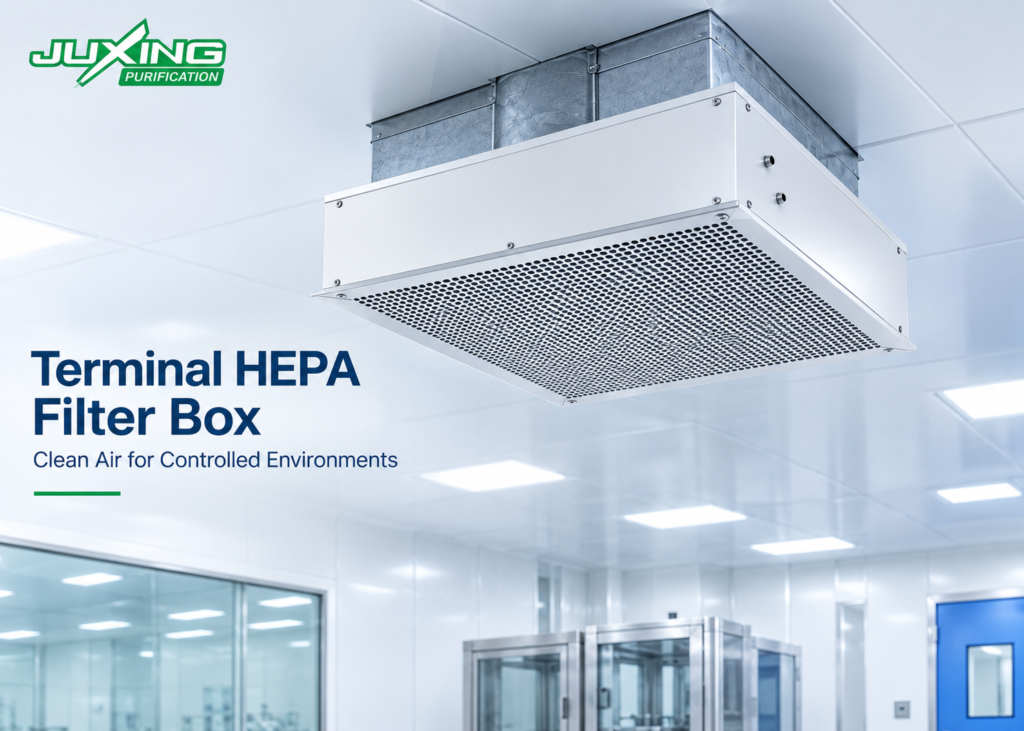
Terminal HEPA filter boxes are one of the final components in a cleanroom ventilation system. Installed at the end of the air distribution ductwork, they house the final HEPA filter before conditioned air enters the controlled environment.
Unlike an Air Handling Unit (AHU), which conditions and distributes large volumes of air, or a Fan Filter Unit (FFU), which integrates a fan and filter into one ceiling-mounted module, a terminal HEPA filter box provides final-stage filtration using pressurized air supplied by the central HVAC system.
Terminal HEPA filter boxes are widely used in pharmaceutical manufacturing, biotechnology laboratories, electronics production, medical device facilities, hospital operating theatres, and other controlled environments where clean, filtered air must be delivered directly into the room.
This guide explains how terminal HEPA filter boxes work, their main components, common types, applications, and the factors buyers should consider when selecting the right solution.
What Is a Terminal HEPA Filter Box?
A terminal HEPA filter box, also known as a HEPA air supply outlet, terminal filter housing, or HEPA terminal module, is an air distribution device installed at the end of an HVAC duct system.
Its primary purpose is to:
- Hold the final HEPA filter securely
- Distribute filtered air evenly into the cleanroom
- Provide a sealed interface between the ductwork and the room
- Support airflow balancing and maintenance
Unlike a diffuser used in conventional buildings, a terminal HEPA filter box is specifically designed to maintain cleanroom integrity by minimizing air leakage and ensuring that all supplied air passes through the final filter.
How Does a Terminal HEPA Filter Box Work?
The operating principle is relatively straightforward.
Step 1 – Air Conditioning by the AHU
Fresh and recirculated air are first treated by the Air Handling Unit (AHU), where temperature, humidity, and preliminary filtration are controlled.
The conditioned air is then transported through the duct system.
Step 2 – Air Enters the Terminal Box
The conditioned air enters the terminal HEPA filter box through its duct connection.
Inside the housing, airflow is distributed across the upstream face of the HEPA filter to help achieve uniform air velocity.
Step 3 – Final HEPA Filtration
The HEPA filter removes airborne particles before the air enters the cleanroom.
Because this is the final filtration stage, maintaining proper filter installation and sealing is critical.
Even a high-efficiency filter cannot perform as intended if leakage occurs around the filter frame.
Step 4 – Clean Air Delivery
After passing through the filter, clean air enters the controlled environment through the outlet face.
Depending on the design, airflow may be delivered through:
- A perforated diffuser
- An equalizing plate
- A perforated stainless-steel screen
- A laminar-flow diffuser
- Other airflow-distribution devices
The selected outlet should provide stable airflow while minimizing turbulence in the protected area.
Main Components of a Terminal HEPA Filter Box
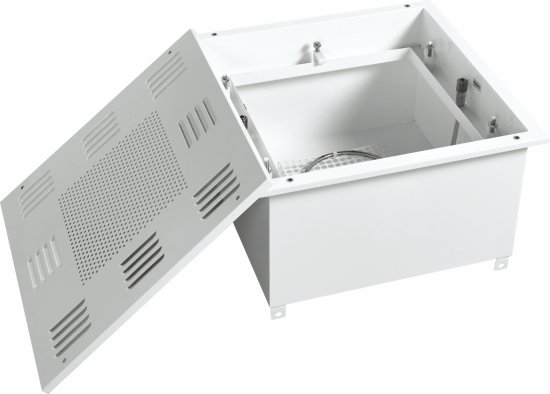
Although designs vary between manufacturers, most terminal HEPA filter boxes include the following components.
Housing
The housing supports the filter and connects the terminal unit to the duct system.
Common materials include:
- Powder-coated steel
- Galvanized steel
- Stainless steel 304
- Stainless steel 316
Material selection depends on the project environment, corrosion resistance requirements, and applicable standards.
HEPA Filter
The terminal box accommodates the final HEPA filter.
Most cleanroom projects use H13 or H14 HEPA filters, although the final specification depends on the project requirements.
Diffuser or Equalizing Plate
An airflow-distribution plate helps produce a more uniform airflow profile beneath the filter.
Different diffuser designs are available depending on whether the project requires non-unidirectional or low-turbulence airflow.
Duct Connection
The inlet collar connects the terminal box to the HVAC ductwork.
Circular and rectangular duct connections are both common.
Pressure Testing Port
Some terminal boxes include upstream and downstream pressure ports that assist with airflow balancing, filter monitoring, or commissioning.
Common Types of Terminal HEPA Filter Boxes
Several configurations are available depending on project requirements.
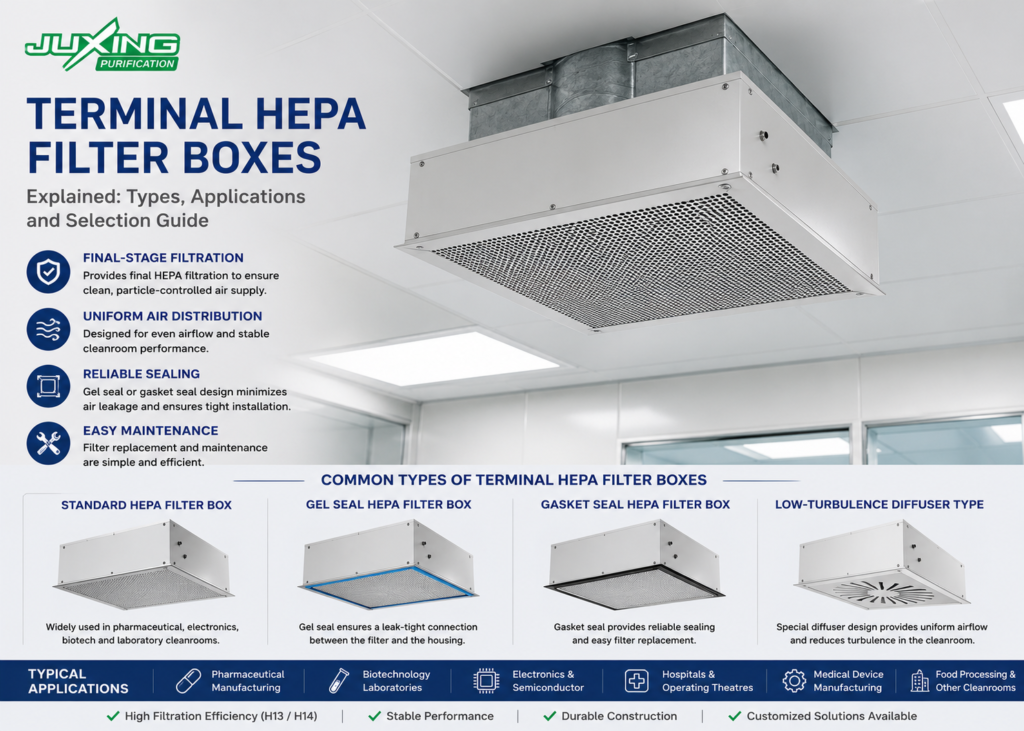
Standard Terminal HEPA Filter Box
The most common design for pharmaceutical, laboratory, and electronics cleanrooms.
It provides final-stage HEPA filtration supplied by a central AHU.
Gel Seal HEPA Filter Box
A gel seal system creates an airtight seal between the filter and the housing using a continuous gel channel.
This design is often selected for applications requiring very high sealing performance and simplified filter replacement.
Gasket Seal HEPA Filter Box
Instead of gel, these units use compressible gaskets to seal the filter.
Both systems are widely used, and the choice depends on project specifications, maintenance preferences, and validation requirements.
Low-Turbulence Diffuser
Certain terminal units incorporate specially designed diffuser plates to provide more uniform airflow in sensitive manufacturing areas.
These should not automatically be described as laminar-flow systems unless the airflow characteristics have been verified.
Typical Applications
Terminal HEPA filter boxes are used in a wide range of controlled environments.
Typical applications include:
Pharmaceutical Manufacturing
Providing final HEPA filtration above production areas, weighing rooms, filling rooms, and clean corridors.
Medical Device Manufacturing
Supplying clean air to assembly, packaging, and inspection areas.
Electronics and Semiconductor Facilities
Delivering filtered air to production environments where particulate contamination must be minimized.
Biotechnology Laboratories
Supporting contamination-controlled research and production areas.
Hospital Operating Theatres
Terminal HEPA filter boxes are commonly integrated into operating theatre ceiling systems where filtered supply air is required.
The airflow pattern and diffuser configuration should be selected according to the room function and applicable healthcare ventilation standards.
Terminal HEPA Filter Box vs FFU
Although both provide filtered air, they operate differently.
A terminal HEPA filter box relies on pressurized air supplied by the central AHU.
An FFU contains its own fan and motor, allowing it to supply filtered air independently.
Neither system is universally better.
The appropriate solution depends on:
- Facility design
- Airflow strategy
- Maintenance requirements
- Energy considerations
- Ceiling layout
- Project specifications
How to Choose the Right Terminal HEPA Filter Box
Several factors should be evaluated before selection.
Filter Efficiency
Confirm the required filter grade according to the project specification.
Airflow Capacity
The selected terminal should provide the required airflow while maintaining acceptable pressure loss.
The airflow requirement should be determined from the cleanroom ventilation design rather than from the terminal size alone.
Housing Material
Consider corrosion resistance, cleaning chemicals, and environmental conditions.
Sealing Method
Determine whether the project specifies:
- Gel seal
- Gasket seal
The sealing method should be compatible with the validation and maintenance strategy.
Maintenance Access
The filter should be replaceable without damaging the housing or surrounding ceiling system.
Compatibility with Ceiling System
The terminal dimensions should match the ceiling grid or cleanroom ceiling system used in the project.
Common Misconceptions
A Terminal HEPA Filter Box Is the Same as an AHU
No.
An AHU conditions and distributes air for the entire HVAC system.
A terminal HEPA filter box performs only the final filtration stage at the room supply point.
Every HEPA Box Produces Laminar Flow
Not necessarily.
Airflow characteristics depend on diffuser design, airflow velocity, ceiling coverage, and room layout.
Larger Filter Boxes Always Provide Better Performance
No.
The correct size should be selected according to the required airflow, pressure loss, ceiling arrangement, and project specifications.
HEPA Filters Never Need Replacement
Incorrect.
Filter life depends on operating conditions, pressure drop, contamination loading, and maintenance practices.
Periodic inspection and replacement remain essential.
Expert Tip
When comparing quotations, don’t evaluate only the filter efficiency. Ask suppliers to specify the housing material, sealing method, airflow capacity, pressure drop, diffuser type, maintenance access, and compatibility with your ceiling system. These details have a significant impact on installation quality, long-term maintenance, and cleanroom performance.
Frequently Asked Questions
What is the purpose of a terminal HEPA filter box?
It provides the final stage of HEPA filtration before conditioned air enters the cleanroom.
Is a terminal HEPA filter box the same as an FFU?
No.
A terminal HEPA filter box depends on airflow supplied by a central AHU, while an FFU contains its own fan.
What filter grades are commonly used?
Most cleanroom projects use H13 or H14 HEPA filters, depending on the project specification.
What is the difference between gel seal and gasket seal?
Both methods create an airtight seal between the filter and the housing.
The preferred option depends on project requirements, maintenance practices, and validation procedures.
Can terminal HEPA filter boxes be used in operating theatres?
Yes.
They are widely used in operating theatres and other healthcare facilities requiring filtered supply air, provided the complete ventilation system is designed according to applicable healthcare standards.
How is a terminal HEPA filter box maintained?
Routine maintenance may include airflow checks, pressure monitoring, filter integrity testing, and filter replacement when required by the maintenance plan or project specifications.
Conclusion
Terminal HEPA filter boxes play a critical role in delivering clean, filtered air into controlled environments. Although relatively simple in appearance, their performance depends on the combination of housing design, filter sealing, airflow distribution, installation quality, and ongoing maintenance.
Selecting the appropriate terminal HEPA filter box requires more than choosing the correct filter grade. Engineers and buyers should also evaluate airflow capacity, sealing method, housing material, compatibility with the ceiling system, and maintenance accessibility. When properly integrated into the HVAC system, terminal HEPA filter boxes contribute to reliable contamination control across pharmaceutical, laboratory, electronics, and healthcare applications.