
Executive Summary
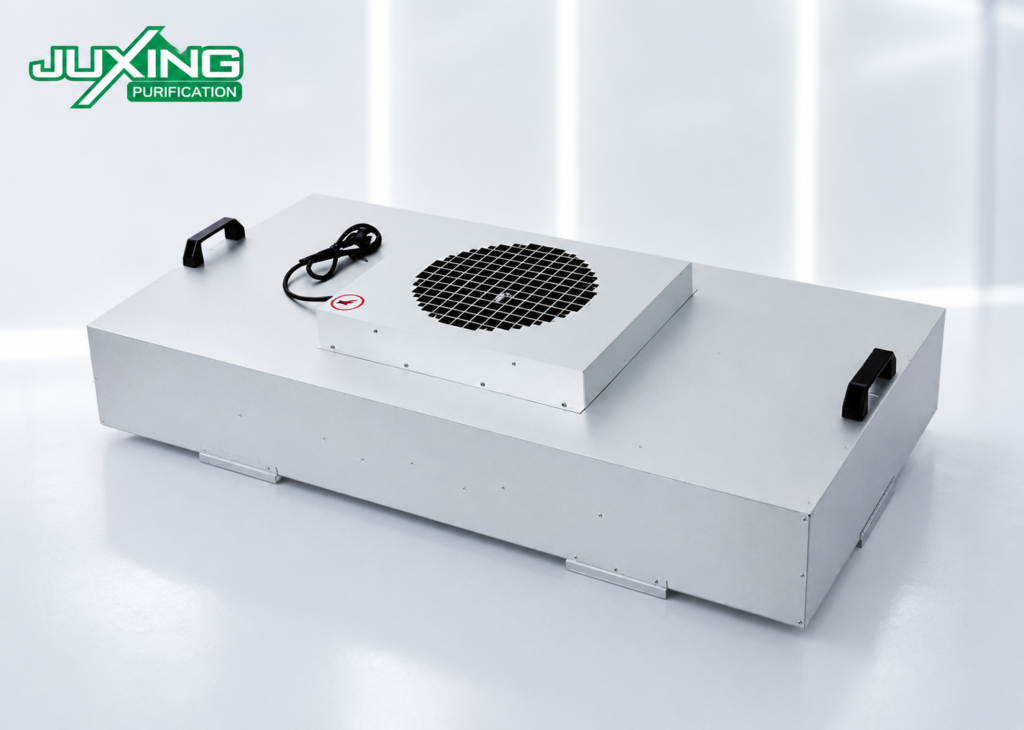
A Fan Filter Unit (FFU) is one of the most important components in many modern cleanrooms. It combines a fan, a high-efficiency filter, and a housing into a self-contained ceiling-mounted air filtration unit that delivers clean, filtered air directly into the controlled environment.
However, selecting the right FFU involves much more than choosing a filter efficiency.
Buyers should evaluate:
- Airflow requirements
- Cleanroom classification
- Motor efficiency
- Energy consumption
- Noise level
- Filter type
- Maintenance accessibility
- Ceiling compatibility
- Control methods
- Long-term operating cost
This guide explains the engineering considerations that procurement teams should understand before selecting FFUs for pharmaceutical plants, hospitals, laboratories, electronics manufacturing, and other cleanroom applications.
Who Should Read This Guide?
This guide is intended for:
- Pharmaceutical engineering teams
- Hospital project managers
- Cleanroom contractors
- EPC companies
- HVAC engineers
- MEP consultants
- Laboratory planners
- Procurement managers
- Medical device manufacturers
- Electronics cleanroom designers
What Is a Fan Filter Unit (FFU)?
An FFU is a modular air supply unit that integrates:
- A fan or blower
- A HEPA or ULPA filter
- A pre-filter (optional in some designs)
- A housing
- A speed control system
Mounted in the cleanroom ceiling grid, an FFU draws air from above, filters it, and supplies clean air into the room.
Unlike centralized HVAC systems alone, FFUs allow flexible airflow distribution and are commonly used in modular cleanrooms and facilities requiring localized clean air delivery.
Why FFUs Are Important
A properly selected FFU helps achieve:
- Stable airflow
- Consistent particle control
- Uniform air distribution
- Lower contamination risk
- Easier cleanroom expansion
- Simplified maintenance
- Flexible cleanroom layouts
Poor FFU selection may lead to:
- Excessive energy consumption
- Uneven airflow
- High noise levels
- Difficult maintenance
- Reduced filter life
- Poor cleanroom performance
1. Understand Your Cleanroom Requirements First
Before comparing FFU models, answer these questions:
- What ISO cleanroom classification is required?
- What industry is the cleanroom serving?
- What airflow pattern is required?
- What ceiling system will be used?
- What air change rate is specified?
- Is laminar airflow required?
- What room pressure strategy is planned?
An FFU should always be selected as part of the overall cleanroom ventilation strategy—not as an isolated product.
2. Choose the Right Filter
The filter determines the cleanliness of the supplied air.
Most FFUs use either:
| Filter Type | Typical Application |
|---|---|
| HEPA Filter | Pharmaceutical, hospitals, laboratories, electronics |
| ULPA Filter | Semiconductor, microelectronics, extremely high cleanliness applications |
Buyers should verify:
- Filter efficiency
- Pressure drop
- Leak testing
- Replacement method
- Filter dimensions
3. Airflow Matters More Than Air Volume Alone
Many buyers compare only air volume (m³/h or CFM).
More important is whether the airflow matches the cleanroom design.
Consider:
- Uniform airflow distribution
- Air velocity
- Laminar flow requirements
- Ceiling coverage
- Interaction with return air
Poor airflow design cannot be corrected simply by installing more FFUs.
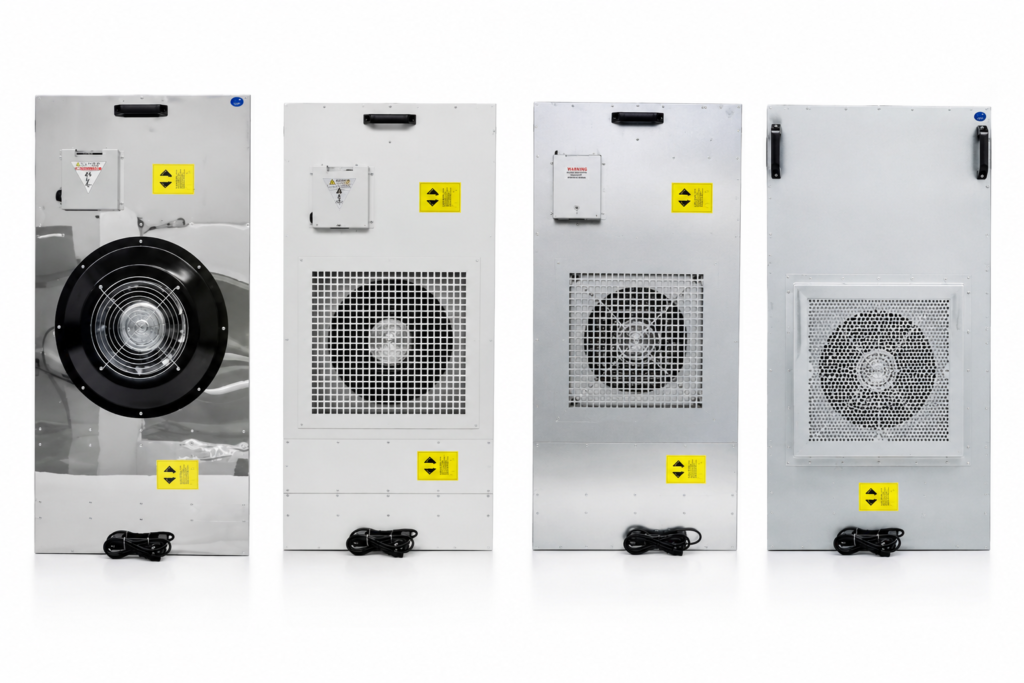
4. Motor Selection
The motor affects:
- Energy consumption
- Noise
- Service life
- Reliability
Common motor types include:
| Motor Type | Characteristics |
| AC Motor | Lower initial cost, mature technology |
| EC Motor | Higher efficiency, lower energy consumption, better speed control |
For projects operating continuously, EC motors often reduce long-term operating costs despite higher initial investment.
5. Energy Efficiency
Because FFUs may operate continuously, energy consumption significantly affects the total cost of ownership.
Evaluate:
- Motor efficiency
- Fan efficiency
- Power consumption
- Airflow per watt
- Speed control capability
Procurement Tip
Do not compare purchase price alone. Compare lifetime operating cost.
6. Noise Level
Noise affects staff comfort, especially in hospitals and laboratories.
Ask suppliers for:
- Noise level at rated airflow
- Measurement conditions
- Fan speed range
Lower noise often indicates better fan design rather than simply lower airflow.
7. Housing Material
Common housing materials include:
- Powder-coated steel
- Galvanized steel
- Aluminum
- Stainless steel
Selection depends on:
- Corrosion resistance
- Cleaning requirements
- Budget
- Industry application
8. Maintenance Accessibility
Routine maintenance should be straightforward.
Ask:
- Is the filter replaced from the room side or ceiling side?
- How long does filter replacement take?
- Are spare parts readily available?
- Can motors be serviced individually?
Easy maintenance reduces downtime.
9. Control System
Modern FFUs may support:
- Individual speed control
- Group control
- Central monitoring
- Building Management System (BMS) integration
For larger cleanrooms, centralized control simplifies operation.
10. Ceiling Compatibility
Ensure the FFU matches:
- Ceiling grid dimensions
- Ceiling load capacity
- Filter size
- Lighting layout
- Sprinkler locations
Coordination with architectural and HVAC drawings is essential.
Typical FFU Selection by Application
| Application | Recommended Configuration |
| Pharmaceutical cleanroom | HEPA, EC motor, low noise |
| Hospital operating theater | HEPA, reliable airflow, low vibration |
| Electronics cleanroom | HEPA or ULPA depending on process |
| Laboratory | HEPA, easy maintenance |
| Medical device manufacturing | HEPA, energy-efficient motor |
| Food processing | HEPA, corrosion-resistant housing |
Common Mistakes When Buying FFUs
Mistake 1
Choosing based only on price.
Mistake 2
Ignoring energy consumption.
Mistake 3
Selecting the wrong filter efficiency.
Mistake 4
Overlooking maintenance access.
Mistake 5
Ignoring airflow balance.
Mistake 6
Choosing incompatible ceiling dimensions.
Mistake 7
Not planning spare filter inventory.
Mistake 8
Purchasing FFUs without considering long-term operating costs.
Buyer Checklist Before Requesting a Quotation
Prepare the following information:
- Cleanroom classification
- Room dimensions
- Ceiling layout
- Air change requirements
- Filter type
- Motor preference
- Control method
- Power supply
- Quantity
- Installation country
- Project schedule
Supplier Questions
Before placing an order, ask:
- What motor type is used?
- Which HEPA or ULPA filter is supplied?
- Can filters be replaced from the room side?
- What is the rated airflow?
- What is the power consumption?
- What is the noise level?
- Is group control available?
- Can the FFU integrate with a BMS?
- What maintenance support is provided?
- Are replacement filters readily available?
Frequently Asked Questions
Is an EC motor worth the extra cost?
For cleanrooms operating many hours each day, EC motors often reduce energy consumption and maintenance costs over the equipment’s lifetime.
Do all cleanrooms require FFUs?
No. Some cleanrooms rely primarily on centralized HVAC systems. The need for FFUs depends on the cleanroom design, airflow strategy, and cleanliness requirements.
Can FFUs be installed in existing cleanrooms?
Yes, provided the ceiling structure, HVAC design, and electrical system are suitable.
How often should HEPA filters be replaced?
Replacement intervals depend on operating conditions, pressure drop, contamination load, and maintenance procedures. Filter performance should be monitored according to the facility’s maintenance program rather than replaced solely on a fixed calendar schedule.
What is the biggest mistake when selecting an FFU?
The most common mistake is treating the FFU as a standalone product rather than part of the overall cleanroom airflow system.
Final Thoughts
A Fan Filter Unit is more than a fan with a filter. It is an integral part of the cleanroom ventilation system and directly influences cleanliness, airflow stability, operating cost, and long-term reliability.
Selecting the right FFU requires balancing cleanroom performance, energy efficiency, maintenance, and lifecycle cost—not simply comparing initial purchase prices.
Working with suppliers who understand cleanroom engineering can help ensure that FFU selection supports the overall success of the cleanroom project.
Need Help Selecting FFUs for Your Cleanroom?
Juxing Purification Technology supplies Fan Filter Units, cleanroom doors, pass boxes, modular cleanroom systems, operating theater solutions, HEPA filtration products, and other cleanroom equipment for international projects.
Our engineering team can help evaluate your cleanroom requirements and recommend FFU solutions that balance performance, energy efficiency, and long-term value.