
Quick Answer
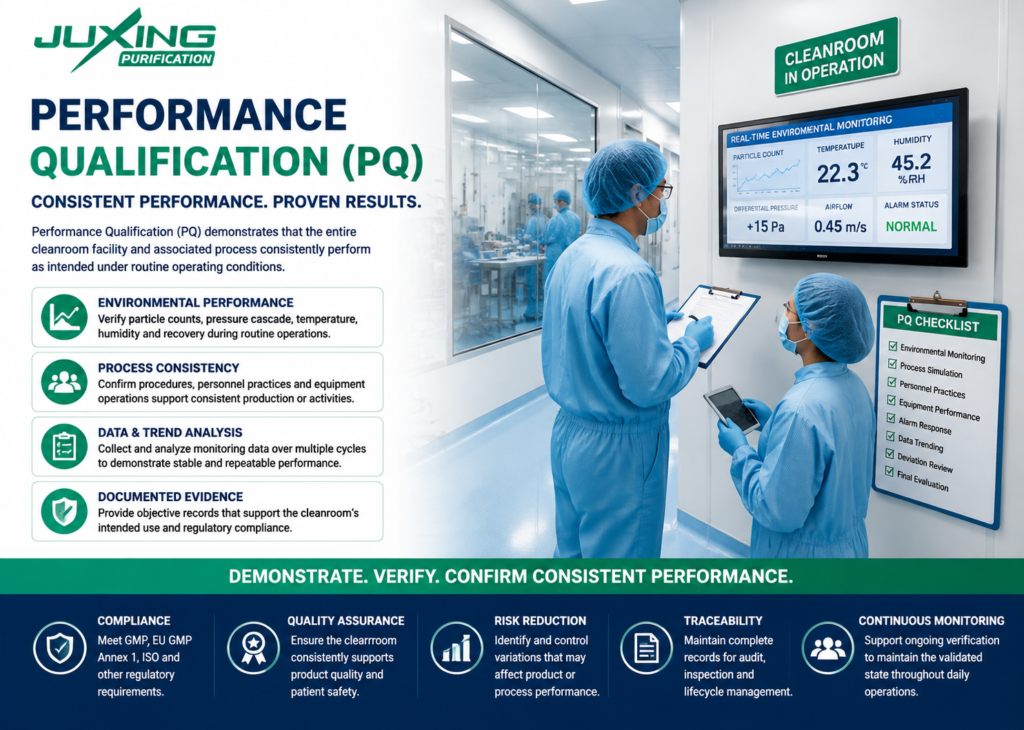
Performance Qualification (PQ) is the documented process of demonstrating that a cleanroom facility, its supporting systems, and the associated manufacturing or clinical process consistently perform as intended under routine operating conditions.
Unlike Operational Qualification (OQ), which verifies that systems can operate within predefined operating ranges, PQ confirms that the complete process repeatedly delivers the required performance when operated by trained personnel using approved procedures.
For pharmaceutical manufacturing, biotechnology, healthcare, and other regulated industries, PQ provides objective evidence that the qualified cleanroom environment is suitable for its intended use before routine production or clinical activities begin.
Key Takeaways
- Performance Qualification (PQ) demonstrates consistent performance during routine operation.
- PQ evaluates the complete process rather than individual equipment alone.
- Successful IQ and OQ are normally prerequisites for PQ.
- PQ uses predefined acceptance criteria and statistically meaningful data where appropriate.
- Environmental conditions, operating procedures, personnel, and equipment all contribute to PQ outcomes.
- PQ generates documented evidence supporting the facility’s intended use throughout its operational lifecycle.
Introduction
A cleanroom may be correctly installed and fully operational, yet still fail to achieve its intended purpose.
For example, an HVAC system may maintain the specified temperature and pressure, automated doors may function correctly, alarms may respond appropriately, and environmental monitoring systems may communicate normally. These results demonstrate that the infrastructure operates as designed—but they do not prove that the cleanroom can consistently support the actual manufacturing, laboratory, or clinical activities for which it was built.
This distinction explains why Performance Qualification (PQ) represents the final stage of the qualification lifecycle.
Rather than focusing on installation or equipment operation, PQ evaluates the performance of the complete system under routine operating conditions. It confirms that facilities, equipment, utilities, operating procedures, personnel, and environmental controls work together to produce consistent, repeatable, and compliant results.
For pharmaceutical manufacturing, biotechnology laboratories, aseptic processing facilities, hospitals, and other controlled environments, PQ provides the documented evidence needed to demonstrate that the cleanroom is capable of supporting its intended use.
This guide explains what Performance Qualification is, why it is important, how it differs from Operational Qualification (OQ), what should be included in a PQ protocol, and how organizations can implement an effective Performance Qualification programme for cleanroom projects.
What Is Performance Qualification (PQ)?
Performance Qualification is the documented verification that a qualified system consistently performs according to its intended purpose during routine operation.
Unlike previous qualification stages, PQ does not evaluate isolated equipment or individual components. Instead, it assesses the integrated performance of the complete operating environment.
Depending on the facility, PQ may evaluate:
- Environmental performance during routine operation
- Manufacturing process consistency
- Personnel operating practices
- Standard Operating Procedures (SOPs)
- Equipment interaction
- Utility reliability
- Environmental monitoring performance
- Cleaning and sanitization effectiveness
- Product protection
- Process repeatability
The primary objective is to answer one fundamental question:
Can the complete cleanroom system consistently support its intended application under normal operating conditions?
Only when this question can be answered with documented evidence can the qualification lifecycle be considered complete.
Why Is Performance Qualification Important?
Earlier qualification stages establish that systems have been installed correctly and operate according to specification.
However, regulatory authorities and project owners ultimately need evidence that the cleanroom performs reliably during its intended use.
Without PQ, important questions remain unanswered.
For example:
- Does the pressure cascade remain stable during normal production?
- Do environmental conditions remain within specification throughout an operating shift?
- Can personnel follow approved procedures without compromising contamination control?
- Does routine cleaning maintain the required cleanliness level?
- Does the complete process consistently protect products or patients?
These questions cannot be answered through IQ or OQ alone.
Performance Qualification provides confidence that the cleanroom can reliably support real-world operation rather than simply passing engineering tests.
Where Does PQ Fit Within the Qualification Lifecycle?
Performance Qualification represents the final formal qualification stage before routine operation.
A typical project sequence is:
Procurement
        ↓
Factory Acceptance Testing (FAT)
        ↓
Delivery
        ↓
Site Acceptance Testing (SAT)
        ↓
Commissioning
        ↓
Installation Qualification (IQ)
        ↓
Operational Qualification (OQ)
        ↓
Performance Qualification (PQ)
Before PQ begins, organizations should normally confirm that:
- Installation Qualification (IQ) has been approved.
- Operational Qualification (OQ) has been successfully completed.
- Critical deviations have been resolved.
- Standard Operating Procedures (SOPs) have been approved.
- Personnel have been trained.
- Preventive maintenance and calibration programmes have been established.
- Environmental monitoring procedures are in place.
- The approved PQ protocol has been reviewed and authorized.
These prerequisites help ensure that PQ evaluates routine performance rather than unresolved engineering issues.
PQ vs. Operational Qualification (OQ)
Performance Qualification and Operational Qualification are closely related but have different objectives.
| Operational Qualification (OQ) | Performance Qualification (PQ) |
|---|---|
| Verifies operational capability | Verifies operational consistency |
| Conducted under controlled test conditions | Conducted under routine operating conditions |
| Focuses on equipment and systems | Focuses on the complete process |
| Confirms systems can operate correctly | Confirms systems consistently support the intended use |
| Tests operating ranges and functions | Evaluates repeatable real-world performance |
For example:
During OQ, engineers may verify that an HVAC system maintains pressure within predefined limits.
During PQ, the project team confirms that those environmental conditions remain consistently within specification throughout normal production activities while personnel, equipment, and routine operations are taking place.
What Is Evaluated During Performance Qualification?
The scope of PQ depends on the intended application of the cleanroom and the associated regulatory requirements.
Typical areas of evaluation include:
- Environmental conditions during routine operation
- Airborne particle performance
- Temperature stability
- Relative humidity stability
- Pressure cascade performance
- Recovery following routine operational activities
- Environmental monitoring trends
- Personnel practices
- Cleaning and disinfection procedures
- Equipment performance during routine use
- Alarm response procedures
- Batch or process consistency (where applicable)
- Documentation and record integrity
Unlike engineering testing, PQ focuses on demonstrating sustained, repeatable performance over an appropriate period rather than isolated test results.
What Is Included in a Performance Qualification Protocol?
A Performance Qualification (PQ) protocol defines how the organization will demonstrate that the cleanroom consistently performs as intended during routine operation.
Unlike Operational Qualification (OQ), which evaluates individual operating functions under controlled conditions, the PQ protocol focuses on long-term, repeatable system performance while the facility is used according to approved procedures.
Although protocol formats vary among organizations, a comprehensive PQ protocol typically includes the following sections.
General Information
- Project name
- Facility identification
- Equipment or system covered
- Protocol number
- Revision history
- Scope of qualification
Purpose
Defines the objective of the qualification.
For example:
To demonstrate that the cleanroom consistently supports its intended operational use while maintaining compliance with approved environmental and process requirements.
Responsibilities
Identifies the personnel responsible for:
- Test execution
- Environmental monitoring
- Quality review
- Data evaluation
- Approval of results
Reference Documents
Typical references include:
- User Requirements Specification (URS)
- Standard Operating Procedures (SOPs)
- Environmental monitoring procedures
- Cleaning procedures
- Calibration records
- Maintenance records
- Previous IQ and OQ reports
- Applicable regulatory requirements
Acceptance Criteria
Every acceptance criterion should be defined before testing begins.
Acceptance criteria should be measurable, objective, and directly related to the intended use of the facility.
Examples include:
- Environmental conditions remain within approved operating limits.
- Airborne particle counts comply with the required cleanroom classification.
- Pressure differentials remain stable during routine operation.
- Alarm responses occur within the specified time.
- Environmental monitoring results remain within predefined action and alert limits.
Environmental Monitoring During PQ
Environmental monitoring plays a central role in most cleanroom Performance Qualification programmes.
Unlike OQ, where individual operating functions are intentionally challenged, PQ evaluates environmental stability during routine activities.
Typical monitoring parameters include:
- Airborne particle concentration
- Differential pressure
- Temperature
- Relative humidity
- Airflow performance
- Microbiological monitoring (where applicable)
- Surface monitoring (where applicable)
- Operator activities
- Equipment operating status
For sterile pharmaceutical manufacturing and other microbiologically controlled environments, microbial monitoring is an essential component of PQ. In contrast, for applications such as semiconductor manufacturing or electronics assembly, PQ may focus primarily on airborne particle control and environmental stability rather than microbiological contamination. The monitoring programme should therefore reflect the intended use of the cleanroom and the applicable regulatory or industry requirements.
Monitoring should be performed under representative operating conditions rather than during an empty-room demonstration.
Process Performance During PQ
The scope of process evaluation depends on the intended application of the cleanroom.
For pharmaceutical manufacturing, PQ may include verification that routine manufacturing operations can be performed repeatedly without compromising environmental control or product quality.
Examples may include:
- Routine production activities
- Equipment loading and unloading
- Personnel movement
- Material transfer
- Cleaning between production batches
- Routine equipment operation
For aseptic processing, media fill studies are often performed as part of process validation to demonstrate that aseptic operations can consistently prevent microbial contamination. However, media fills are not a universal requirement for every cleanroom PQ. They are specific to aseptic manufacturing processes and should not be generalized to all cleanroom applications.
For hospitals, research laboratories, semiconductor facilities, and other non-aseptic environments, PQ activities should be designed around the actual operational risks and intended use of the facility.
Data Trending and Statistical Evaluation
Performance Qualification should evaluate more than isolated measurements.
Collecting data over multiple operating cycles helps demonstrate that system performance is stable and repeatable.
Depending on the project, evaluation may include:
- Trend analysis
- Comparison with baseline data
- Analysis of repeated measurements
- Review of alarm frequency
- Environmental monitoring trends
- Process capability, where appropriate
- Statistical analysis, when defined by the validation strategy
The extent of statistical evaluation should be appropriate for the process, product, and regulatory expectations. It is not necessary to apply complex statistical methods to every cleanroom project, but sufficient analysis should be performed to demonstrate consistent performance.
What Evidence Supports Successful PQ?
A successful Performance Qualification should produce objective evidence demonstrating that the cleanroom consistently performs as intended.
Typical evidence includes:
- Completed PQ protocol
- Environmental monitoring records
- Particle count results
- Microbiological monitoring records (where applicable)
- Temperature and humidity records
- Differential pressure records
- Alarm history
- Trend reports
- Deviation reports
- Corrective action records
- Training records
- Final PQ report
These records should be maintained according to the organization’s document control procedures and retained for future audits, inspections, investigations, and lifecycle management.
Common Deviations Identified During PQ
Unlike IQ or OQ, deviations identified during PQ often arise from routine operational activities rather than equipment installation or system functionality.
Examples include:
Environmental Instability
- Pressure fluctuations during production
- Temperature drifting outside limits
- Humidity instability
- Unexpected airflow disturbances
Personnel-Related Issues
- Incorrect gowning practices
- Excessive personnel movement
- Failure to follow SOPs
- Inadequate cleaning practices
Process-Related Issues
- Material transfer affecting pressure control
- Equipment loading disrupting airflow
- Excessive door opening
- Process-generated contamination
Monitoring Issues
- Alarm response delays
- Incomplete environmental monitoring records
- Missed monitoring locations
- Trending outside alert limits
Each deviation should be documented, investigated, and assessed using the organization’s quality management system.
Corrective and preventive actions (CAPA) should be implemented where appropriate before the cleanroom is approved for routine operation.
Continued Performance Verification
Performance Qualification should not be viewed as the end of cleanroom quality management.
Modern GMP guidance increasingly emphasizes a lifecycle approach, in which qualified systems continue to be monitored throughout routine operation.
Following successful PQ, organizations typically continue activities such as:
- Environmental monitoring
- Periodic cleanroom requalification
- Preventive maintenance
- Instrument recalibration
- Trend analysis
- Change control
- CAPA management
- Internal audits
These ongoing activities help ensure that the cleanroom continues to operate within its validated state throughout its operational life.
Buyer’s PQ Checklist
Before approving Performance Qualification, project owners, quality teams, and validation personnel should confirm that the cleanroom has demonstrated consistent performance under routine operating conditions and that sufficient documented evidence supports its intended use.
The following checklist provides a practical reference for cleanroom projects.
Qualification Prerequisites
☐ Installation Qualification (IQ) has been successfully completed.
☐ Operational Qualification (OQ) has been successfully completed.
☐ Critical deviations from previous qualification stages have been closed.
☐ Standard Operating Procedures (SOPs) have been approved.
☐ Personnel training records are complete.
☐ Preventive maintenance programme has been established.
☐ Calibration status of critical instruments remains valid.
Environmental Performance
☐ Airborne particle concentrations comply with the required cleanroom classification.
☐ Differential pressure remains within the approved operating range.
☐ Temperature remains within specified limits.
☐ Relative humidity remains within specified limits.
☐ Environmental conditions remain stable throughout routine operations.
☐ Environmental monitoring has been completed according to the approved programme.
Operational Performance
☐ Routine operating procedures have been followed.
☐ Personnel practices comply with approved SOPs.
☐ Material transfer procedures have been verified.
☐ Equipment operates consistently during routine use.
☐ Cleaning and disinfection procedures have been completed as specified.
☐ Alarm response procedures have been verified.
Documentation Review
☐ Environmental monitoring records are complete.
☐ Training records are current.
☐ Maintenance records have been reviewed.
☐ Calibration records remain valid.
☐ Deviations have been documented and investigated.
☐ CAPA records have been completed where required.
☐ Trend analysis supports consistent system performance.
Final Approval
☐ PQ protocol has been completed.
☐ Acceptance criteria have been satisfied.
☐ PQ report has been reviewed and approved.
☐ The cleanroom has been formally released for its intended operational use.
A successful Performance Qualification should demonstrate not only that individual systems operate correctly, but also that the complete cleanroom consistently supports its intended application under routine operating conditions.
Common Misconceptions
Misconception 1: “Passing OQ Means PQ Is Unnecessary”
Operational Qualification demonstrates that systems can operate within predefined limits under controlled test conditions.
Performance Qualification goes a step further by demonstrating that the complete cleanroom consistently performs as intended during routine operation.
Both stages are important, but they answer different questions and should not be considered interchangeable.
Misconception 2: “PQ Is Only About Environmental Monitoring”
Environmental monitoring is an important component of many PQ programmes, but it represents only one aspect of performance.
Depending on the application, PQ may also evaluate:
- Operating procedures
- Personnel practices
- Equipment interaction
- Material flow
- Cleaning effectiveness
- Process consistency
- Alarm management
- Documentation quality
The overall objective is to confirm that the complete operational system consistently supports its intended purpose.
Misconception 3: “A Few Successful Test Results Are Sufficient”
Performance Qualification is not based on isolated measurements.
Instead, it evaluates consistency over an appropriate period of operation.
One successful environmental monitoring report cannot demonstrate long-term process capability.
Repeatability, trend analysis, and sustained compliance provide stronger evidence that the cleanroom remains in a qualified state.
Misconception 4: “Performance Qualification Is Performed Only Once”
Initial PQ is an important milestone, but it is not the end of lifecycle management.
Changes to facilities, equipment, utilities, software, operating procedures, or manufacturing processes may require reassessment, partial requalification, or additional performance studies.
Ongoing monitoring and periodic review help ensure that the qualified state is maintained throughout the operational life of the facility.
Expert Tip
One of the most common reasons for delays during Performance Qualification is attempting to compensate for unresolved issues from earlier project stages.
Experienced validation teams avoid this by ensuring that commissioning, Installation Qualification (IQ), and Operational Qualification (OQ) have been fully completed before initiating PQ. Using PQ to resolve engineering problems often results in repeated testing, unnecessary deviations, and extended project schedules.
Another best practice is to collect performance data over multiple routine operating cycles rather than relying on a single successful test. Reviewing environmental trends, equipment performance, alarm history, and operator compliance over time provides stronger evidence that the cleanroom can consistently support its intended application.
Finally, organizations should remember that maintaining the validated state extends beyond initial qualification. Environmental monitoring, preventive maintenance, calibration, change control, deviation management, and periodic requalification all contribute to continued compliance throughout the facility lifecycle.
Frequently Asked Questions
Who performs Performance Qualification?
Performance Qualification is typically carried out by a multidisciplinary team that may include validation engineers, quality assurance personnel, production representatives, engineering staff, and the facility owner. Depending on the project, equipment suppliers or external consultants may also participate in specific testing activities.
Is Performance Qualification required for every cleanroom?
The extent of PQ depends on the intended use of the cleanroom, applicable regulations, project requirements, and the organization’s quality management system.
For GMP-regulated pharmaceutical and biotechnology facilities, PQ is generally considered an essential qualification activity before routine manufacturing begins.
For other industries, such as electronics or semiconductor manufacturing, qualification programmes may follow different industry standards and customer requirements.
How long should Performance Qualification last?
There is no universal duration.
The length of PQ depends on factors such as process complexity, product risk, regulatory expectations, monitoring frequency, and project-specific acceptance criteria.
The qualification period should be sufficient to demonstrate consistent performance rather than simply completing a predefined number of test days.
What happens if PQ acceptance criteria are not met?
Any failure to meet predefined acceptance criteria should be documented and investigated through the organization’s quality management system.
Depending on the root cause, corrective actions may include equipment adjustments, procedure revisions, additional training, engineering modifications, or repeat qualification activities before the facility is released for routine operation.
Can changes after qualification affect PQ?
Yes.
Significant changes to equipment, utilities, software, operating procedures, room layout, or manufacturing processes may affect the validated state.
Organizations should evaluate proposed changes through an approved change control process to determine whether additional qualification or requalification is necessary.
What happens after Performance Qualification?
Following successful PQ, the cleanroom typically enters routine operational use.
However, maintaining compliance requires continuous activities such as environmental monitoring, preventive maintenance, calibration, deviation management, change control, periodic review, and requalification where appropriate.
These activities help ensure that the facility continues to perform according to its intended purpose throughout its operational lifecycle.
Conclusion
Performance Qualification represents the final stage of the qualification lifecycle, providing documented evidence that a cleanroom consistently supports its intended use during routine operation.
Unlike Installation Qualification, which confirms correct installation, or Operational Qualification, which verifies operational capability under controlled conditions, Performance Qualification demonstrates sustained performance in the real operating environment. It evaluates the interaction between facilities, equipment, utilities, procedures, personnel, and environmental controls to ensure that the complete system functions reliably and repeatedly.
For pharmaceutical manufacturing, biotechnology laboratories, hospitals, and other controlled environments, a well-planned PQ programme strengthens regulatory compliance, reduces operational risk, and increases confidence that the cleanroom is capable of supporting safe and consistent operations.
Most importantly, successful Performance Qualification should be viewed not as the end of quality management, but as the beginning of lifecycle performance assurance. Ongoing environmental monitoring, maintenance, calibration, change control, and periodic requalification are all essential to maintaining the validated state throughout the life of the facility.