
Introduction
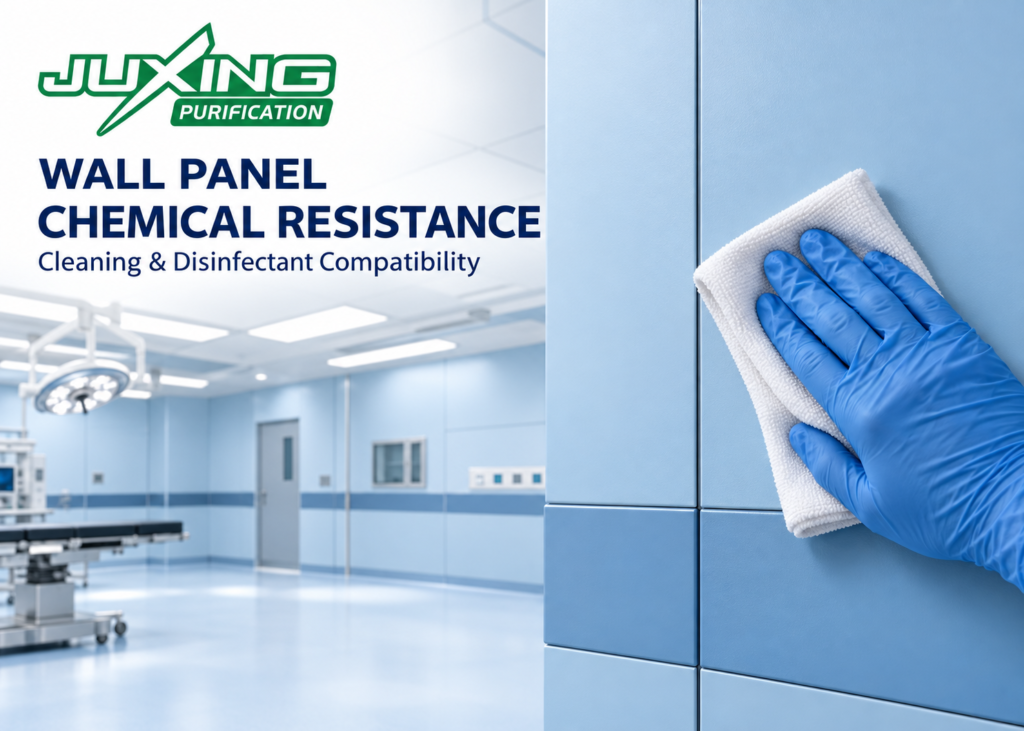
Operating theater wall panel chemical resistance should be assessed before materials are approved for production. A wall finish may look smooth and durable when installed, yet repeated exposure to an incompatible cleaning product can affect its appearance, surface integrity or joints.
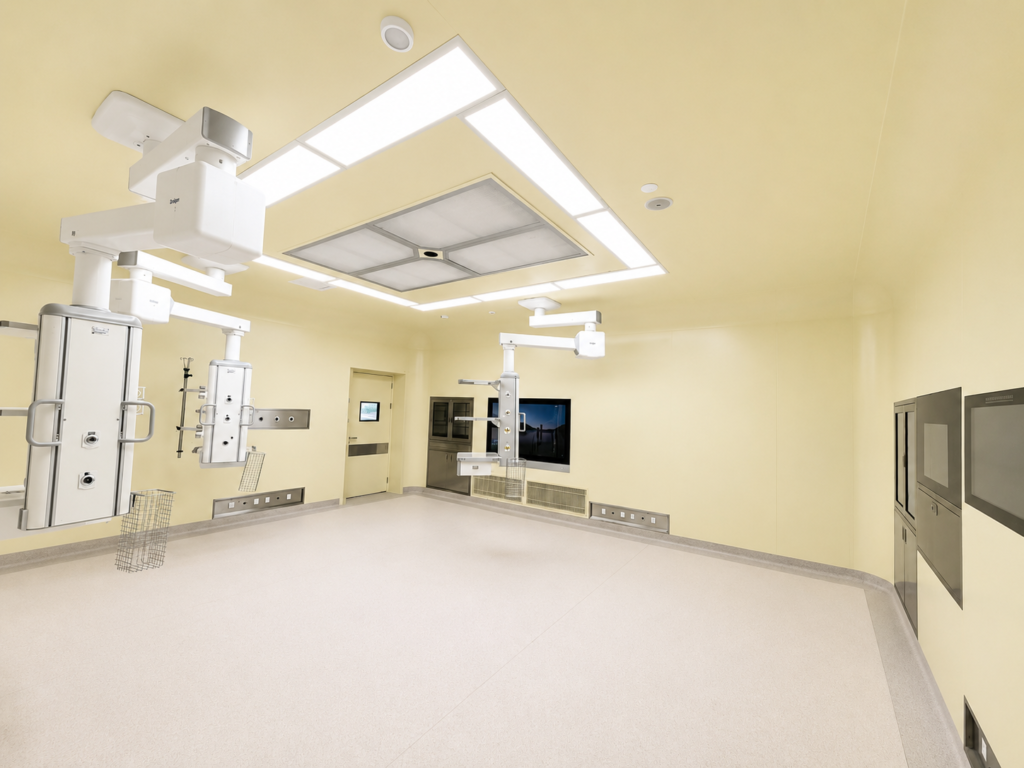
For modular operating theaters, this assessment extends beyond the visible metal face. Powder coatings, printed glass finishes, removable gaskets, perimeter sealants and exposed accessories may respond differently to the same cleaning procedure.
This guide explains how hospital owners, consultants and contractors can define compatibility requirements, review supplier evidence and coordinate wall specifications with the hospital’s cleaning team.
Quick Answer
Operating theater wall panel chemical resistance is the ability of the exposed wall materials and interfaces to withstand specified cleaning and disinfecting conditions without unacceptable deterioration.
Compatibility depends on the exact chemical formulation, working concentration, contact time, application method and frequency of exposure. A statement such as “resistant to hospital disinfectants” is insufficient unless these conditions and the materials assessed are identified.
Procurement should therefore connect three things: the hospital’s approved cleaning products, the proposed wall system and documented compatibility evidence.
Key Takeaways
- Assess the complete exposed assembly, including coatings, gaskets, sealants and accessories.
- Identify cleaning products by their actual formulation and working conditions.
- Separate material compatibility from disinfectant effectiveness.
- Request evidence that represents the proposed production materials.
- Include repeated wiping and joint exposure where relevant to actual use.
- Agree maintenance instructions and replacement procedures before handover.
What Does Operating Theater Wall Panel Chemical Resistance Cover?
Chemical resistance is a conditional property. It does not mean that a surface can withstand every disinfectant, concentration or cleaning method.
A useful assessment considers whether the specified exposure causes unacceptable changes such as:
- Discoloration or loss of gloss.
- Softening, tackiness, blistering or coating separation.
- Corrosion at scratches, edges or exposed fasteners.
- Swelling, hardening or cracking of gaskets.
- Loss of sealant adhesion.
- Damage to printed finishes, labels or exposed trims.
Cosmetic and functional acceptance criteria should be distinguished. A minor appearance change may require a different response from a failed seal or an exposed substrate.
For cleanroom wall and ceiling panels, the specification should identify which materials are exposed to cleaning during normal operation and which could become exposed following damage or maintenance.
Which Cleaning Conditions Should Buyers Define?
The cleaning team should participate before the wall finish is finalized. Describing the intended product only as “chlorine,” “alcohol” or “hydrogen peroxide” leaves important information unresolved.
CDC guidance identifies dilution, contact time and material compatibility among the conditions that must be considered when using cleaning and disinfecting products.
The following schedule is a practical engineering tool for collecting that information:
| Information required | What to record |
|---|---|
| Product identity | Manufacturer, product name and formulation or reference number |
| Working concentration | Ready-to-use condition or specified dilution |
| Contact time | Required wet contact period under the approved procedure |
| Application method | Wipe, cloth, mop or another specifically approved method |
| Exposure frequency | Routine cleaning and any additional scheduled procedures |
| Cleaning sequence | Pre-cleaning, disinfection, rinsing and drying where applicable |
| Mechanical action | Cloth or pad type and expected wiping method |
| Exceptional use | Spill response or other separately approved procedures |
Product instructions govern the conditions needed for effective use. Compatibility concerns should be resolved by selecting suitable materials or an approved alternative procedure, rather than shortening the required disinfectant contact time.
Chemical families alone do not establish compatibility. Products with similar active ingredients may contain different additives or have different working conditions.
Why Must the Entire Wall Assembly Be Reviewed?
A resistant panel face does not establish the suitability of every adjoining component.
| Component | Compatibility question |
|---|---|
| Powder-coated metal face | Has the actual coating system been assessed under the proposed cleaning conditions? |
| Exposed stainless steel | What cleaning restrictions apply to the selected grade and surface finish? |
| Removable gasket | Does exposure affect its dimensions, flexibility, fit or sealing function? |
| Perimeter sealant | Does it retain adhesion and integrity after the specified exposure? |
| Glazing and decorative finishes | Are exposed coatings, printed layers and edge seals included? |
| Fasteners and trims | Are exposed finishes and dissimilar material interfaces suitable? |
| Panel edges and openings | Could cleaning liquid reach backing materials or concealed components? |
Neither “stainless steel” nor “powder coated” is a complete compatibility specification. Buyers need the actual material and finish identification, supported by relevant information from the manufacturer.
Similarly, generic descriptions such as “silicone sealant” or “rubber gasket” do not identify a specific product formulation.
Within coordinated operating room systems, cabinet surrounds, door frames, observation windows and service panels should be included wherever they share the cleaning environment.
What Evidence Should Suppliers Provide?
Evidence should be traceable to the proposed materials and relevant to the intended exposure.
Useful documentation may include:
- Material and finish identification.
- Written cleaning and maintenance instructions.
- Compatibility statements naming the assessed cleaning products.
- Test reports identifying specimens, methods and exposure conditions.
- Recorded observations and acceptance criteria.
- Limitations, exclusions and repair instructions.
An unspecified “chemical resistance test passed” statement provides little basis for comparison.
Ask whether the evidence concerns a flat coating sample, a finished panel or a representative assembly. A flat sample may provide useful information about the face finish while leaving gasket behavior, exposed edges and sealant adhesion unresolved.
Where a report cites a standard method, review its edition, scope and any departures. A coating test does not automatically demonstrate the suitability of the complete modular wall system.
Likewise, compatibility evidence does not prove disinfectant efficacy or establish a reduction in hospital infection rates.
How Can a Project-Specific Sample Assessment Be Planned?
When existing evidence does not cover the proposed cleaning regime, the project team can agree a supplementary assessment before production approval.
The following steps are engineering recommendations, rather than a universal mandatory test protocol.
1. Select representative specimens
Use the proposed substrate, coating, color, surface preparation and curing process. Include representative joints or interfaces where their behavior matters.
A sample made with a different finish should not be treated as equivalent without justification.
2. Reproduce the intended exposure
Define the product, concentration, wet contact period, application method and cleaning sequence.
Where repeated wiping is expected, consider both chemical exposure and mechanical action. Immersion or prolonged soaking should not be substituted for normal use without explaining how the result will be interpreted.
3. Agree acceptance criteria in advance
Record the initial condition and define acceptable changes before testing begins.
Depending on project risks, assessment may address appearance, coating adhesion, corrosion, gasket condition, sealant adhesion and continued joint function. Specialist measurements should use an agreed method where required.
4. Document results and limitations
Record specimen identification, preparation, exposure cycles, observations and photographs.
An agreed number of cleaning cycles can support comparison between options. It should not be converted into a guaranteed service life unless a defensible relationship with actual operating conditions has been established.
How Should Joints and Openings Be Detailed for Cleaning?
Chemical compatibility and cleanable detailing should be reviewed together.
A suitable face material can still perform poorly if liquid collects in a recess or reaches a vulnerable edge. Design reviews should therefore consider:
- Whether routine wiping can reach the exposed joint surfaces.
- Whether sealants are continuous and accessible for inspection.
- Whether panel openings expose absorbent backing materials.
- Whether trims create ledges or pockets that retain liquid.
- Whether cleaning around service penetrations can disturb seals.
- Whether damaged components can be repaired or replaced effectively.
Removable panels require particular attention. Removal and reinstatement should preserve the intended joint condition, and cleaning staff should understand which components they may handle.
Wall panels should not be assumed suitable for pressure washing or unrestricted direct spraying. Any such method needs specific approval for the complete assembly and nearby electrical or service interfaces.
What Should Be Included in the Purchase Specification?
A procurement requirement should connect the approved cleaning regime with the proposed materials and supporting evidence.
For example:
The supplier shall identify the exposed panel finishes, gaskets, sealants and accessories and submit compatibility information for the cleaning and disinfecting products listed in the project cleaning schedule. Evidence shall state the assessed materials, working concentrations, contact periods, application methods and limitations. Unresolved compatibility issues shall be reviewed before production approval.
This is example specification wording and should be adapted to the contract.
Also define who approves substitutions. Changes to the coating, gasket, sealant or cleaning product may require a new compatibility review.
Any conflict between the hospital’s cleaning procedure and the supplier’s maintenance instructions should be resolved before procurement is finalized.
Buyer’s Checklist
Before approving the wall system, confirm that:
- The hospital has supplied its intended cleaning and disinfecting product list.
- Working concentrations and contact times are recorded.
- Routine and exceptional cleaning procedures are distinguished.
- Panel coatings, gaskets, sealants and exposed accessories are identified.
- Evidence relates to the proposed production materials.
- Relevant edges, openings and joints have been considered.
- Acceptance criteria and unresolved limitations are documented.
- Cleaning instructions are usable by the hospital’s environmental services team.
- Repair materials and replacement components are identified.
- Material or cleaning-product substitutions trigger an appropriate review.
Common Misconceptions
“Stainless steel is compatible with every hospital cleaning product.”
Suitability depends on the selected grade, finish, product formulation and exposure conditions. Obtain specific maintenance and compatibility information.
“If the panel face passes, the complete wall passes.”
Gaskets, sealants, trims and exposed edges require their own consideration.
“A stronger solution provides a better compatibility test.”
It evaluates a different exposure condition. Any departure from intended use needs an agreed purpose and interpretation.
“A short spot test proves long-term durability.”
It may identify an immediate adverse reaction, but it does not establish performance under repeated cleaning or predict service life.
“An antimicrobial coating replaces cleaning.”
A coating claim does not remove the need for the hospital’s approved environmental cleaning procedures.
Expert Tip
Create one controlled compatibility schedule shared by procurement, the wall-system supplier, infection prevention personnel and the cleaning team.
For each exposed material, record the relevant cleaning products, supporting evidence, restrictions and approval status. This makes unresolved combinations visible before materials are ordered and provides a useful reference when products change.
Frequently Asked Questions
How is operating theater wall panel chemical resistance verified?
Review evidence for the actual materials under defined chemical exposure conditions. Where information is incomplete, agree a representative sample assessment covering the relevant finishes and interfaces.
Can a hospital change disinfectants after installation?
A proposed change should be reviewed against the wall system’s maintenance instructions and available compatibility evidence. The review should include the complete formulation and working procedure, not just the active ingredient.
Does powder coating make a wall panel disinfectant resistant?
Powder coating describes a finish category. Compatibility depends on the particular coating system, its processing and the cleaning conditions. Request evidence for the specified finish.
Should removable gaskets be included?
Yes. Assess whether the proposed cleaning regime affects their condition, retention or intended function. Include replacement instructions in the maintenance documentation.
Is a safety data sheet enough to prove compatibility?
No. A safety data sheet provides chemical hazard and handling information. It does not, by itself, establish suitability for a particular coating, gasket, sealant or assembled wall.
Does ISO cleanroom classification prove chemical resistance?
No. Airborne particle classification does not establish the chemical durability of wall finishes or joints. Compatibility requires separate evidence.
Conclusion
Operating theater wall panel chemical resistance should be specified around the hospital’s actual cleaning procedures and the complete exposed wall assembly.
The strongest procurement approach identifies the products and conditions of use, reviews relevant supplier evidence, resolves gaps before production and provides clear maintenance instructions. This helps owners select a wall system that can be maintained using the hospital’s approved procedures.
References
- CDC — Core Infection Prevention and Control Practices: Environmental Cleaning and Disinfection. Guidance includes following product instructions for dilution, contact time and material compatibility. CDC
- CDC — Cleaning Supplies and Equipment. Guidance addresses material compatibility when selecting environmental cleaning products.