
Executive Summary
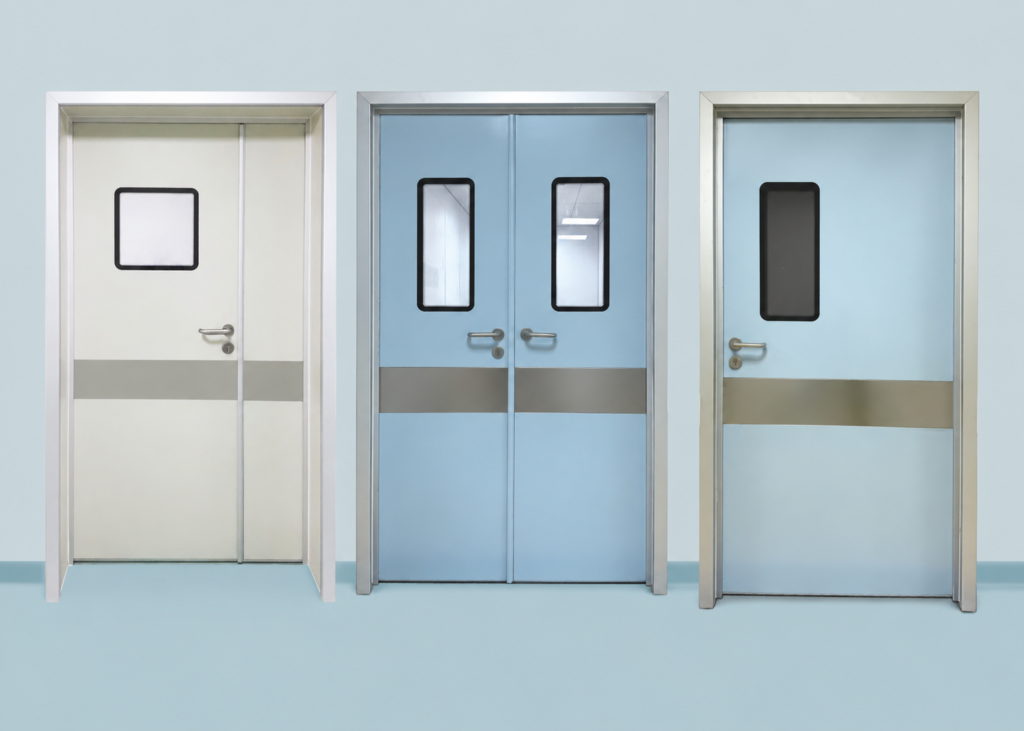
Choosing a cleanroom door is not simply about selecting a door panel. A cleanroom door affects contamination control, pressure stability, cleaning performance, maintenance cost, user safety, and the long-term reliability of the facility.
For buyers, the most important question is not “Which door is cheapest?” but:
Which door is suitable for my cleanroom classification, application, cleaning process, traffic flow, and compliance requirements?
Before placing an order, buyers should evaluate twelve key factors:
- Cleanroom classification and room function
- Door material
- Airtight performance
- Door type: hinged, sliding, automatic, or manual
- Door frame design
- Door core and panel structure
- Surface finish and cleanability
- Hardware and accessories
- Vision panel requirements
- Fire, radiation, or special protection needs
- Installation and sealing quality
- Supplier engineering capability
A well-selected cleanroom door helps maintain environmental control. A poorly selected door may cause air leakage, difficult cleaning, premature corrosion, pressure imbalance, frequent maintenance, and unnecessary replacement costs.
Who Is This Guide For?
This guide is written for:
- Hospital project managers
- Pharmaceutical engineering teams
- Cleanroom contractors
- EPC companies
- MEP engineers
- Procurement managers
- Laboratory planners
- Medical device manufacturers
- Healthcare architects
- Cleanroom equipment buyers
It is especially useful for buyers working on pharmaceutical facilities, hospital operating theaters, laboratories, electronics cleanrooms, medical device workshops, food processing areas, and other controlled environments.
Why Cleanroom Doors Matter
In a normal building, a door is mainly an access point. In a cleanroom, the door is part of the contamination control system.
A cleanroom door must support several functions:
- Separate clean and less-clean areas
- Help maintain pressure differences
- Reduce uncontrolled air leakage
- Provide smooth and cleanable surfaces
- Withstand frequent cleaning and disinfection
- Allow safe movement of people, carts, equipment, and materials
- Integrate with interlock systems, access control, or automatic operation when required
Many cleanroom problems are not caused by the door panel itself, but by poor matching between the door, wall system, HVAC design, traffic flow, cleaning method, and installation details.
That is why cleanroom doors should be selected during the design stage, not after the cleanroom layout has already been finalized.
1. Start With the Cleanroom Classification and Room Function
The first step is to understand where the door will be used.
A door for a pharmaceutical production room is different from a door for a hospital operating theater, a laboratory, or an electronics workshop.
Cleanroom classification is usually based on airborne particle concentration. However, the door selection should also consider room function, pressure direction, cleaning procedure, personnel flow, material flow, and safety requirements.
Typical Application Requirements
| Application | Main Door Requirements |
|---|---|
| Pharmaceutical cleanroom | Airtightness, cleanability, chemical resistance, GMP-friendly design |
| Hospital operating theater | Hygiene, easy disinfection, reliable opening, good sealing, smooth surface |
| Medical device workshop | Cleanability, stable performance, cost efficiency |
| Electronics cleanroom | Low particle generation, smooth finish, reliable sealing |
| Laboratory | Chemical resistance, safety, visibility, access control |
| Food processing area | Corrosion resistance, washability, hygiene |
| Radiation room | Lead shielding, radiation-proof vision panel, heavy-duty hardware |
Expert Recommendation
Do not choose a door only based on the product catalogue. First define the room function and risk level. For example, a corridor door, an airlock door, a material transfer door, and an operating room door may all require different configurations even within the same project.
2. Choose the Right Door Material
Material selection has a major impact on durability, cleaning, corrosion resistance, appearance, and cost.
The most common cleanroom door materials include:
- Powder-coated galvanized steel
- Stainless steel 304
- Stainless steel 316
- HPL or composite panel doors
- Aluminum frame doors for certain modular systems
For most pharmaceutical, hospital, and industrial cleanroom projects, powder-coated steel and stainless steel are the most common options.
Powder-Coated Galvanized Steel Doors
Powder-coated galvanized steel doors are widely used because they offer a good balance between cost, durability, and cleanroom suitability.
They are often suitable for:
- Pharmaceutical production areas
- Medical device workshops
- Electronics factories
- General ISO 7 or ISO 8 cleanrooms
- Corridors and auxiliary clean areas
Advantages:
- Cost-effective
- Smooth surface
- Good appearance
- Suitable for many cleanroom applications
- Available in different colors
- Compatible with modular wall systems
Limitations:
- Less corrosion-resistant than stainless steel
- Not ideal for very wet, highly corrosive, or aggressive chemical environments
- Surface quality depends heavily on coating quality and production process
Stainless Steel 304 Doors
SUS304 stainless steel is commonly used in hospitals, laboratories, food processing, and areas requiring stronger corrosion resistance.
Suitable for:
- Operating theaters
- Laboratories
- Sterile preparation areas
- Washing or wet areas
- Food and beverage clean areas
- Areas with frequent disinfection
Advantages:
- Strong corrosion resistance
- Easy to clean
- Hygienic appearance
- Durable in demanding environments
- Good long-term value
Limitations:
- Higher cost
- Surface scratches may be more visible
- Poor fabrication can still create gaps, sharp edges, or cleaning problems
Stainless Steel 316 Doors
SUS316 stainless steel provides higher corrosion resistance than SUS304 because of its molybdenum content. It is normally used only when the environment requires it.
Suitable for:
- Highly corrosive environments
- Areas exposed to strong chemicals
- Certain pharmaceutical or laboratory applications
- Coastal or high-humidity environments when corrosion risk is high
Advantages:
- Superior corrosion resistance
- Better performance in aggressive environments
Limitations:
- Significantly higher cost
- Often unnecessary for standard cleanroom applications
Material Selection Matrix
| Project Condition | Recommended Material |
|---|---|
| Standard pharmaceutical cleanroom | Powder-coated galvanized steel or SUS304 |
| Hospital operating theater | SUS304 or high-quality powder-coated steel, depending on specification |
| Wet cleaning area | SUS304 |
| Highly corrosive area | SUS316 |
| Electronics cleanroom | Powder-coated steel |
| Food processing clean area | SUS304 |
| Budget-sensitive ISO 7/ISO 8 cleanroom | Powder-coated galvanized steel |
| Radiation room | Steel or stainless steel with lead shielding |
Expert Recommendation
Stainless steel is not always the best choice. In many projects, high-quality powder-coated steel can meet the cleanroom requirement while reducing cost. The right question is not “Which material looks better?” but “Which material matches the cleaning chemicals, humidity, usage frequency, and project budget?”
3. Evaluate Airtight Performance
Airtightness is one of the most important differences between a normal door and a cleanroom door.
Cleanrooms often rely on pressure differences to control airflow direction. If the door leaks too much air, it may affect:
- Room pressure stability
- HVAC energy consumption
- Contamination control
- Airflow direction
- Comfort and noise
- Long-term operating cost
Airtight performance depends on:
- Door frame design
- Gasket quality
- Door leaf flatness
- Hinge or sliding mechanism
- Threshold design
- Installation accuracy
- Wall opening accuracy
For high-grade cleanrooms, airlocks, operating theaters, and pharmaceutical areas, airtightness should be carefully specified.
Common Airtight Door Features
- Continuous sealing gasket
- Flush or semi-flush design
- Strong door frame
- Accurate door leaf alignment
- Drop seal or bottom seal when needed
- Interlock system for airlocks
- Automatic closing device
Buyer Warning
Many suppliers call their product an “airtight cleanroom door,” but not all of them provide the same level of sealing performance. Buyers should ask how airtightness is achieved and whether the door design has been used in similar cleanroom projects.
Questions to Ask the Supplier
- What sealing structure is used?
- Is the gasket replaceable?
- Is there a bottom seal?
- Can the door maintain pressure difference in airlock applications?
- Has the design been used in pharmaceutical or hospital projects?
- Can drawings show the sealing details?
4. Select the Right Door Type
Cleanroom doors are available in several types. The right type depends on space, traffic flow, hygiene requirements, budget, and operating habits.
Hinged Cleanroom Doors
Hinged doors are the most common and cost-effective cleanroom doors.
Best for:
- Personnel access
- Small rooms
- Corridors
- Standard pharmaceutical or electronics cleanrooms
- Areas with limited budget
Advantages:
- Simple structure
- Lower cost
- Easy maintenance
- Reliable operation
- Suitable for many cleanroom applications
Limitations:
- Requires swing space
- Not ideal for high cart traffic
- Manual operation may increase touchpoints unless automatic accessories are added
Sliding Cleanroom Doors
Sliding doors are often used where space is limited or larger openings are required.
Best for:
- Hospital operating theaters
- Equipment transfer areas
- Wider openings
- Areas with frequent trolley movement
Advantages:
- Saves swing space
- Suitable for large openings
- Smooth access for beds, carts, and equipment
- Can be automatic
Limitations:
- Higher cost
- More complex installation
- Requires better track and sealing design
- Maintenance is more important
Automatic Cleanroom Doors
Automatic doors are commonly used in operating theaters, high-traffic areas, and areas requiring hands-free access.
Best for:
- Operating rooms
- ICU areas
- Sterile corridors
- Material transfer routes
- High-frequency access points
Advantages:
- Reduces hand contact
- Improves workflow
- Supports hygiene requirements
- Convenient for staff and equipment movement
Limitations:
- Higher cost
- Requires motor, sensor, controller, and maintenance
- Needs stable power supply and proper installation
Door Type Decision Table
| Requirement | Best Option |
|---|---|
| Lowest cost, simple access | Hinged door |
| Limited space | Sliding door |
| Hospital operating theater | Automatic sliding or hermetic sliding door |
| High cart traffic | Sliding door |
| Airlock personnel access | Hinged door with interlock |
| Large equipment movement | Double-leaf hinged or sliding door |
| Hands-free access | Automatic door |
Expert Recommendation
Do not choose automatic doors simply because they look more advanced. Automatic systems are valuable when they improve hygiene, workflow, or safety. For low-traffic cleanrooms, a well-designed manual hinged door may be more reliable and cost-effective.
5. Pay Attention to Door Frame Design
Door frame design is often overlooked, but it directly affects sealing, installation quality, cleanability, and long-term durability.
A good cleanroom door frame should be:
- Strong enough to prevent deformation
- Compatible with the wall system
- Easy to clean
- Accurately aligned with the door leaf
- Designed to reduce dust accumulation
- Properly sealed to the wall opening
Common frame options include:
- Steel frame
- Stainless steel frame
- Aluminum profile frame
- Flush frame for modular wall systems
- Wrap-around frame for stronger wall connection
Why Frame Design Matters
Even a high-quality door leaf will fail if the frame is poorly installed or incompatible with the wall system. Gaps between the frame and wall can become dirt traps and air leakage points.
Buyer Checklist for Door Frames
- Is the frame material the same as the door leaf?
- Is the frame suitable for the wall thickness?
- Is the frame welded or assembled?
- How is the frame sealed to the wall?
- Are there visible gaps after installation?
- Can the supplier provide frame section drawings?
Expert Recommendation
When comparing quotations, do not only compare the door leaf. Ask for the complete door set: door leaf, frame, gasket, hardware, viewing window, closer, lock, accessories, and installation details.
6. Check Door Core and Panel Structure
The internal structure of a cleanroom door affects strength, weight, sound insulation, fire performance, and long-term flatness.
Common door core materials may include:
- Paper honeycomb
- Aluminum honeycomb
- Rock wool
- Polyurethane foam
- Magnesium board or other composite cores
- Special fire-rated cores
Each core has different performance characteristics.
General Comparison
| Door Core | Advantages | Typical Use |
|---|---|---|
| Paper honeycomb | Lightweight, cost-effective | General clean areas |
| Aluminum honeycomb | Stronger, lightweight, good flatness | Higher-grade cleanrooms |
| Rock wool | Fire resistance, sound insulation | Fire-rated requirements |
| PU foam | Insulation, lightweight | Temperature-controlled areas |
| Special composite core | Project-specific performance | Fire, impact, or special applications |
What Buyers Should Consider
- Door size
- Frequency of use
- Impact risk
- Fire rating requirement
- Weight limitation
- Sound insulation requirement
- Temperature or humidity conditions
Expert Recommendation
For high-use hospital and pharmaceutical projects, door flatness and structural stability are very important. A door that deforms over time may lose sealing performance even if the material surface is still intact.
7. Evaluate Surface Finish and Cleanability
Cleanroom doors should be easy to clean and should not create unnecessary dirt traps.
Important surface requirements include:
- Smooth surface
- Low particle shedding
- Good coating adhesion
- Resistance to cleaning agents
- No unnecessary grooves
- No exposed porous materials
- Rounded or well-finished edges where possible
- Good connection between vision panel, frame, and door leaf
For pharmaceutical and medical applications, cleanability is not a cosmetic issue. It affects hygiene, inspection readiness, and long-term maintenance.
Surface Finish Options
| Surface | Advantages | Suitable For |
|---|---|---|
| Powder-coated steel | Smooth, economical, color options | General cleanrooms |
| Brushed stainless steel | Durable, hygienic appearance | Hospitals, labs, food |
| Mirror stainless steel | Easy to clean visually, premium appearance | Selected hospital or display areas |
| HPL surface | Impact resistance, design flexibility | Some hospital interiors |
Buyer Warning
A surface may look smooth in photos but still have weak coating, rough edges, poor joints, or difficult-to-clean details. Always check product details, not just overall appearance.
Expert Recommendation
Before choosing the surface finish, confirm the cleaning chemicals used by the facility. Some disinfectants may damage low-quality coatings over time.
8. Select Reliable Hardware and Accessories
Hardware is one of the most common failure points in cleanroom doors.
Important hardware includes:
- Hinges
- Handles
- Locks
- Door closers
- Drop seals
- Gaskets
- Interlock devices
- Automatic operators
- Sensors
- Access control systems
In cleanrooms and hospitals, doors are opened and closed many times every day. Low-quality hardware may cause noise, misalignment, poor closing, air leakage, and frequent maintenance.
Hardware Selection Guide
| Hardware | What to Check |
|---|---|
| Hinges | Load capacity, corrosion resistance, smooth operation |
| Door closer | Closing force, durability, adjustable speed |
| Handle | Easy cleaning, ergonomic design, corrosion resistance |
| Lock | Compatibility with access control if required |
| Gasket | Replaceability, chemical resistance, sealing performance |
| Drop seal | Smooth operation, durability |
| Automatic operator | Motor quality, sensor reliability, safety features |
| Interlock system | Logic control, emergency release, indicator lights |
Expert Recommendation
For high-frequency doors, hardware quality is often more important than a small difference in panel price. A cheap hinge or closer can cause repeated service problems and damage the buyer’s confidence in the whole project.
9. Define the Vision Panel Requirement
Vision panels allow staff to see through the door and reduce collision risk. They are common in hospitals, laboratories, cleanrooms, and corridors.
However, the vision panel must be properly designed for cleanroom use.
Important considerations:
- Glass type
- Glass thickness
- Double glazing or single glazing
- Flush installation
- Sealing quality
- Cleaning ease
- Fire-rated glass if required
- Lead glass for radiation rooms
Typical Vision Panel Options
| Application | Recommended Vision Panel |
|---|---|
| General cleanroom | Flush sealed glass window |
| Operating theater | Larger observation window if required |
| Corridor door | Vision panel for safety |
| Radiation room | Lead glass window |
| Fire-rated door | Fire-rated glass |
| Privacy-sensitive room | Blinds or smaller window if appropriate |
Buyer Warning
Poorly installed vision panels may become leakage points or cleaning problems. In cleanroom doors, the window detail is just as important as the door panel.
10. Confirm Fire, Radiation, or Special Protection Requirements
Some cleanroom doors require more than cleanliness.
Depending on the project, buyers may need:
- Fire-rated doors
- Radiation shielding doors
- Lead-lined doors
- Acoustic doors
- Anti-static doors
- Explosion-resistant doors
- Access-controlled doors
These requirements must be confirmed early because they affect material, core, hardware, weight, frame design, installation, and cost.
Fire-Rated Cleanroom Doors
Fire-rated requirements depend on local building codes and project specifications. If fire rating is required, the buyer should confirm:
- Required fire resistance time
- Door core material
- Frame design
- Fire-rated hardware
- Fire-rated glass if there is a vision panel
- Certification or test report availability
Radiation Shielding Doors
Radiation shielding doors are used in X-ray rooms, CT rooms, and other radiation-controlled areas.
Important factors include:
- Required lead equivalency
- Lead sheet thickness
- Door weight
- Hinge or sliding system strength
- Lead glass vision panel
- Frame shielding continuity
- Installation quality
Expert Recommendation
Never treat radiation shielding doors as normal cleanroom doors with lead added inside. Shielding continuity around the frame, window, lock area, and wall connection must be considered carefully.
11. Consider Installation Quality and Site Coordination
A cleanroom door is only as good as its installation.
Even a well-made door can perform poorly if:
- The wall opening is inaccurate
- The frame is not level
- The gasket is compressed unevenly
- The door leaf is misaligned
- The wall connection is not sealed properly
- The floor level is uneven
- The sliding track is not installed correctly
Installation affects sealing, smooth operation, cleaning, safety, and service life.
Site Coordination Checklist
Before installation, confirm:
- Wall thickness
- Opening size
- Floor level
- Door opening direction
- Ceiling height
- Power supply for automatic doors
- Space for sliding track
- Access control wiring
- Interlock wiring
- Finished floor level
- Coordination with wall panel supplier
Expert Recommendation
For overseas projects, buyers should request detailed installation drawings and videos before shipment. This reduces misunderstanding between the supplier, contractor, and installation team.
12. Evaluate the Supplier’s Engineering Capability
A cleanroom door supplier should not only sell products. They should understand cleanroom applications.
A reliable supplier should be able to provide:
- Product drawings
- Door schedule support
- Material recommendations
- Frame section drawings
- Hardware options
- Custom sizes
- Project-specific solutions
- Installation guidance
- Packing suitable for export
- Spare parts support
- Quality control documentation
Supplier Evaluation Table
| Evaluation Item | Why It Matters |
|---|---|
| Cleanroom project experience | Shows practical understanding |
| Customization ability | Cleanroom projects often require non-standard sizes |
| Drawing support | Reduces design and installation errors |
| Material knowledge | Helps avoid over-specification or wrong selection |
| Hardware quality | Affects long-term reliability |
| Export packing | Reduces damage during international shipping |
| Lead time control | Important for project schedules |
| After-sales support | Essential for overseas buyers |
| Ability to supply related products | Helps contractors reduce coordination work |
Questions to Ask Before Ordering
- Have you supplied doors for pharmaceutical, hospital, or cleanroom projects before?
- Can you provide technical drawings before production?
- What materials and core options do you offer?
- Can you customize sizes and hardware?
- How do you pack the doors for export?
- Can you provide installation guidance?
- What spare parts are available?
- What is the normal production lead time?
- Can you supply matching cleanroom windows, pass boxes, or wall systems?
Expert Recommendation
For international buyers, supplier communication and engineering support are as important as the product itself. A low quotation may become expensive if the supplier cannot support drawings, customization, packing, installation, and after-sales coordination.
Cleanroom Door Selection by Project Type
| Project Type | Recommended Door Solution |
|---|---|
| Pharmaceutical ISO 7 cleanroom | Powder-coated steel or SUS304 hinged door with good gasket sealing |
| Hospital operating theater | Automatic sliding or hermetic sliding door, often SUS304 or high-quality coated steel |
| Medical device workshop | Cost-effective cleanroom hinged door with smooth surface |
| Electronics cleanroom | Powder-coated steel door with low particle shedding surface |
| Laboratory | SUS304 or chemically resistant door depending on process |
| Food processing clean area | SUS304 door with washable surface |
| Airlock room | Hinged door with interlock system and good sealing |
| Radiation room | Lead-lined door with lead glass and reinforced hardware |
| High-traffic corridor | Durable hinged or sliding door with strong hardware |
| Budget-sensitive cleanroom | Powder-coated steel door with reliable frame and gasket |
Common Mistakes When Buying Cleanroom Doors
Mistake 1: Choosing the Lowest Price Only
The cheapest cleanroom door may cost more in the long run if it causes air leakage, corrosion, installation problems, or frequent hardware failure.
Mistake 2: Selecting Material Before Understanding the Cleaning Process
Cleaning chemicals, humidity, and disinfection frequency should influence material selection. Do not choose stainless steel or powder-coated steel without understanding the actual operating environment.
Mistake 3: Ignoring the Door Frame
Many buyers compare door panels but forget the frame. The frame affects sealing, installation, and cleanability.
Mistake 4: Over-Specifying Stainless Steel
Stainless steel is excellent, but not always necessary. In many cleanrooms, powder-coated steel offers a better balance of performance and cost.
Mistake 5: Under-Specifying Hardware
Hinges, closers, handles, and gaskets determine daily performance. Poor hardware can damage the user experience quickly.
Mistake 6: Not Confirming Wall Compatibility
The door must match the wall system. Wall thickness, opening size, panel type, and frame fixing method should be confirmed before production.
Mistake 7: Forgetting Maintenance
Gaskets, closers, locks, and automatic operators may need maintenance or replacement. Buyers should ask about spare parts and service support.
Mistake 8: Treating Special Doors as Standard Doors
Fire-rated doors, lead-lined doors, and automatic hermetic doors require special design. They should not be selected as ordinary cleanroom doors.
Buyer Checklist Before Requesting a Quotation
Before asking for a quotation, prepare the following information:
- Cleanroom classification or room grade
- Industry application
- Room function
- Door size
- Wall thickness
- Opening direction
- Hinged or sliding type
- Manual or automatic operation
- Material preference
- Door core requirement
- Surface finish
- Vision panel size
- Lock type
- Door closer requirement
- Interlock requirement
- Access control requirement
- Fire rating requirement
- Radiation shielding requirement
- Quantity
- Project country
- Required lead time
- Installation responsibility
The more clearly these details are provided, the more accurate the quotation will be.
Supplier Scorecard for Cleanroom Door Buyers
Use this simple scorecard when comparing suppliers.
| Question | Supplier A | Supplier B | Supplier C |
|---|---|---|---|
| Do they understand cleanroom applications? | |||
| Can they provide drawings? | |||
| Do they offer material options? | |||
| Can they customize sizes? | |||
| Do they provide frame details? | |||
| Are hardware options clearly listed? | |||
| Is export packing reliable? | |||
| Can they provide installation support? | |||
| Do they supply related cleanroom products? | |||
| Is communication professional and responsive? |
A supplier with a slightly higher price but stronger engineering support may be a better choice for international cleanroom projects.
Frequently Asked Questions
1. What is the best material for a cleanroom door?
There is no single best material for every project. Powder-coated galvanized steel is suitable for many pharmaceutical, electronics, and medical device cleanrooms. SUS304 stainless steel is better for hospitals, laboratories, wet areas, and environments requiring stronger corrosion resistance. SUS316 is usually reserved for highly corrosive environments.
2. Are stainless steel cleanroom doors always better?
No. Stainless steel has excellent corrosion resistance, but it is not always necessary. For many standard cleanrooms, high-quality powder-coated steel can provide good performance at a lower cost.
3. What is the difference between a cleanroom door and a normal door?
A cleanroom door is designed for controlled environments. It normally has smoother surfaces, better sealing, cleanable materials, compatible frames, and options such as interlock, automatic operation, or special vision panels.
4. Should I choose a hinged or sliding cleanroom door?
Choose hinged doors for standard personnel access and cost-effective applications. Choose sliding doors for operating theaters, limited space, larger openings, or frequent trolley movement.
5. Do cleanroom doors need to be airtight?
Many cleanroom doors require good sealing to support pressure control and contamination control. The required airtightness depends on the room function, pressure difference, and cleanroom design.
6. Can cleanroom doors be automatic?
Yes. Automatic cleanroom doors are commonly used in operating theaters, high-traffic clean areas, and areas requiring hands-free access.
7. Can cleanroom doors have windows?
Yes. Vision panels are common, but they should be properly sealed and easy to clean. For radiation rooms or fire-rated doors, special glass may be required.
8. What information should I provide to get an accurate quotation?
You should provide door size, quantity, wall thickness, material preference, door type, opening direction, room function, hardware requirements, and any special requirements such as fire rating, radiation shielding, interlock, or automatic operation.
9. How long does a cleanroom door last?
Service life depends on material, hardware quality, usage frequency, cleaning chemicals, installation quality, and maintenance. In high-traffic areas, hardware and gasket quality are especially important.
10. Can one supplier provide different types of cleanroom doors for the same project?
Yes. A complete project may require hinged doors, sliding doors, automatic doors, lead-lined doors, and fire-rated doors. Working with a supplier that can provide multiple door types helps reduce coordination work.
11. Do cleanroom doors require maintenance?
Yes. Gaskets, hinges, closers, locks, sliding tracks, sensors, and automatic operators should be inspected regularly. Maintenance helps preserve sealing performance and smooth operation.
12. What is the most common mistake when buying cleanroom doors?
The most common mistake is focusing only on door material or price while ignoring the frame, gasket, hardware, installation, and room application.
Conclusion
Choosing the right cleanroom door requires more than comparing prices or materials. Buyers should evaluate the complete door system, including material, airtightness, frame design, core structure, surface finish, hardware, installation, and supplier capability.
For pharmaceutical plants, hospitals, laboratories, electronics factories, and other controlled environments, the best cleanroom door is not always the most expensive one. It is the door that matches the project’s cleanliness requirement, workflow, cleaning process, safety needs, and long-term maintenance expectations.
A good supplier should help buyers make the right decision—not simply sell a standard product.
Need Help Selecting Cleanroom Doors for Your Project?
Juxing Purification Technology provides cleanroom doors, medical doors, pass boxes, FFU units, air filtration products, and turnkey cleanroom and operating theater solutions for international projects.
If you are planning a hospital, pharmaceutical, laboratory, electronics, or industrial cleanroom project, our team can help evaluate your requirements and recommend suitable cleanroom door solutions based on your application, budget, and project standards.