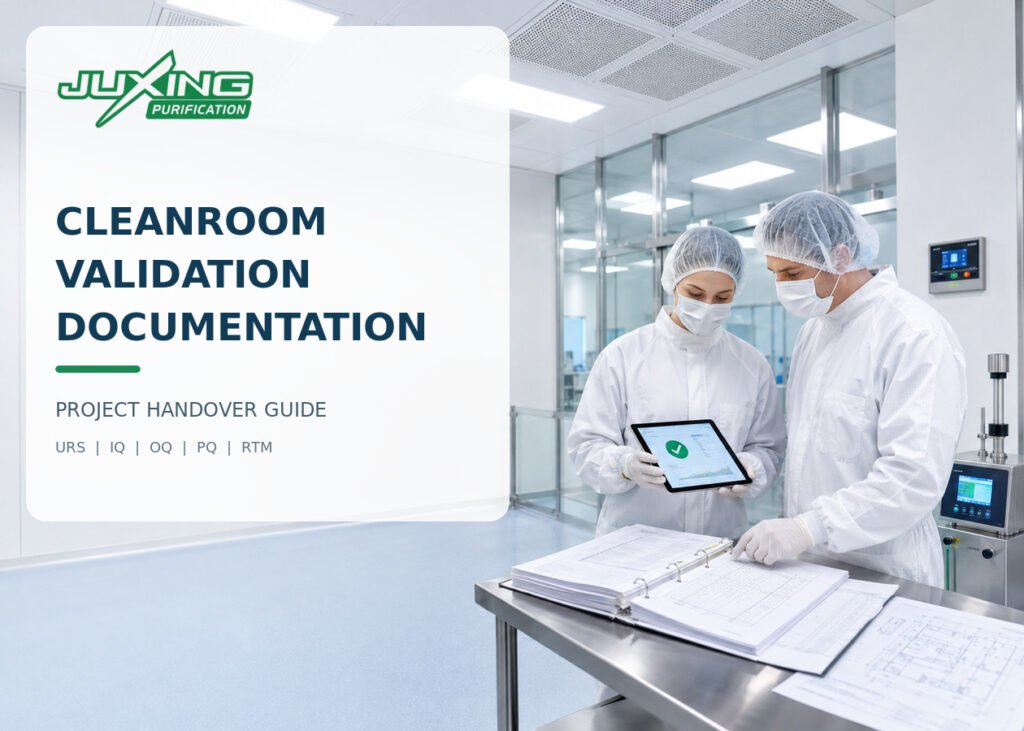
Cleanroom validation is not complete simply because the rooms have been constructed and the environmental tests have passed. The project must also provide a complete, accurate, traceable, and approved documentation package.
This documentation demonstrates that the cleanroom was designed according to defined requirements, installed correctly, tested under appropriate conditions, and shown to perform as intended. It also provides the technical baseline for operation, maintenance, change control, requalification, deviation investigation, and future audits.
For owners and international buyers, validation documentation should therefore be treated as a contractual deliverable—not as paperwork to be assembled after construction.
Quick Answer
A complete cleanroom validation package should connect the user requirements to design decisions, installation records, commissioning results, qualification tests, deviations, corrective actions, and final acceptance.
The core documentation normally includes:
- User Requirements Specification
- Validation Master Plan
- Design Qualification
- Requirements Traceability Matrix
- Approved drawings and technical specifications
- Factory and site acceptance test records
- Installation Qualification
- Operational Qualification
- Performance Qualification
- Calibration and material certificates
- HVAC and HEPA filter test reports
- Standard operating procedures
- Training records
- Deviation and change-control records
- Final validation summary report
- Handover and acceptance documents
The exact document set should be defined according to the cleanroom’s application, regulatory requirements, project scope, and risk level.
Key Takeaways
- Validation documents should be planned before construction and testing begin.
- Every critical user requirement should be traceable to design, installation, testing, and acceptance evidence.
- Approved protocols must define test methods and acceptance criteria before execution.
- Raw data, calculations, instrument records, deviations, and approvals form part of the validation evidence.
- FAT, SAT, commissioning, and qualification have different purposes, although some test results may be leveraged when scientifically justified.
- “As-built” drawings must reflect the completed facility rather than the original design alone.
- Open deviations and incomplete records should be clearly controlled before final handover.
- Electronic files should be organized, protected, searchable, and consistent with signed records.
Why Is Cleanroom Validation Documentation Important?
A cleanroom is an integrated controlled environment. Its performance depends on the interaction of:
- Room layout
- Wall and ceiling systems
- HVAC equipment
- HEPA filtration
- Airflow distribution
- Pressure cascades
- Utilities
- Doors and interlocks
- Monitoring systems
- Cleaning procedures
- Personnel and material flow
- Operational practices
A single particle-count report cannot demonstrate that all these elements have been appropriately designed and controlled.
A well-structured documentation package provides evidence that the cleanroom has moved through a controlled lifecycle:
- Requirements were defined.
- The design addressed those requirements.
- Equipment and systems were supplied as specified.
- Installation matched the approved design.
- Systems operated within defined limits.
- The cleanroom performed as intended.
- Deviations and changes were evaluated.
- The owner received the information necessary to maintain the qualified state.
For regulated pharmaceutical projects, the European Commission’s Annex 15 on Qualification and Validation describes a lifecycle approach under which qualification and validation activities should be planned, documented, and based on quality risk management.
The appropriate requirements for a particular project may also come from ISO standards, national regulations, GMP guidance, contractual specifications, and the owner’s quality system.
What Is the Difference Between Commissioning Documents and Validation Documents?
Commissioning and validation are related, but they do not have identical objectives.
Commissioning documentation
Commissioning demonstrates that building systems and equipment have been installed, started, adjusted, and made ready for operation.
Typical commissioning records include:
- Equipment startup sheets
- Pre-functional checklists
- Electrical and mechanical inspections
- Air balancing reports
- Control-point verification
- Alarm and interlock checks
- Utility startup records
- Defect and punch-list records
- Commissioning reports
Validation documentation
Validation or qualification provides documented evidence that the cleanroom and its systems are suitable for their intended use and meet approved requirements.
Typical validation documents include:
- URS
- VMP
- DQ
- IQ
- OQ
- PQ
- RTM
- Approved protocols
- Executed test records
- Deviations and investigations
- Validation summary report
Commissioning results may support qualification when the tests are suitable, documented, reviewed, and performed under an approved approach. However, commissioning records should not automatically be relabeled as qualification evidence.
For an explanation of the earlier project stage, see What Is Cleanroom Commissioning? A Complete Guide Before Validation.
Which Planning Documents Should Be Prepared First?
User Requirements Specification
The User Requirements Specification, or URS, defines what the cleanroom must achieve from the user’s perspective.
It may cover:
- Intended use
- Required cleanroom grades or ISO classes
- Room functions
- Occupancy and operating states
- Temperature and humidity ranges
- Differential-pressure requirements
- Airflow strategy
- Environmental-monitoring needs
- Utilities
- Cleaning requirements
- Material and personnel flows
- Alarms and data recording
- Maintenance access
- Applicable regulations and standards
- Documentation and training deliverables
Requirements should be clear, measurable, and testable. Statements such as “the cleanroom shall have good airflow” are not suitable because they do not define an objective acceptance criterion.
More detail is available in What Is a User Requirements Specification? A Complete Guide for Cleanroom Projects.
Validation Master Plan
The Validation Master Plan, or VMP, defines the overall validation strategy.
It should establish:
- Project scope
- Systems to be qualified
- Roles and responsibilities
- Validation stages
- Required protocols and reports
- Risk-assessment methodology
- Document formats
- Acceptance and approval processes
- Deviation handling
- Change-control requirements
- Use of vendor documentation
- Requalification strategy
- Required training
- Record-retention expectations
The VMP should be approved before major qualification activities begin.
See What Is a Validation Master Plan? A Complete Guide for Cleanroom Projects.
Validation risk assessment
The risk assessment determines which systems, functions, and parameters can affect product quality, process performance, patient safety, or contamination control.
It can be used to establish:
- Critical systems
- Critical design features
- Required test coverage
- Testing depth
- Sampling locations
- Acceptance criteria
- Documentation priorities
- Requalification frequencies
Risk assessment should focus resources on meaningful risks without removing necessary verification.
What Design Documents Are Required?
The design package creates the technical basis for construction and qualification.
It may include:
- Approved room layouts
- Cleanroom zoning drawings
- Personnel-flow diagrams
- Material-flow diagrams
- Pressure-cascade diagrams
- HVAC schematics
- Airflow and air-volume calculations
- HEPA filter layouts
- Room data sheets
- Equipment schedules
- Utility drawings
- Control-system architecture
- Alarm philosophy
- Door and interlock schedules
- Wall, ceiling, floor, window, and door details
- Material specifications
- Cleaning and maintenance access details
Design Qualification
Design Qualification, or DQ, documents the review of the proposed design against the URS, applicable requirements, risk assessment, and accepted engineering practices.
A DQ should not be limited to a signature on a drawing. It should show how the design addresses critical requirements and identify any unresolved issues before installation.
The review may examine:
- Room classification strategy
- Pressure relationships
- Airflow patterns
- HEPA filter placement
- Return-air locations
- Cleanability
- Personnel and material segregation
- Door opening directions
- Maintenance access
- Monitoring-point locations
- Utility connections
- Control and alarm functions
- Potential contamination traps
Design deficiencies identified after construction are usually more expensive and disruptive to correct.
What Supplier Documents Should Be Included?
Supplier documentation provides important evidence about installed equipment and materials.
Depending on the project, required records may include:
- Approved technical submittals
- Equipment datasheets
- Manufacturer drawings
- Bills of materials
- Product certificates
- Material certificates
- Filter certificates
- Calibration certificates
- Electrical diagrams
- Control-panel drawings
- Software or configuration records
- Welding or fabrication records
- Surface-finish information
- Operation and maintenance manuals
- Recommended spare-parts lists
- Warranty documents
The required supplier documentation should be specified in purchase orders and contracts. If documentation requirements are introduced only at the end of the project, important manufacturing and inspection records may no longer be recoverable.
What Are FAT and SAT Records?
Factory Acceptance Testing
FAT is performed at the manufacturer’s facility before equipment is shipped.
FAT records may cover:
- Equipment identification
- Dimensions and construction
- Materials and components
- Electrical functions
- Controls
- Alarms
- Interlocks
- Safety functions
- Documentation review
- Visual inspection
- Outstanding defects
FAT can reduce site problems, but it does not confirm that the equipment will perform correctly after transportation and installation.
Site Acceptance Testing
SAT is performed after delivery and installation at the project site.
SAT may verify:
- Shipping condition
- Equipment identity
- Installation interfaces
- Electrical connections
- Utility connections
- Control communication
- Alarm functions
- Interlocks
- Site-specific operating functions
- Resolution of FAT observations
FAT and SAT protocols should clearly define the equipment, test conditions, acceptance criteria, responsibilities, and treatment of deviations.
What Must Be Included in Installation Qualification?
Installation Qualification, or IQ, provides documented verification that systems and equipment have been installed according to approved specifications and drawings.
IQ documentation may include:
- Equipment identification
- Manufacturer and model
- Serial numbers
- Installation location
- Component verification
- Material verification
- Utility connections
- Instrument lists
- Calibration status
- Filter identification
- Motor and fan information
- Drawing verification
- Software or firmware versions
- Spare-parts verification
- Maintenance requirements
- Document availability
- Safety checks
IQ should also verify that required operating procedures, manuals, drawings, and certificates are available.
As-built drawings
As-built drawings are particularly important. They should show the facility as actually constructed, including approved changes made during installation.
Relevant as-built records may include:
- Architectural layouts
- Ceiling layouts
- HEPA filter locations
- Supply and return air paths
- Ductwork
- Pressure-monitoring points
- Utilities
- Electrical systems
- control-system architecture
- Door and interlock locations
- Service penetrations
Marking an original design drawing “as built” without verifying field conditions is not sufficient.

What Must Be Included in Operational Qualification?
Operational Qualification, or OQ, verifies that the cleanroom and its systems operate as intended throughout specified operating ranges.
Depending on the cleanroom type, OQ may include:
- HEPA filter integrity testing
- Air velocity or air-volume measurement
- Air-change-rate calculation
- Differential-pressure verification
- Airflow-direction testing
- Airflow visualization
- Non-viable particle classification
- Temperature mapping
- Relative-humidity testing
- Recovery testing
- Alarm testing
- Door-interlock testing
- Building-management-system verification
- Power-failure response
- Control-system challenge testing
- Data-recording verification
The executed OQ protocol should contain actual results—not only “pass” or “fail” marks.
Each test record should identify:
- Test date and time
- Room or equipment
- Test method
- Test condition
- Acceptance criteria
- Actual result
- Instrument used
- Instrument calibration status
- Tester
- Reviewer
- Related deviation, if applicable
What Must Be Included in Performance Qualification?
Performance Qualification, or PQ, demonstrates that the cleanroom performs effectively under representative operating conditions.
PQ may involve:
- Normal personnel numbers
- Representative equipment
- Defined process activities
- Routine cleaning procedures
- Actual material and personnel movement
- Environmental monitoring
- Process-specific contamination controls
- Repeated testing over an approved period
- Assessment of operational variability
A cleanroom can pass at-rest classification but perform poorly when personnel, equipment, and processes are introduced. PQ therefore evaluates the interaction between the facility and actual operations.
The distinction between at-rest and operational conditions should be clearly stated in protocols and reports.
What Is a Requirements Traceability Matrix?
The Requirements Traceability Matrix, or RTM, links each approved requirement to the documents that demonstrate its implementation and verification.
A typical RTM may contain:
| URS reference | Requirement | Design reference | Risk classification | Verification stage | Test reference | Result |
|---|---|---|---|---|---|---|
| URS-ENV-001 | Room shall meet required cleanliness classification | HVAC drawing and room data sheet | Critical | OQ | OQ-PC-01 | Pass |
| URS-HVAC-004 | Room pressure shall be maintained within the approved range | Pressure-cascade drawing | Critical | OQ/PQ | OQ-DP-02 | Pass |
| URS-CTL-006 | Pressure excursion shall generate an alarm | Control narrative | Major | OQ | OQ-ALM-04 | Pass |
The RTM helps reveal:
- Requirements that were never tested
- Tests with no linked requirement
- Design changes that were not reassessed
- Missing evidence
- Unresolved deviations
- Inconsistent references
See What Is a Requirements Traceability Matrix? A Complete Guide for Cleanroom Projects.
What Should a Validation Protocol Contain?
Each protocol should be approved before execution and normally include:
- Document title and number
- Version
- Purpose
- Scope
- Responsibilities
- System description
- References
- Prerequisites
- Required instruments
- Test methods
- Acceptance criteria
- Data-recording forms
- Deviation procedure
- Approval signatures
Acceptance criteria should be based on approved requirements, design specifications, risk assessment, applicable standards, or validated process needs.
Criteria should not be created or weakened after results are known merely to obtain a passing outcome.
What Records Must Be Preserved During Testing?
The complete evidence package may include:
- Original test sheets
- Instrument printouts
- Electronic data
- Photographs
- Videos of airflow visualization
- Raw particle-count data
- Environmental-monitoring results
- Calculations
- Calibration certificates
- Equipment identification
- Test setup diagrams
- Annotated drawings
- Deviation records
- Repeat-test justification
- Investigator notes
- Approval records
Summary reports should not replace raw data.
If data are recorded electronically, the project should define file formats, access controls, audit-trail expectations, backup arrangements, naming conventions, and record retention.
How Should Deviations Be Documented?
Any departure from the approved protocol, method, acceptance criterion, or expected condition should be recorded.
A qualification deviation record should include:
- Description of the event
- Test step affected
- Date and location
- Immediate action
- Evidence preserved
- Investigation
- Root cause or most probable cause
- Impact assessment
- Correction
- CAPA, if required
- Retesting requirements
- Final disposition
- Quality approval
A failed test should not be deleted or replaced by a new passing test. The original result, investigation, correction, and approved retest must remain traceable.
Open deviations should be clearly listed in the final report. Any decision to proceed before closure should be formally justified, risk assessed, and approved.
How Should Changes Be Controlled During the Project?
Cleanroom projects frequently change because of site conditions, user requests, equipment interfaces, or coordination problems.
Relevant changes may include:
- Room dimensions
- Door locations
- HEPA filter quantities
- Return-air positions
- Pressure setpoints
- Finishing materials
- Equipment models
- Control logic
- Alarm delays
- Monitoring locations
- Utility routes
Each significant change should be assessed for its effect on:
- URS compliance
- Design qualification
- Risk assessment
- Drawings
- Test protocols
- Completed test results
- Qualification status
- Operating procedures
- Training
- Requalification requirements
Uncontrolled field changes create gaps between the installed facility and the approved documentation.
Which SOPs and Operational Documents Are Required at Handover?
Validation confirms that the cleanroom can perform as intended. Operating procedures help ensure that it continues to do so.
Required procedures may include:
- Cleanroom entry and exit
- Gowning
- Material transfer
- Cleaning and disinfection
- Environmental monitoring
- Pressure-alarm response
- HVAC operation
- HEPA filter replacement
- Preventive maintenance
- Calibration
- Door and interlock operation
- Deviation reporting
- Change control
- Requalification
- Shutdown and restart
- Emergency response
Procedures should correspond to the installed facility and actual operating model. Generic supplier manuals alone are not sufficient for site-specific operation.
What Training Records Should Be Included?
Personnel should be trained according to their responsibilities before independent operation.
Training records may cover:
- Cleanroom behavior
- Gowning qualification
- Cleaning procedures
- Equipment operation
- Alarm response
- Environmental monitoring
- Maintenance activities
- Data recording
- Deviation reporting
- Emergency procedures
A signature confirming attendance does not always demonstrate competence. Where appropriate, training effectiveness should be assessed through observation, practical demonstration, written testing, or supervised performance.
What Is the Final Validation Summary Report?
The Validation Summary Report consolidates the results of the qualification program and supports the final decision on whether the cleanroom is suitable for intended use.
It should summarize:
- Scope
- Systems qualified
- Protocols executed
- Test results
- Deviations
- Changes
- Retesting
- Outstanding items
- Risk assessments
- Acceptance status
- Limitations or operating conditions
- Requalification requirements
- Final conclusion
The report should not state that the cleanroom is validated if critical tests, deviations, or documents remain unresolved without an approved justification.
How Should the Handover Package Be Organized?
A practical handover package may be divided into the following sections:
- Project and contract documents
- User requirements and validation planning
- Risk assessments
- Design qualification
- Approved drawings and specifications
- Supplier and material documentation
- FAT and SAT records
- Installation Qualification
- Operational Qualification
- Performance Qualification
- Deviations and change controls
- SOPs and training records
- Operation and maintenance manuals
- Calibration and maintenance schedules
- Spare-parts and warranty records
- Requirements Traceability Matrix
- Validation Summary Report
- Final acceptance records
An index should identify document numbers, titles, revision status, approval status, and file locations.
Both paper and electronic records should use consistent document identifiers.
Buyer’s Checklist for Cleanroom Validation Documentation
Before signing final project acceptance, confirm that:
- The URS is approved and current.
- The VMP defines the completed validation strategy.
- Critical risks have been assessed.
- DQ has been completed.
- Approved and as-built drawings are available.
- Equipment and materials match approved specifications.
- FAT and SAT observations have been resolved.
- IQ, OQ, and PQ protocols were approved before execution.
- Test instruments had valid calibration.
- Raw data and calculations are included.
- Acceptance criteria are clear and traceable.
- Failed tests and deviations remain visible in the records.
- Retesting is supported by approved investigations.
- Changes have been assessed and approved.
- Critical open items have been closed or formally controlled.
- Required SOPs are effective.
- Operators and maintenance personnel have been trained.
- Preventive-maintenance schedules are available.
- Requalification requirements are defined.
- The RTM demonstrates complete requirement coverage.
- The Validation Summary Report is approved.
- Final documentation has been received in the agreed format.
Common Misconceptions
“A passing particle-count report proves that the cleanroom is validated.”
Particle classification is only one test. Validation may also require evidence relating to installation, HEPA integrity, airflow, pressure, temperature, humidity, controls, alarms, recovery, procedures, and operational performance.
“Vendor certificates can replace site qualification.”
Vendor certificates are useful supporting documents, but they may not demonstrate correct site installation or performance under actual conditions.
“FAT results do not need to be retained after SAT.”
FAT establishes part of the equipment history and may document functions that are difficult to repeat on site. It should remain traceable within the final package.
“Commissioning and qualification tests must always be repeated.”
Some commissioning data may be leveraged if the method, instrument control, acceptance criteria, documentation, execution, and approval meet the qualification strategy. The decision should be defined and justified.
“As-built drawings are only needed for future renovations.”
They are also important for maintenance, troubleshooting, HEPA testing, pressure investigation, change control, and requalification.
“An electronic folder containing many files is a complete handover package.”
A complete package must be indexed, approved, version-controlled, traceable, readable, and consistent with the installed facility.
Expert Tip
Define the final documentation index during the procurement or contract stage.
For every required document, specify:
- Responsible party
- Required format
- Language
- Approval authority
- Submission stage
- Number of copies
- Electronic file type
- Acceptance requirements
This prevents documentation from becoming an uncontrolled collection of drawings, certificates, and test sheets at the end of the project.
Frequently Asked Questions
Who is responsible for preparing cleanroom validation documents?
Responsibility is normally shared among the owner, cleanroom contractor, HVAC contractor, equipment suppliers, commissioning team, validation specialists, testing organizations, and quality unit. The responsibility matrix should be agreed before execution.
Can the cleanroom supplier perform validation?
A qualified supplier may prepare protocols or conduct specified tests. However, the owner remains responsible for defining requirements, ensuring appropriate oversight, reviewing evidence, and approving the facility for intended use.
Are IQ, OQ, and PQ required for every cleanroom?
The required qualification stages depend on the industry, application, regulatory framework, owner’s quality system, and risk assessment. Regulated facilities commonly use the DQ–IQ–OQ–PQ lifecycle, but the scope and terminology may vary.
Can ISO 14644 classification replace GMP qualification?
No. ISO 14644 classification provides important evidence of airborne particle cleanliness, but GMP qualification and contamination control generally involve additional systems, risks, procedures, and operational requirements.
Should validation protocols be approved before testing?
Yes. Protocols should normally be reviewed and approved before execution so that the test method and acceptance criteria are not influenced by the results.
What happens if a test fails?
The result should be documented, investigated, and assessed for impact. Corrective action and approved retesting may be required. The original failed result must remain part of the record.
When should the documentation package be handed over?
Documents should be submitted progressively throughout the project. Waiting until final completion makes it more difficult to review deficiencies and recover missing evidence.
How long should cleanroom validation records be retained?
Retention periods depend on applicable regulations, product requirements, contracts, and the owner’s quality system. Records should remain available for as long as they are needed to support the facility’s qualified state and relevant product or process history.
Conclusion
Cleanroom validation documentation is the evidence that connects intended requirements with actual facility performance.
A reliable handover package should demonstrate that the cleanroom was properly specified, designed, installed, commissioned, qualified, and prepared for controlled operation. It should also provide the owner with the records needed for maintenance, investigations, change control, and future requalification.
The most effective approach is to define documentation requirements at the beginning of the project, generate records as the work progresses, review them before each approval stage, and resolve gaps before final acceptance.
A cleanroom without complete and traceable documentation may appear finished, but its state of control cannot be confidently demonstrated.
Further Reading: