
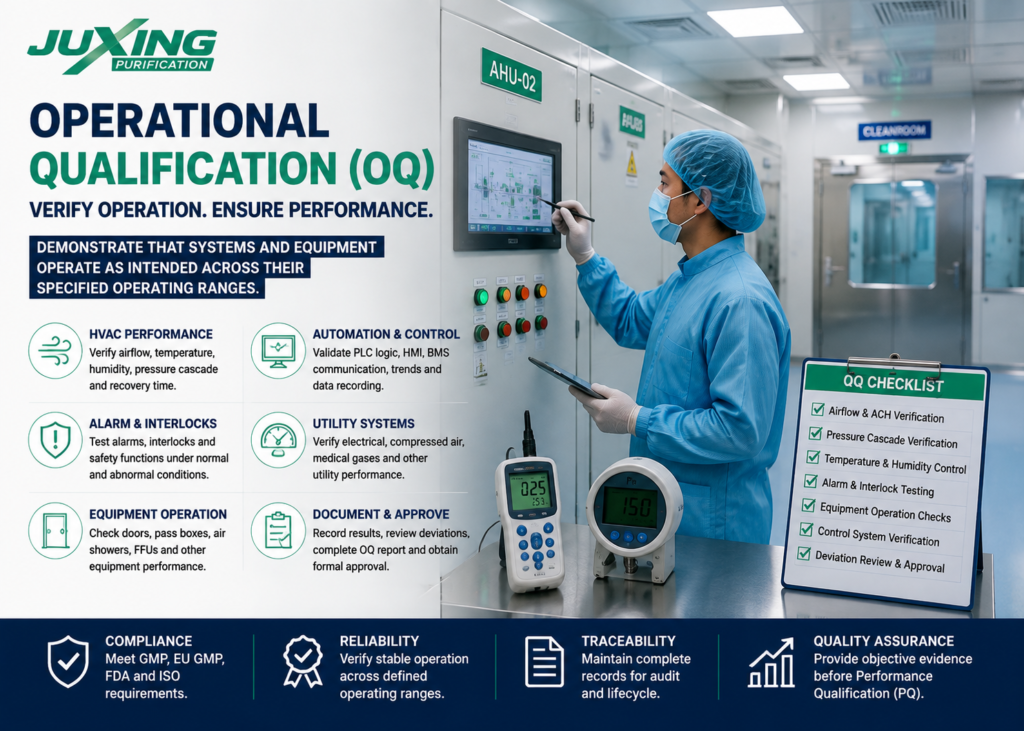
Quick Answer
Operational Qualification (OQ) is the documented process of demonstrating that a cleanroom system, equipment, or utility operates as intended throughout its specified operating ranges under controlled conditions.
Unlike Installation Qualification (IQ), which verifies that equipment has been installed correctly, OQ evaluates operational functionality. It confirms that critical parameters—including airflow, pressure, temperature, humidity, alarms, interlocks, control systems, and operating sequences—perform consistently according to predefined acceptance criteria.
OQ is normally performed after Installation Qualification (IQ) has been successfully completed and before Performance Qualification (PQ). It provides objective evidence that the system is ready for routine process qualification or production.
Key Takeaways
- Operational Qualification (OQ) verifies that equipment and systems operate according to approved specifications.
- OQ evaluates performance across defined operating ranges rather than under routine production conditions.
- Acceptance criteria should be established before testing begins.
- OQ follows successful Installation Qualification (IQ) and normally precedes Performance Qualification (PQ).
- Every operational test should produce documented, objective, and traceable evidence.
- Deviations identified during OQ should be investigated and resolved before proceeding to PQ.
Introduction
Successfully installing cleanroom equipment does not automatically demonstrate that it performs correctly.
A cleanroom may contain properly installed HVAC systems, hermetic doors, pass boxes, monitoring devices, programmable controllers, environmental sensors, and utility systems, yet still fail to maintain the required environmental conditions during operation.
This is why Operational Qualification (OQ) is an essential stage within the qualification lifecycle.
Rather than confirming how equipment has been installed, OQ evaluates how the installed systems actually perform when operated under predefined conditions.
For pharmaceutical manufacturing facilities, biotechnology laboratories, hospitals, semiconductor plants, and other controlled environments, OQ provides documented evidence that critical systems function consistently throughout their intended operating ranges before routine production begins.
Unlike Performance Qualification (PQ), which evaluates process performance during actual production, OQ focuses on the operational capability of the facility and its supporting systems.
This guide explains what Operational Qualification is, why it is important, what should be tested, how it differs from IQ and PQ, and how organizations can implement an effective OQ programme for cleanroom projects.
What Is Operational Qualification (OQ)?
Operational Qualification is the documented verification that equipment, systems, and utilities operate according to approved specifications throughout their defined operating ranges.
The objective is to demonstrate that all critical operating functions perform consistently under controlled test conditions.
An effective OQ confirms that:
- Operating parameters remain within predefined limits.
- Control systems respond correctly.
- Alarms activate when required.
- Safety functions operate properly.
- Automatic sequences function as designed.
- Equipment performs repeatedly and reliably.
Unlike routine production testing, OQ deliberately challenges systems under both normal and abnormal operating conditions to confirm that protective functions continue to perform as intended.
Why Is Operational Qualification Important?
Many operational issues cannot be identified during installation or visual inspection alone.
Examples include:
- Unstable pressure control
- Incorrect alarm settings
- Inaccurate sensor readings
- Improper PLC logic
- Delayed control responses
- Communication failures
- Recovery time outside specification
- Temperature instability
- Humidity fluctuations
Although these issues may not be visible immediately after installation, they can significantly affect product quality, environmental control, regulatory compliance, and operational reliability.
Operational Qualification identifies these problems before production begins.
Resolving operational deficiencies during OQ is considerably less costly than discovering them during process validation or regulatory inspections.
Where Does OQ Fit Within the Qualification Lifecycle?
Operational Qualification forms the second stage of formal qualification.
A typical project sequence is:
Procurement
        ↓
Factory Acceptance Testing (FAT)
        ↓
Delivery
        ↓
Site Acceptance Testing (SAT)
        ↓
Commissioning
        ↓
Installation Qualification (IQ)
        ↓
Operational Qualification (OQ)
        ↓
Performance Qualification (PQ)
Although project execution varies, OQ generally begins only after:
- Installation Qualification has been approved.
- Major commissioning activities have been completed.
- Critical deviations have been resolved.
- Calibration is current.
- Test procedures have been approved.
Beginning OQ before these prerequisites are satisfied often results in repeated testing and unnecessary deviations.
OQ vs. Installation Qualification (IQ)
Operational Qualification and Installation Qualification are complementary but fundamentally different.
Installation Qualification documents that equipment has been installed correctly.
Operational Qualification demonstrates that the installed equipment operates correctly.
| Installation Qualification (IQ) | Operational Qualification (OQ) |
|---|---|
| Verifies installation | Verifies operation |
| Reviews documentation | Evaluates functional performance |
| Confirms equipment identification | Confirms operating capability |
| Verifies utilities and installation | Challenges operating parameters |
| Focuses on physical installation | Focuses on operational behaviour |
For example:
During IQ, engineers verify that a pressure transmitter has been installed correctly and possesses a valid calibration certificate.
During OQ, engineers verify that the same pressure transmitter accurately detects pressure changes, communicates with the control system, and activates alarms at the specified setpoints.
OQ vs. Performance Qualification (PQ)
OQ and PQ are often confused because both involve testing system performance.
However, their objectives differ.
Operational Qualification demonstrates that equipment can operate correctly throughout its specified operating ranges.
Performance Qualification demonstrates that the complete process consistently produces acceptable results during routine production or actual operational use.
For example:
An OQ may verify that:
- HVAC maintains temperature between predefined limits.
- Pressure cascade remains stable.
- Alarms activate correctly.
- Door interlocks function properly.
- Environmental monitoring responds appropriately.
PQ, by contrast, evaluates whether the complete cleanroom consistently supports the intended manufacturing process or clinical activity over time.
In short:
OQ asks:
Can the system operate correctly?
PQ asks:
Can the system consistently support its intended process?
When Should Operational Qualification Be Performed?
Operational Qualification should begin only after several prerequisites have been satisfied.
Typical prerequisites include:
- IQ has been successfully completed.
- Commissioning has been completed.
- Calibration certificates remain valid.
- Critical deviations have been closed.
- Standard Operating Procedures (SOPs) are available.
- Test instruments have been calibrated.
- Approved OQ protocol has been issued.
- Qualified personnel are available.
Careful preparation reduces repeated testing and improves overall qualification efficiency.
What Is Included in Operational Qualification?
Although every project differs, most cleanroom OQ protocols evaluate similar categories of operational performance.
Typical verification includes:
- Airflow performance
- Pressure cascade
- Temperature control
- Relative humidity control
- Alarm functions
- Interlock operation
- Control sequences
- Emergency shutdown
- Power recovery
- Sensor response
- Building Management System (BMS) communication
- Environmental monitoring interfaces
- User access permissions
- Software functionality
- Data recording
Each test should include predefined acceptance criteria established before testing begins.
Objective evidence—not subjective observations—should determine whether each requirement has been satisfied.
What Should Be Tested During Operational Qualification?
The purpose of Operational Qualification is to verify that the installed system operates consistently throughout its defined operating range under controlled test conditions.
Unlike commissioning, which focuses on adjusting and optimizing system performance, OQ confirms—through documented evidence—that operational requirements have been achieved and can be reproduced.
The scope of OQ should be based on:
- User Requirements Specification (URS)
- Functional Specification (FS)
- Approved Design Specification (DS)
- Risk assessment
- Regulatory requirements
- Project acceptance criteria
Every operational test should have:
- A predefined objective
- A documented procedure
- Measurable acceptance criteria
- Recorded results
- Final approval
The emphasis is on objective evidence rather than subjective judgement.
HVAC Operational Testing
Because HVAC systems largely determine cleanroom environmental performance, they form one of the most critical components of Operational Qualification.
Typical HVAC-related OQ tests include:
- Supply airflow verification
- Return airflow verification
- Exhaust airflow verification
- Airflow balance
- Temperature control
- Relative humidity control
- Pressure cascade verification
- Alarm functionality
- Fan failure response
- Automatic changeover (if applicable)
- Control sequence verification
- BMS communication
Each parameter should be tested under predefined operating conditions rather than under ideal laboratory conditions.
Where automatic control systems are used, the qualification should demonstrate stable operation over the specified operating range.
Air Changes per Hour (ACH)
One important operational parameter is the verification of Air Changes per Hour (ACH).
Rather than simply measuring airflow volume, OQ should confirm that the ventilation system consistently delivers the required air change rate specified in the project design.
Typical verification includes:
- Supply airflow measurements
- Room volume confirmation
- ACH calculation
- Comparison with design values
- Repeatability of results
Related reading:
Where airflow is automatically controlled, testing should also verify stable operation following adjustments to system demand.
Differential Pressure Verification
Maintaining the correct pressure relationship between adjacent spaces is essential for contamination control.
During OQ, pressure should be evaluated under representative operating conditions.
Typical verification includes:
- Room-to-room pressure differences
- Pressure stability
- Pressure alarm setpoints
- Alarm response time
- Sensor response
- Pressure recovery following door operation
The objective is not merely to observe positive or negative pressure, but to demonstrate that the designed pressure cascade remains stable throughout normal operating conditions.
Related reading:
Cleanroom Differential Pressure
Recovery Time Verification
Recovery time demonstrates how quickly a cleanroom returns to its specified environmental condition after a controlled disturbance.
Typical disturbances include:
- Door opening
- Simulated personnel movement
- Temporary interruption of airflow
Following the disturbance, engineers record the time required for environmental parameters to return to the predefined acceptance limits.
Recovery testing provides valuable evidence regarding HVAC performance and room stability.
Acceptance criteria should always be defined before testing begins.
Temperature and Humidity Control
Environmental stability is another critical component of Operational Qualification.
Typical OQ activities include:
- Temperature mapping
- Humidity verification
- Sensor comparison
- Control stability
- Alarm verification
- Trend recording
Testing should evaluate both steady-state operation and system response following changes in operating conditions.
The goal is to demonstrate that environmental parameters remain within the approved operating range without excessive fluctuation.
Equipment-Specific Operational Qualification
Different cleanroom equipment requires different operational tests.
The following examples represent common engineering practice.
Hermetic Doors
Typical OQ tests include:
- Opening speed
- Closing speed
- Automatic operation
- Manual operation
- Safety sensor verification
- Emergency release
- Interlock operation
- Alarm verification
- Repeat operating cycles
- Recovery after power interruption
Where doors interface with access control or Building Management Systems, communication should also be verified.
Related reading:
Cleanroom Door Specifications Explained
Pass Boxes
Operational Qualification commonly includes:
- Door interlock testing
- UV cycle verification (if applicable)
- Fan operation
- HEPA filter monitoring (where applicable)
- Alarm verification
- Timer verification
- Indicator lights
- Recovery following power interruption
Testing should demonstrate reliable operation over multiple cycles rather than a single successful operation.
Air Showers
Typical OQ activities include:
- Cycle duration
- Fan performance
- Air velocity verification (where specified)
- Door interlock operation
- Emergency stop
- Alarm response
- Automatic restart
- Control panel functionality
The objective is to verify repeatable operational performance under predefined conditions.
Fan Filter Units (FFUs)
For FFUs, OQ may include:
- Fan speed control
- Airflow response
- Controller communication
- Alarm verification
- Filter status monitoring
- Power recovery
- Noise and vibration checks (where specified)
Where FFUs are connected to a centralized control system, communication stability should also be verified.
Control Systems and Automation
Automation testing often represents one of the most extensive sections of an OQ protocol.
Typical tests include:
- PLC logic verification
- Human-Machine Interface (HMI) operation
- User access permissions
- Alarm priorities
- Trend recording
- Historical data storage
- Communication with BMS
- Communication with environmental monitoring systems
- Backup and restore functions
- Power recovery
- Fail-safe operation
Every alarm, interlock, and automated sequence should be challenged under predefined conditions rather than simply observed during normal operation.
Acceptance Criteria
A common weakness in poorly prepared OQ protocols is the use of vague acceptance criteria.
Statements such as:
“System operates normally.”
provide little objective evidence.
Instead, acceptance criteria should be measurable.
Examples include:
- Pressure differential remains within the approved operating range.
- Alarm activates within the specified response time.
- Door interlock prevents simultaneous opening.
- Temperature remains within the approved operating range throughout the test period.
- PLC executes the required control sequence without faults.
Predefined acceptance criteria improve consistency and simplify qualification reviews.
Common Operational Deviations
Operational Qualification frequently identifies issues that were not apparent during Installation Qualification.
Typical examples include:
HVAC Control Problems
- Unstable airflow
- Pressure fluctuations
- Slow recovery time
- Incorrect control tuning
Automation Issues
- Incorrect PLC programming
- Alarm configuration errors
- Communication failures
- Incorrect user permissions
Sensor Problems
- Incorrect calibration settings
- Sensor drift
- Delayed response
- Incorrect alarm thresholds
Equipment Performance Issues
- Door interlocks operating inconsistently
- Pass box cycle failures
- FFU speed instability
- Control panel communication interruptions
Each deviation should be documented, investigated, and assessed according to the project’s quality management procedures.
Corrective actions should be verified before the qualification process proceeds to Performance Qualification (PQ).
Buyer’s OQ Checklist
Before approving Operational Qualification, project owners, quality teams, and engineering personnel should confirm that the operational testing has been completed according to the approved protocol and that objective evidence demonstrates compliance with all predefined acceptance criteria.
The following checklist provides a practical reference for cleanroom projects.
Documentation
☐ Approved OQ protocol is available.
☐ IQ has been successfully completed and approved.
☐ Required commissioning activities have been completed.
☐ Current calibration certificates are available.
☐ Approved Standard Operating Procedures (SOPs) are available.
☐ Test instruments are calibrated and traceable.
☐ Acceptance criteria have been defined before testing begins.
HVAC Operational Performance
☐ Air Changes per Hour (ACH) meets the design specification.
☐ Room pressure differentials remain within the approved operating range.
☐ Temperature remains stable during the test period.
☐ Relative humidity remains within the specified limits.
☐ Recovery time complies with project requirements.
☐ HVAC alarms function correctly.
☐ Automatic control sequences perform as specified.
Equipment Performance
☐ Hermetic doors operate consistently.
☐ Door interlocks function correctly.
☐ Pass box operating cycles perform correctly.
☐ Air shower operating cycles perform correctly.
☐ FFU controllers operate normally.
☐ Safety devices function correctly.
☐ Emergency shutdown functions have been verified.
Automation and Control Systems
☐ PLC logic performs according to the approved functional specification.
☐ Human-Machine Interface (HMI) operates correctly.
☐ Alarm priorities are correctly configured.
☐ Historical data recording functions properly.
☐ User access permissions have been verified.
☐ Communication with Building Management System (BMS) is stable.
☐ Communication with environmental monitoring systems has been verified.
Documentation and Approval
☐ All operational test results have been recorded.
☐ Deviations have been documented.
☐ Corrective actions have been completed.
☐ Required retesting has been successfully completed.
☐ OQ report has been reviewed and approved.
☐ Equipment is formally authorized to proceed to Performance Qualification (PQ).
Completing this checklist provides documented evidence that the cleanroom systems are capable of operating reliably within their specified operating ranges.
Common Misconceptions
Misconception 1: “OQ Is Just Turning the Equipment On”
Operating equipment successfully is only one small part of Operational Qualification.
OQ is a structured verification process designed to demonstrate that equipment consistently operates within predefined limits under controlled conditions.
A single successful startup does not provide sufficient evidence that the system performs reliably across its intended operating range.
Misconception 2: “Passing OQ Means the Facility Is Ready for Production”
Not necessarily.
Operational Qualification demonstrates that the equipment and supporting systems operate correctly.
It does not demonstrate that the cleanroom consistently supports the intended manufacturing process or clinical activity.
That objective belongs to Performance Qualification (PQ).
Misconception 3: “Normal Production Can Replace OQ”
Routine production should not be used instead of Operational Qualification.
OQ follows a predefined protocol with documented test procedures, controlled operating conditions, objective acceptance criteria, and complete records.
Production activities rarely provide the level of control and documentation required for formal qualification.
Misconception 4: “Only HVAC Systems Need OQ”
HVAC is one of the most important systems, but Operational Qualification should also evaluate other critical systems that affect cleanroom performance.
Examples include:
- Hermetic doors
- Pass boxes
- Air showers
- Fan Filter Units (FFUs)
- Environmental monitoring systems
- Building Management Systems (BMS)
- PLCs and automation systems
- Alarm systems
- Safety interlocks
The exact scope should be determined through project-specific risk assessment and regulatory requirements.
Expert Tip
One of the most effective ways to improve OQ efficiency is to perform a comprehensive pre-OQ review before formal testing begins.
Experienced project teams verify that commissioning records, calibration certificates, SAT reports, IQ documentation, software revisions, and operating procedures are complete before executing the OQ protocol.
Another best practice is to challenge systems under both normal and simulated abnormal operating conditions whenever appropriate. For example, deliberately triggering alarm conditions, simulating sensor failures, interrupting power supplies, or opening interlocked doors provides stronger evidence that safety functions and control logic perform as intended.
Finally, every OQ test should be fully traceable. Test conditions, measured values, instrument identification, acceptance criteria, operator signatures, dates, and any deviations should be recorded clearly so that the qualification can withstand future internal reviews and regulatory inspections.
Frequently Asked Questions
Who performs Operational Qualification?
Operational Qualification is typically performed by qualified validation or engineering personnel. Depending on the project, the work may involve the equipment supplier, EPC contractor, commissioning engineers, quality assurance representatives, and the facility owner.
Is OQ required for every cleanroom project?
The answer depends on the intended use of the facility, applicable regulations, contractual requirements, and the project’s quality management system.
For pharmaceutical, biotechnology, and other GMP-regulated facilities, OQ is generally regarded as a fundamental qualification activity before routine operation begins.
Can Operational Qualification begin before IQ is completed?
Generally, no.
Installation Qualification provides the documented evidence that the system has been installed correctly. Beginning OQ before IQ has been completed may result in repeated testing, unresolved installation issues, and incomplete qualification records.
How are deviations handled during OQ?
All deviations should be documented, investigated, and evaluated according to the project’s quality management procedures.
Corrective actions should be implemented and verified, and any required retesting should be completed before the system proceeds to Performance Qualification.
Does OQ verify cleanroom classification?
Not usually.
Cleanroom classification tests, such as airborne particle concentration testing in accordance with ISO 14644, are separate activities with their own procedures and acceptance criteria.
OQ may include verification of environmental control systems that support cleanroom performance, but formal classification should follow the applicable testing standards and project requirements.
What comes after Operational Qualification?
Once Operational Qualification has been successfully completed and approved, the project typically advances to Performance Qualification (PQ).
PQ evaluates whether the complete cleanroom, equipment, and associated processes consistently perform as intended during actual operational use, providing the final stage of qualification before routine production or clinical operation.
Conclusion
Operational Qualification is the critical link between installation verification and routine operational use. By demonstrating that cleanroom systems operate consistently within predefined limits, OQ provides documented evidence that the facility is technically ready for Performance Qualification.
Unlike Installation Qualification, which focuses on how systems have been installed, OQ evaluates how they function. It verifies operational parameters, confirms control strategies, challenges alarm and safety functions, and demonstrates that critical systems respond predictably under controlled conditions.
For pharmaceutical manufacturing facilities, biotechnology laboratories, hospitals, semiconductor plants, and other controlled environments, a well-executed OQ reduces operational risk, strengthens regulatory compliance, and builds confidence that the cleanroom infrastructure is capable of supporting its intended purpose.
When integrated with Factory Acceptance Testing (FAT), Site Acceptance Testing (SAT), Commissioning, Installation Qualification (IQ), and the subsequent Performance Qualification (PQ), Operational Qualification forms a key element of a lifecycle approach to delivering reliable, compliant, and high-performing cleanroom facilities.