
Cleanroom Classification vs Monitoring: Key Differences Explained
Introduction
A cleanroom may pass its initial airborne particle classification test and still develop performance problems later.
Filter loading, airflow imbalance, damaged door seals, process changes, equipment installation, maintenance work and changes in personnel activity can all affect contamination control after the cleanroom has been commissioned.
This is why cleanroom classification and cleanroom monitoring must be treated as two different but complementary activities.
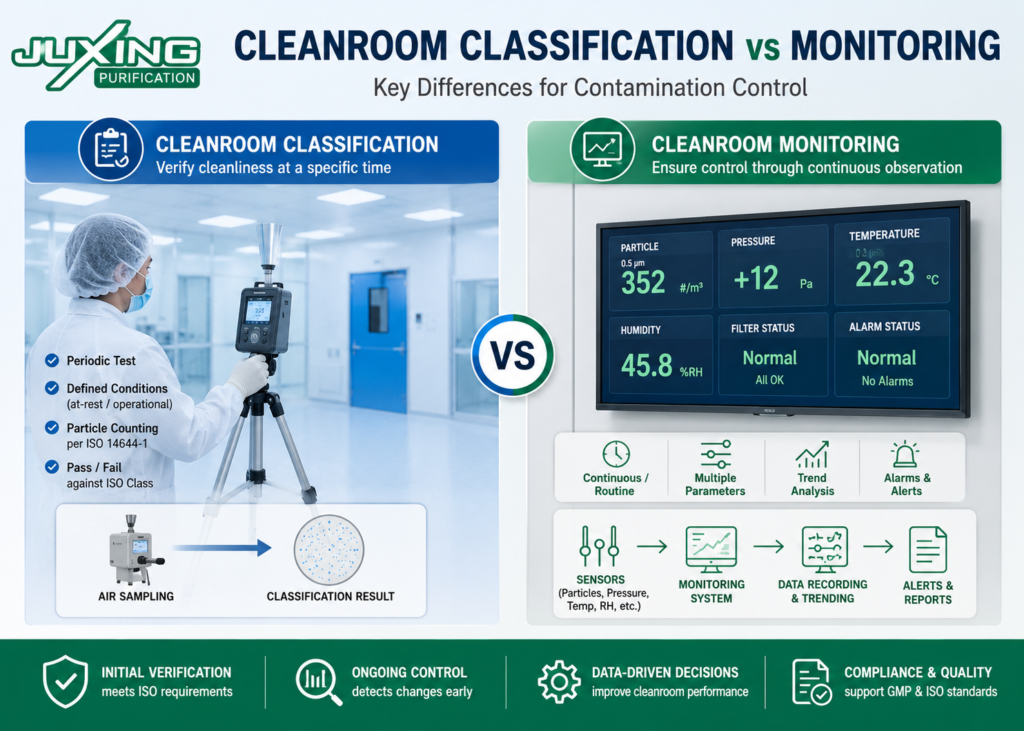
Classification provides evidence that a cleanroom meets a specified airborne particle cleanliness class under defined conditions. Monitoring provides ongoing evidence about whether selected cleanroom performance parameters remain within established limits over time.
For cleanroom owners, EPC contractors, consultants, procurement managers and quality teams, understanding this distinction is essential when defining testing scope, monitoring systems and long-term operating responsibilities.
What Is Cleanroom Classification?
Cleanroom classification is the formal process of determining whether a cleanroom or clean zone meets a specified airborne particle concentration class.
ISO 14644-1 establishes cleanroom classes based on the concentration of airborne particles at specified particle sizes. Classification is performed under a defined occupancy state, such as:
- As-built
- At-rest
- Operational
The test normally involves measuring airborne particle concentrations at defined sampling locations and comparing the results with the applicable class limits.
In simple terms:
Classification answers the question: Does the cleanroom meet its specified particle cleanliness class at the time of testing?
ISO 14644-1 provides the framework for classifying air cleanliness by particle concentration, while ISO 14644-2 addresses monitoring used to provide evidence of ongoing cleanroom performance related to particle cleanliness.
What Is Cleanroom Monitoring?
Cleanroom monitoring is the planned observation, measurement and review of selected parameters that indicate whether the cleanroom remains in a controlled state.
Depending on the application, a monitoring program may include:
- Airborne particle concentration
- Differential pressure
- Temperature
- Relative humidity
- Airflow velocity or volume
- Microbiological contamination
- Filter or fan operating status
- Door status
- Alarm records
- Equipment and utility conditions
ISO 14644-2 specifically establishes minimum requirements for a monitoring plan related to cleanroom performance based on airborne particle concentration. It does not create a universal monitoring schedule for every cleanroom; the monitoring plan should reflect the facility, process, risk and performance needs.
For sterile pharmaceutical manufacturing, monitoring is broader than non-viable particle counting. It forms part of the facility’s environmental monitoring and contamination control systems. FDA guidance describes environmental monitoring as an important laboratory control that provides information about the quality and trends of aseptic processing environments.
Classification vs Monitoring at a Glance
| Aspect | Cleanroom Classification | Cleanroom Monitoring |
|---|---|---|
| Main purpose | Confirm compliance with a specified cleanliness class | Detect changes and provide evidence of continued performance |
| Typical timing | Initial qualification, requalification or after significant change | Routine, periodic or continuous during operation |
| Main reference | ISO 14644-1 | ISO 14644-2 and project-specific requirements |
| Primary measurement | Airborne particle concentration | Particles and other selected environmental parameters |
| Test condition | Defined as-built, at-rest or operational state | Based on actual process and monitoring strategy |
| Result | Pass or fail against class limits | Data trends, alarms, excursions and state-of-control evidence |
| Duration | A defined test event | Ongoing throughout facility operation |
| Main users | Commissioning and qualification teams | Operations, engineering, quality and facility teams |
The key point is:
Classification is a snapshot. Monitoring shows how performance changes over time.
Is Classification the Same as Qualification?
No.
Classification is normally one component of broader cleanroom qualification.
A complete cleanroom qualification program may include:
- Airborne particle classification
- Airflow volume or velocity testing
- HEPA filter integrity testing
- Differential pressure testing
- Airflow visualization
- Recovery testing
- Temperature and humidity verification
- Room integrity or leakage-related assessments
- Alarm and control-system verification
EU GMP Annex 1 lists cleanroom and clean-air-equipment qualification considerations such as installed filter leakage testing, airflow testing, pressure-difference testing, airflow visualization, microbial contamination, temperature, humidity and recovery testing where relevant.
Therefore:
- Classification confirms the particle cleanliness class.
- Qualification demonstrates that the cleanroom and its supporting systems perform according to approved requirements.
- Monitoring provides ongoing evidence after qualification.
Is Monitoring the Same as Reclassification?
No.
Routine monitoring does not automatically replace formal reclassification or requalification.
Monitoring data may show that particle levels, pressure or environmental conditions remain stable, but periodic formal testing may still be required by:
- Applicable regulations
- Quality systems
- Customer specifications
- Risk assessments
- Validation plans
- Internal procedures
- Contractual requirements
Similarly, passing a periodic classification test does not eliminate the need for appropriate monitoring between test dates.
A cleanroom can pass an annual classification test but experience intermittent pressure reversals, filter alarms or elevated particle levels during production. Routine monitoring is intended to detect these events.
Why Initial Classification Alone Is Not Enough
Cleanroom performance can change after handover.
Common causes include:
Filter Loading
As filters collect particles, resistance may increase and airflow can change.
Door Seal Deterioration
Damaged or poorly adjusted doors can affect pressure stability and contamination migration.
HVAC Imbalance
Changes in supply, return or exhaust airflow may alter room pressure and air distribution.
Equipment Installation
New equipment can block airflow or create heat and particles.
Process Changes
A higher production rate or different activity may generate more contamination.
Personnel Changes
Additional operators or changes in movement patterns can increase particle generation.
Maintenance Activities
Ceiling work, filter replacement or HVAC maintenance can affect cleanroom integrity.
Sensor Drift
Pressure, temperature and particle sensors may require calibration and maintenance.
Classification demonstrates performance under the specific conditions present during testing. Monitoring is needed to identify changes that occur afterward.
What Should a Cleanroom Monitoring Plan Include?
A monitoring plan should be documented and based on risk, process requirements and the intended cleanroom use.
Key elements include the following.
1. Monitoring Objectives
The plan should clearly define what the monitoring system is intended to demonstrate.
Examples include:
- Detect loss of pressure cascade
- Identify particle excursions
- Confirm temperature and humidity control
- Monitor critical processing zones
- Provide trend data
- Support batch review
- Trigger investigation or corrective action
2. Parameters to Be Monitored
Not every parameter must be measured continuously in every cleanroom.
The project team should determine which parameters are critical to:
- Product quality
- Personnel protection
- Process performance
- Regulatory compliance
- Cleanroom classification
- Containment strategy
3. Monitoring Locations
Sampling points should be selected according to risk and process relevance, not only convenience.
Potential locations include:
- Critical work zones
- Product exposure points
- Near doors
- Near material-transfer points
- High-activity areas
- Pressure interfaces
- Return air areas
- Locations identified during airflow studies
FDA guidance states that sampling timing, frequency and locations should be carefully selected according to their relationship with the operations being performed.
4. Monitoring Frequency
Monitoring may be:
- Continuous
- Per production shift
- Per batch
- Daily
- Weekly
- Periodic
- Event-based
The correct frequency depends on process risk and the potential speed and consequence of losing control.
5. Alert and Action Levels
The monitoring plan should distinguish between:
- Normal operating range
- Alert level
- Action level
- System alarm limit
- Specification limit, where applicable
These terms should be defined carefully because they may have different meanings under different quality systems.
6. Response to Excursions
The plan should define:
- Who receives the alarm
- Immediate operational action
- Investigation requirements
- Product-impact assessment
- Corrective and preventive actions
- Documentation requirements
- Conditions for restarting production
7. Data Review and Trending
Single values should not be reviewed in isolation.
Trend analysis may identify:
- Gradually increasing particle levels
- Repeated pressure fluctuations
- Filter deterioration
- Seasonal humidity problems
- Recurrent alarms during door opening
- Changes linked to particular shifts or activities
Which Parameters Require Continuous Monitoring?
There is no single answer for every cleanroom.
Continuous monitoring is more likely to be appropriate where:
- Loss of control could quickly affect product quality
- Critical aseptic processes are operating
- Pressure reversal presents significant risk
- Environmental changes can occur rapidly
- Immediate alarms are necessary
- Regulations or approved procedures require it
FDA’s aseptic-processing guidance recommends continuously monitoring pressure differentials during production shifts and documenting and investigating alarms and deviations from established limits.
For less critical industrial cleanrooms, periodic monitoring may be suitable for some parameters, provided the approach is supported by risk assessment and operating history.
The final monitoring strategy should distinguish between:
- What is technically possible
- What is operationally useful
- What is required by the applicable quality or regulatory system
Particle Classification vs Routine Particle Monitoring
Although both use particle-counting equipment, their purposes differ.
Classification Testing
Classification testing follows a defined method to determine whether the room meets an ISO class.
It considers:
- Room area
- Minimum number of sampling locations
- Sampling volume
- Particle sizes
- Occupancy state
- Statistical and acceptance requirements
Routine Particle Monitoring
Routine monitoring observes selected locations over time.
It may focus on:
- Critical process points
- Worst-case areas
- Specific production activities
- Alarm limits
- Long-term trends
- Event investigation
Routine monitoring locations are therefore not necessarily identical to classification sampling locations.
A classification test seeks representative evidence of the room’s class. Routine monitoring focuses on locations most relevant to ongoing process risk.
Non-Viable Particle Monitoring vs Microbiological Monitoring
These two activities should not be confused.
Non-Viable Particle Monitoring
Measures particles based on size and concentration.
It does not determine whether particles are living microorganisms.
Microbiological Monitoring
Assesses viable contamination using methods such as:
- Active air sampling
- Settle plates
- Surface contact plates
- Swabs
- Personnel monitoring
In pharmaceutical cleanrooms, both forms of monitoring may be needed because particle control does not directly prove microbiological control.
FDA guidance describes environmental monitoring as a program that should identify potential routes of contamination and provide meaningful information about aseptic processing environments and trends.
The selection of microbiological methods, locations and limits should be determined by qualified microbiology and quality personnel according to the process and applicable GMP requirements.
Monitoring Differential Pressure
Differential pressure is one of the most important indicators of airflow direction between adjacent rooms.
Pressure monitoring can help detect:
- Open doors
- Failed door seals
- HVAC imbalance
- Blocked filters
- Fan failure
- Exhaust-system problems
- Pressure reversals
However, a displayed pressure value must be interpreted correctly.
A pressure sensor may show an acceptable value while:
- The door is open
- Airflow direction is locally unstable
- Sensor tubing is blocked
- The transmitter is out of calibration
- The measurement point does not represent the critical interface
Pressure monitoring should therefore be supported by:
- Correct sensor placement
- Calibration
- Alarm testing
- Door-control logic
- Periodic airflow verification
- Investigation of repeated excursions
Monitoring Temperature and Relative Humidity
Temperature and relative humidity may affect:
- Personnel comfort
- Product stability
- Static electricity
- Microbial growth potential
- Equipment performance
- Process repeatability
- Condensation risk
Their acceptable ranges should be based on the process and product, not on a generic cleanroom number.
A cleanroom’s ISO class does not by itself determine a universal temperature or humidity requirement.
For example, an electronics cleanroom may prioritize static control, while a pharmaceutical process may prioritize operator comfort, material stability and microbial-risk management.
Monitoring System Design Considerations
Sensor Location
Sensors should measure conditions relevant to the room and process. Avoid locations that create misleading readings due to local drafts, heat sources or inaccessible tubing.
Calibration Access
Sensors should be accessible for calibration without unnecessary disruption.
Alarm Management
Too many nuisance alarms can lead operators to ignore meaningful events.
Alarm delays and limits should be justified carefully so they do not conceal genuine loss of control.
Data Integrity
Where monitoring data support regulated decisions, the system should provide appropriate:
- User access control
- Time-stamped records
- Audit trails, where required
- Data backup
- Change control
- Review and approval processes
Integration
Monitoring may be integrated with:
- Building management systems
- Environmental monitoring systems
- Manufacturing execution systems
- Alarm-notification platforms
- Batch-record systems
The required level of integration depends on the facility and quality system.
Common Monitoring Mistakes
1. Installing Sensors Without a Risk Assessment
More sensors do not automatically create a better monitoring program.
Each location should have a clear purpose.
2. Using Classification Points as the Only Monitoring Points
Classification locations may not represent the highest process risk.
3. Setting Generic Alarm Limits
Limits copied from another facility may not be appropriate.
4. Ignoring Short Pressure Excursions
Repeated short-duration events may reveal door-control or HVAC problems.
5. Collecting Data Without Trending It
Large volumes of data have little value if they are not reviewed.
6. Failing to Define Alarm Response
Operators must know what action to take after an alarm.
7. Treating Monitoring as a Substitute for Maintenance
Monitoring may detect a problem, but it does not replace filter testing, calibration, balancing or preventive maintenance.
8. Treating Monitoring as a Substitute for Qualification
Continuous data cannot automatically replace formal testing required by the project or quality system.
When Should a Cleanroom Be Reclassified or Requalified?
Reclassification or partial requalification may be appropriate after:
- Initial construction
- Major HVAC modification
- HEPA filter replacement
- Change in room layout
- Installation of large equipment
- Change in room use
- Significant pressure-control failure
- Extended shutdown
- Major maintenance work
- Repeated adverse monitoring trends
- Contamination event
- Periodic requalification interval
The required scope should be based on the nature of the change and its potential impact.
For example:
- Replacing one terminal HEPA filter may require integrity testing, airflow verification and selected follow-up tests.
- Changing an entire production layout may require airflow visualization, classification and a broader qualification review.
- A minor sensor replacement may require calibration and alarm verification without complete room reclassification.
A risk-based change-control process should define the necessary testing.
Buyer and EPC Checklist
When specifying cleanroom monitoring systems, include:
- Target cleanroom class
- Room names and classifications
- Operating state
- Parameters to be monitored
- Continuous and periodic measurements
- Sensor locations
- Particle-monitoring locations
- Pressure-reference points
- Alert and action limits
- Alarm delays
- Local and remote displays
- Data-recording frequency
- Data-retention period
- User-access requirements
- Calibration requirements
- BMS or EMS integration
- Power-failure response
- Backup requirements
- Reporting and trend functions
- Qualification responsibilities
- Training and handover requirements
The monitoring scope should be coordinated with the user requirement specification before procurement. Adding sensors and data systems after construction may require additional wiring, wall penetrations and system changes.
Practical Example
Consider an ISO 7 pharmaceutical preparation room connected to an ISO 8 corridor.
Classification Scope
During qualification, the room may undergo:
- Airborne particle classification
- HEPA filter integrity testing
- Airflow measurement
- Pressure-difference verification
- Recovery testing
- Airflow visualization, where relevant
Routine Monitoring Scope
During operation, the facility may monitor:
- Room-to-corridor differential pressure
- Temperature
- Relative humidity
- Selected non-viable particle locations
- Microbiological conditions according to the quality program
- Door or alarm events
The classification proves the room met its specified class under the test conditions.
The monitoring program then provides evidence about whether operating conditions remain controlled and whether adverse trends are developing.
Best Practices
- Treat classification, qualification and monitoring as separate but connected activities.
- Define monitoring objectives before selecting equipment.
- Base sampling locations on process and contamination risk.
- Use classification testing to confirm ISO particle class.
- Use routine monitoring to identify changes and adverse trends.
- Define alert, action and alarm-response procedures.
- Calibrate sensors according to approved schedules.
- Review data trends rather than only individual values.
- Reassess the monitoring plan after major process or layout changes.
- Coordinate monitoring systems with cleanroom doors, HVAC controls and pressure strategy.
- Maintain clear responsibility between the owner, contractor, commissioning team and quality department.
Conclusion
Cleanroom classification and cleanroom monitoring do not serve the same purpose.
Classification confirms whether a cleanroom meets its specified airborne particle cleanliness class under defined test conditions. Monitoring provides ongoing information about whether selected parameters remain controlled during continued use.
For procurement managers and EPC contractors, the most important principle is:
Do not specify only the cleanroom class. Define how the facility will demonstrate continued control after handover.
A reliable project should coordinate classification testing, broader cleanroom qualification, routine monitoring, alarm management and periodic requalification from the design stage.
This approach produces more useful data, reduces commissioning disputes and gives facility owners a stronger basis for maintaining long-term contamination control.
FAQ
What is cleanroom classification?
Cleanroom classification is the formal determination of airborne particle cleanliness according to a specified ISO class under defined test conditions.
What is cleanroom monitoring?
Cleanroom monitoring is the routine or continuous measurement of selected parameters to provide evidence of ongoing cleanroom performance.
Is cleanroom monitoring the same as classification?
No. Classification is a defined compliance test, while monitoring tracks selected parameters over time.
Does ISO 14644-2 classify cleanrooms?
No. ISO 14644-1 addresses classification by airborne particle concentration. ISO 14644-2 addresses monitoring plans related to particle-cleanliness performance.
Can continuous particle monitoring replace reclassification?
Not automatically. Monitoring and reclassification have different purposes. Applicable regulations, project specifications and the facility quality system determine whether periodic formal testing remains necessary.
Is classification part of qualification?
Yes. Particle classification is commonly one element of a broader cleanroom qualification program.
Which cleanroom parameters should be monitored continuously?
The answer depends on process risk. Critical pharmaceutical environments may require continuous or frequent monitoring of pressure and selected particle conditions, while other cleanrooms may use periodic monitoring for some parameters.
Are particle-monitoring locations the same as classification locations?
Not necessarily. Classification locations are selected to demonstrate room compliance, while routine monitoring locations are generally selected according to process and contamination risk.
Does particle monitoring detect microorganisms?
No. A non-viable particle counter measures particle size and concentration but does not determine whether particles are viable microorganisms.
When should a cleanroom be requalified?
Requalification may be needed periodically or after significant changes, HVAC modifications, HEPA replacement, contamination events, extended shutdowns or adverse monitoring trends.