
Introduction
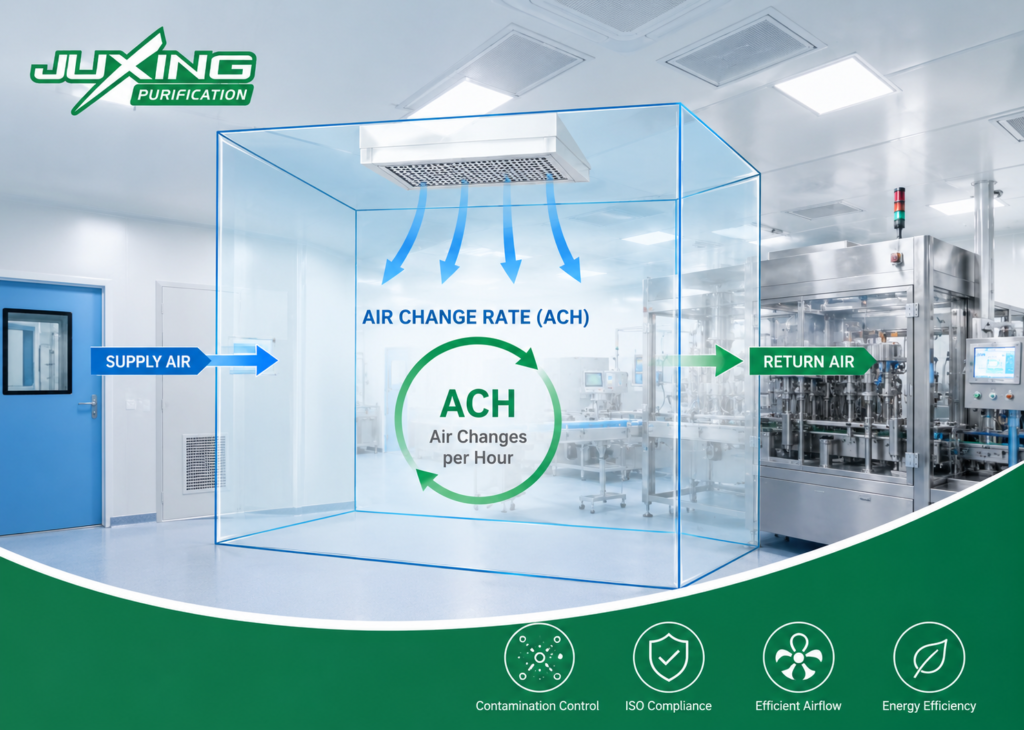
Cleanroom air change rate, often expressed as air changes per hour (ACH), is one of the key HVAC design parameters used to control airborne contamination in cleanrooms.
For procurement managers, EPC contractors, cleanroom engineers, and facility owners, ACH is important because it directly affects:
- HVAC system capacity
- HEPA filter quantity
- FFU selection
- Energy consumption
- Cleanroom recovery performance
- Contamination control stability
However, ACH should not be treated as a fixed universal number. A cleanroom with the same ISO class may require different airflow rates depending on process risk, personnel activity, equipment heat load, particle generation, room layout, and regulatory expectations.
This article explains what cleanroom air change rate means, how to calculate it, and how to apply it correctly in cleanroom design.
What Is Cleanroom Air Change Rate?
Cleanroom air change rate refers to how many times the total room air volume is supplied, filtered, and replaced within one hour.
It is usually expressed as:
ACH = Airflow Volume per Hour ÷ Room VolumeFor example, if a cleanroom has a room volume of 100 m³ and receives 3,000 m³/h of filtered supply air:
ACH = 3,000 ÷ 100 = 30 ACHThis means the equivalent of the room’s full air volume is supplied 30 times per hour.
Why ACH Matters in Cleanroom Design
ACH helps determine whether the cleanroom can dilute and remove airborne particles generated by people, equipment, materials, and processes.
A properly designed air change rate can help:
- Reduce airborne particle concentration
- Support ISO cleanliness classification
- Improve cleanroom recovery after door opening or activity
- Maintain stable airflow patterns
- Support temperature and humidity control
- Reduce contamination risk during operation
But higher ACH is not always better. Excessive airflow can increase energy cost, create turbulence, disturb process airflow, and increase HVAC equipment size unnecessarily.
Good cleanroom design requires the right balance between cleanliness, airflow stability, energy efficiency, and project cost.
How to Calculate Cleanroom ACH
The basic ACH formula is:
ACH = Q ÷ VWhere:
Q = Supply airflow volume per hour
V = Cleanroom volume
If using metric units:
ACH = m³/h ÷ m³If using imperial units:
ACH = CFM × 60 ÷ Room Volume in ft³Example Calculation
Assume a cleanroom has the following dimensions:
Length: 10 m
Width: 6 m
Height: 3 m
Room volume:
10 × 6 × 3 = 180 m³If the HVAC system supplies:
5,400 m³/hThen:
ACH = 5,400 ÷ 180 = 30 ACHSo the cleanroom has an air change rate of 30 air changes per hour.
Does ISO 14644 Specify Exact ACH Values?
A common misunderstanding is that ISO 14644 directly assigns a fixed ACH number for each ISO class.
In practice, ISO 14644 focuses on airborne particle concentration limits and cleanroom classification, not a universal ACH table for every facility. Airflow rate is a design and verification parameter, but the required ACH depends on the intended cleanliness level, room use, contamination load, airflow pattern, and operating conditions. ISO 14644-3 discusses airflow testing, and total airflow rate may be used to determine air exchange rate in non-unidirectional cleanrooms.
Therefore, ACH should be determined through engineering design and validated through cleanroom testing, not copied blindly from a generic table.
Typical ACH Ranges by Cleanroom Class
The following table provides general engineering reference ranges only. Actual project values should be confirmed by cleanroom design calculations, process risk assessment, and applicable standards.
| Cleanroom Class | Typical ACH Reference Range | Common Applications |
|---|---|---|
| ISO 8 | 10–25 ACH | Packaging, support areas, lower-risk production |
| ISO 7 | 30–60 ACH | Pharmaceutical support areas, medical device production |
| ISO 6 | 60–150 ACH | Higher-control production, precision assembly |
| ISO 5 | Often uses unidirectional airflow rather than simple ACH | Critical zones, aseptic processing, semiconductor processes |
These ranges are practical references, not universal rules. In high-risk pharmaceutical or semiconductor applications, airflow velocity, airflow pattern, recovery time, pressure cascade, and contamination control strategy may be more important than ACH alone.
ACH vs Airflow Pattern
ACH tells you how much air is supplied, but it does not fully describe how air moves inside the cleanroom.
Two rooms may have the same ACH but very different cleanliness performance if one has good airflow distribution and the other has dead zones or turbulence.
Cleanroom airflow design should consider:
- Supply air location
- Return air location
- HEPA filter coverage
- Equipment obstruction
- Personnel movement
- Door opening frequency
- Airflow direction
- Room pressure cascade
For this reason, ACH should always be reviewed together with airflow visualization, particle testing, and cleanroom commissioning results.
ACH and HEPA Filtration
In most cleanrooms, supply air passes through HEPA filters before entering the controlled area.
The required airflow volume affects:
- Number of HEPA filters
- FFU quantity
- AHU capacity
- Duct size
- Ceiling layout
- Energy consumption
- Noise level
For modular cleanrooms, FFUs are often selected based on the required cleanroom class, room size, target ACH, and ceiling coverage.
For larger pharmaceutical, hospital, or industrial cleanrooms, AHU-based systems may be used with terminal HEPA filters or ducted HEPA modules.
ACH and Cleanroom Recovery Time
Recovery time refers to how quickly a cleanroom returns to its target cleanliness level after particle generation or disturbance.
Higher ACH can help improve recovery, but recovery also depends on:
- Airflow pattern
- Filtration efficiency
- Room layout
- Particle source strength
- Return air position
- Personnel behavior
- Door opening frequency
EU GMP Annex 1 requires cleanroom qualification to include, where relevant, airflow tests and recovery tests, among other qualification elements. It also emphasizes maintaining appropriate filtered air supply and airflow protection for clean areas.
This means recovery performance should be verified during commissioning rather than assumed only from an ACH calculation.
ACH and Differential Pressure
ACH and differential pressure are related, but they are not the same.
ACH describes the amount of filtered air supplied to the room.
Differential pressure describes the pressure relationship between adjacent spaces.
A cleanroom can have high ACH but still fail pressure control if supply, return, exhaust, leakage, and door sealing are not properly balanced.
Positive pressure cleanrooms usually require supply air to exceed return and exhaust air, while negative pressure rooms require exhaust air to exceed supply air.
This is why HVAC airflow balancing, airtight doors, and pressure monitoring are critical for stable cleanroom operation.
Common Mistakes When Selecting ACH
1. Copying generic ACH tables without process analysis
ACH values should be based on the process, contamination risk, room layout, and regulatory requirements.
2. Assuming higher ACH always means better performance
Excessive airflow may create turbulence, increase cost, and disturb critical airflow patterns.
3. Ignoring heat load
Equipment, lighting, and personnel generate heat. HVAC airflow must also support temperature and humidity control.
4. Ignoring return air design
Poor return air placement can create dead zones, even if the calculated ACH looks sufficient.
5. Confusing ACH with ISO classification
ISO classification is based on particle concentration limits, not ACH alone.
6. Not verifying performance after installation
Cleanroom performance must be confirmed through testing, balancing, and commissioning.
How to Specify ACH in a Cleanroom RFQ
When preparing a cleanroom RFQ, buyers should not only write “ISO 7 cleanroom” or “30 ACH.” A more complete specification should include:
- Target ISO classification
- Room dimensions
- Process type
- Personnel number
- Equipment heat load
- Required temperature and humidity
- Pressure cascade requirements
- HEPA or ULPA filtration requirements
- FFU or AHU preference
- Door opening frequency
- Recovery time expectations
- Applicable standards or GMP requirements
This helps suppliers calculate airflow more accurately and avoid under-designed or over-designed systems.
Practical Design Example
For an ISO 7 pharmaceutical preparation room, the designer may start with a reference ACH range of 30–60 ACH.
However, the final airflow may change depending on:
- Number of operators
- Open or closed process
- Particle generation from materials
- Whether the room is at-rest or operational
- Temperature and humidity requirements
- Pressure cascade with adjacent rooms
- Recovery time target
- Local GMP interpretation
A conservative engineering approach is to size the HVAC system based on process risk and then verify performance through cleanroom qualification.
Best Practices for Cleanroom ACH Design
- Use ACH as a design reference, not the only performance indicator.
- Confirm cleanroom class based on ISO 14644 particle limits.
- Evaluate process contamination risk before selecting airflow volume.
- Coordinate ACH with HEPA filter layout and return air design.
- Avoid excessive airflow that creates turbulence or unnecessary energy cost.
- Verify airflow volume during commissioning.
- Confirm cleanroom performance through particle testing and recovery testing.
- Rebalance airflow after major layout or equipment changes.
Conclusion
Cleanroom air change rate is an important HVAC design parameter, but it should be applied carefully. ACH helps determine the amount of filtered air supplied to a cleanroom, but cleanroom performance depends on much more than airflow volume alone.
A reliable cleanroom design must consider ISO classification, process risk, HEPA filtration, pressure cascade, airflow pattern, recovery time, and commissioning test results.
For procurement managers and EPC contractors, the most important principle is this:
Do not select ACH as an isolated number. Select it as part of a complete contamination control strategy.
FAQ
What does ACH mean in cleanroom design?
ACH means air changes per hour. It shows how many times the room’s total air volume is supplied and filtered within one hour.
How do you calculate cleanroom ACH?
Use this formula:
ACH = Supply airflow volume per hour ÷ Room volumeFor metric projects:
ACH = m³/h ÷ m³Does ISO 14644 require a fixed ACH for each cleanroom class?
No. ISO 14644 focuses on particle concentration limits and cleanroom classification. ACH is a design parameter that should be selected according to room use, contamination risk, airflow pattern, and project requirements.
Is higher ACH always better?
Not always. Higher ACH may improve dilution and recovery, but excessive airflow can increase energy cost, create turbulence, and oversize the HVAC system.
What is a typical ACH for ISO 7 cleanrooms?
Many ISO 7 cleanrooms are designed in the general range of 30–60 ACH, but the final value depends on process risk, occupancy, equipment load, and regulatory requirements.
What is the difference between ACH and differential pressure?
ACH measures air volume supplied per hour. Differential pressure controls airflow direction between rooms. Both are important, but they are different design parameters.
Can FFUs be selected based on ACH?
Yes. FFU quantity can be estimated based on room volume and target ACH, but final selection should also consider ceiling coverage, airflow distribution, noise, maintenance access, and cleanroom class.