
Introduction
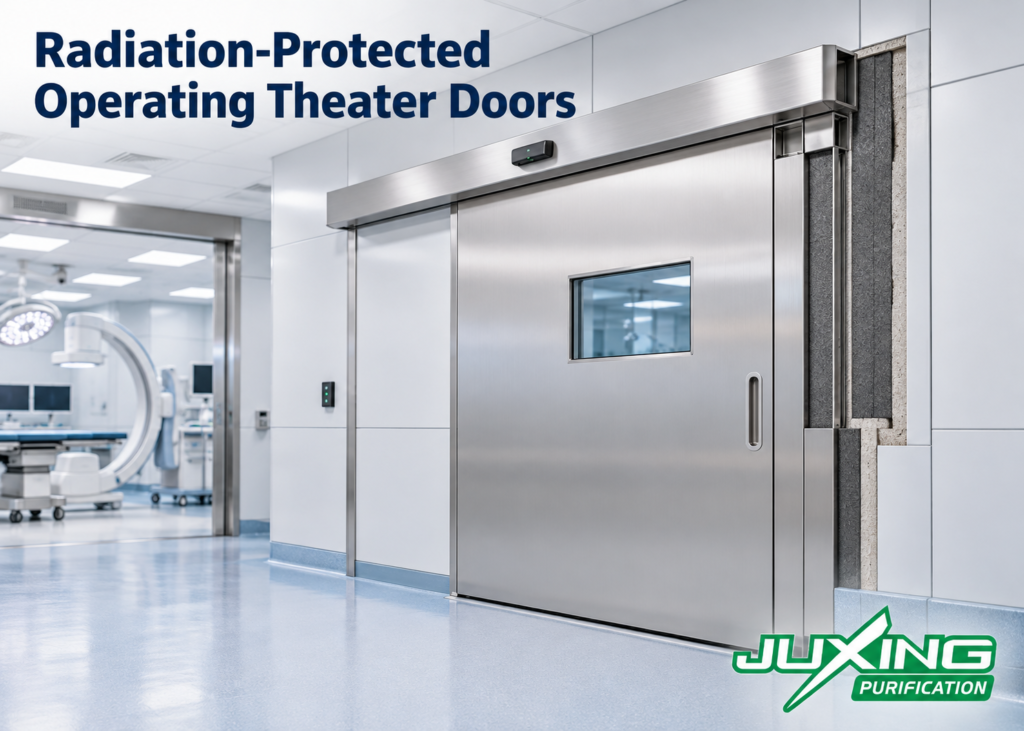
Radiation-protected operating theater doors are used where imaging equipment produces ionizing radiation during surgery or interventional procedures. Common applications include hybrid operating rooms, intraoperative imaging rooms and surgical suites containing fixed or mobile X-ray equipment.
A radiation-protected door must do more than contain lead sheet. Its shielding must remain continuous across the door leaf, frame, surrounding wall, hardware penetrations and closing interfaces. The door must also remain safe to operate despite its increased weight.
The required shielding cannot be selected from the room name alone. It must be calculated by a qualified radiation-protection specialist according to the imaging equipment, workload, beam direction, room layout and occupancy of adjoining areas.
Quick Answer
Radiation-protected operating theater doors normally combine:
- A heavy-duty door leaf
- Encapsulated radiation-shielding material
- A shielded frame
- Continuous protection at the leaf-to-frame interface
- Suitable hinges, rollers or sliding hardware
- Safety sensors where the door is powered
- A cleanable surface compatible with the operating-theater environment
- Interfaces coordinated with the shielded wall construction
A specification such as “2 mm lead door” is incomplete unless it also defines the frame shielding, wall overlap, clear opening, door type, surface finish, automation, safety devices and required verification.
Key Takeaways
- Lead thickness must be determined by radiation-shielding calculations.
- A common lead value is not automatically suitable for every project.
- The door leaf, frame and surrounding wall must form a continuous shielding barrier.
- Radiation protection and airtightness are separate performance requirements.
- Automatic doors require safety devices suitable for their increased mass.
- Door frames must match the complete finished wall thickness.
- Shielding materials should be securely fixed and fully enclosed.
- Hybrid operating rooms may require more complex shielding than standard operating rooms.
- Installed shielding should be inspected and verified by qualified personnel.
- Heavy imaging equipment and radiation design are outside the normal scope of a modular wall-panel manufacturer.
What Are Radiation-Protected Operating Theater Doors?
Radiation-protected operating theater doors are specially constructed doors designed to reduce radiation transmission through an opening in a shielded wall.
The shielding material may be:
- Lead sheet
- Lead-lined board
- Steel plate
- Proprietary lead-free shielding material
- A calculated combination of materials
Lead is widely used because it provides substantial attenuation within a relatively small thickness. However, the specification should normally state the required shielding performance as a lead equivalent, together with the relevant radiation energy or design basis.
The shielding layer is generally enclosed within the door leaf so that it is not exposed during normal use. The visible surfaces may be stainless steel, powder-coated metal, laminate or another approved finish.
The door must still satisfy the operating theater’s practical requirements for:
- Cleaning
- Impact resistance
- Clear opening
- Trolley movement
- Hands-free operation
- Emergency access
- Maintenance
- Integration with modular walls
When Does an Operating Theater Need a Radiation-Protected Door?
Not every operating theater requires radiation shielding.
A protected door may be necessary where the room contains or regularly uses:
- Fixed C-arm systems
- Mobile C-arms
- Intraoperative CT systems
- Angiography equipment
- Hybrid operating-room imaging systems
- Other equipment producing ionizing radiation
The requirement depends on actual equipment use, not simply whether the room is called a hybrid theater.
The shielding assessment should consider:
- Radiation type and energy
- Equipment output
- Expected procedure workload
- Primary beam direction
- Scatter and leakage radiation
- Distance to the door
- Position and orientation of the equipment
- Occupancy of adjacent rooms
- Occupancy above and below
- Applicable dose constraints
- Local radiation regulations
The IAEA states that medical imaging equipment producing X-rays requires a radiation-shielding plan, and shielding should be designed for the actual facility and equipment. Programme Implementation
A radiation-protection adviser, medical physicist or other qualified specialist should therefore determine whether the door requires shielding and specify the required performance.
How Is the Required Lead Equivalent Determined?
The required lead equivalent is calculated as part of the room’s overall shielding design.
It should not be selected solely from typical values such as 1 mm, 2 mm or 3 mm Pb. These values may appear in project specifications, but they are not universal international requirements.
A shielding calculation generally considers:\[ \text{Required shielding} = f(\text{source output, workload, distance, occupancy, use factor, dose constraint}) \]
The calculated result may then be converted into a thickness of lead, steel, concrete or another shielding material.
Important questions include:
- Is the door exposed mainly to scatter radiation?
- Can the primary beam be directed toward the door?
- How close is the imaging source to the opening?
- Is the adjoining space continuously occupied?
- Will the imaging workload increase in the future?
- Is the door part of a control-room boundary?
- Does the shielding design include the frame and threshold?
The IAEA Safety Guide on medical uses of ionizing radiation provides recommendations for occupational, public and medical-exposure protection, but project calculations must follow the applicable national regulations and approved design criteria. iaea.org
Why Is Shielding Continuity More Important Than Lead Thickness Alone?
A thick lead sheet in the door leaf cannot compensate for an unshielded gap around the frame.
Radiation can pass through discontinuities such as:
- Gaps between the door leaf and frame
- Unshielded frame sections
- Poorly overlapped lead sheets
- Hardware cut-outs
- Lock cases
- Vision panels
- Cable penetrations
- Wall-to-frame junctions
- Open spaces above sliding-door tracks
- Unprotected thresholds
The door assembly should overlap or otherwise coordinate with the wall shielding so that the protective barrier remains continuous.
IAEA training material identifies doors, frames, windows, joints and penetrations as critical areas where shielding continuity can fail. It also recommends verification after construction. PDF
The shielding detail should therefore show:
- Lead or equivalent material inside the door leaf
- Shielding within or around the frame
- Connection between frame shielding and wall shielding
- Protective overlap at closing edges
- Shielding around locks, operators and other hardware
- Treatment of the head, jambs and threshold
Which Door Types Can Be Radiation-Protected?
Hinged radiation-protected doors
A hinged door is relatively simple and may be manual or powered.
Its advantages include:
- Clear closing geometry
- Familiar operation
- Straightforward frame overlap
- Easier visual inspection of the shielding interface
Its challenges include:
- High loads on hinges and frame fixings
- Large operating force
- Possible floor or wall impact
- Space needed for the swing arc
- Increased stress on automatic operators
Heavy-duty hinges and reinforcement must be selected for the actual door-leaf mass. The structural opening must be capable of supporting the loads.
Sliding radiation-protected doors
A sliding door can provide a wide clear opening without occupying swing space.
Its advantages include:
- Suitable for patient beds and large equipment
- Efficient use of operating-room space
- Convenient automatic operation
- No door swing into circulation routes
Its challenges include:
- Maintaining shielding overlap at the jambs and head
- Supporting the heavy leaf and track
- Preventing derailment
- Providing safe closing-edge protection
- Accessing the operator and rollers for maintenance
- Accommodating the opening leaf beside the wall
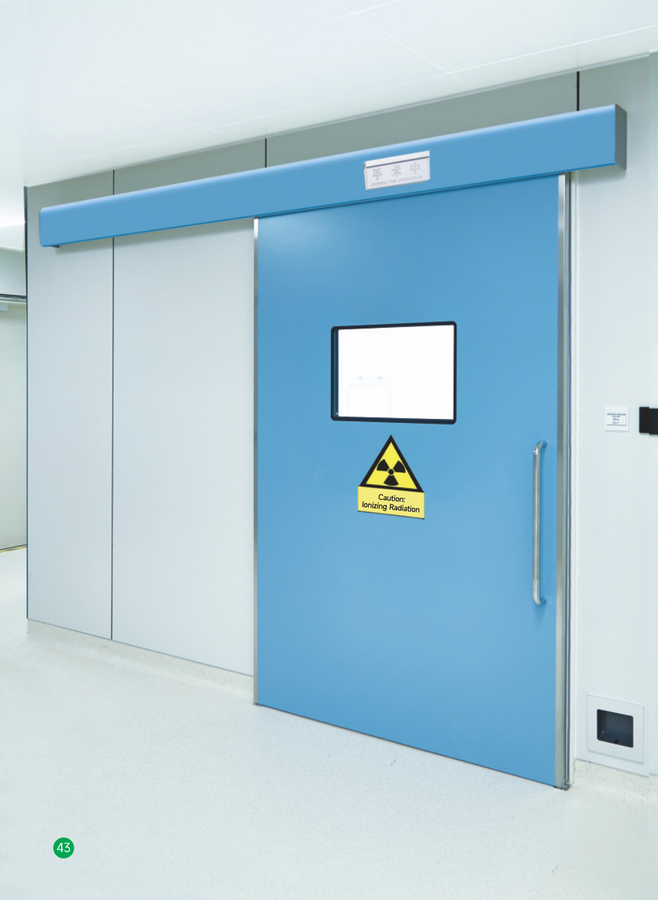
The door leaf commonly extends beyond the structural opening to create the shielding overlap required by the approved design. The overlap dimension must be specified rather than assumed.
Telescopic or multi-leaf doors
These may be considered where a wide opening is required but limited wall space is available. Their multiple joints make shielding continuity more complex, so they require specific engineering and approval.
Is a Radiation-Protected Door Automatically Hermetic?
No.
Radiation shielding and airtightness are separate functions.
A radiation-protected door may reduce radiation transmission without providing a tested airtight seal. A hermetic door may control air leakage without providing radiation protection.
If both performances are required, the specification must address:
- Lead equivalent
- Frame shielding
- Perimeter gaskets
- Bottom sealing
- Closing pressure
- Surface flatness
- Leakage-test method
- Operator capacity
- Long-term gasket compression
The additional shielding increases the door mass, which may affect how evenly the seals engage.
For the distinction between these door functions, see hermetic doors vs cleanroom doors.
How Should the Door Frame Connect to Modular Wall Panels?
The frame should be designed according to the complete finished wall assembly, not only the visible panel thickness.
The coordination must include:
- Metal wall panels
- Backing boards
- Wall framing
- Radiation shielding
- Frame anchoring
- Hygienic trims
- Gaskets or sealant
- Removable panel edges
- Ceiling and floor junctions
The wall shielding should connect continuously to the shielded frame. Simply placing a lead-lined door into an ordinary unshielded frame leaves a weak point at the opening.
For removable wall systems, the frame should not prevent future panel access unless the approved construction specifically requires a permanent panel.
Detailed coordination principles are explained in the operating theater door-frame and removable-wall-panel guide.
How Should Lead Be Installed Inside the Door?
Where lead sheet is used, it should be:
- Of the specified thickness
- Continuous across the required protected area
- Securely bonded or mechanically supported
- Protected from sagging
- Properly overlapped or joined
- Fully enclosed within the door construction
- Traceable through material records
Poorly supported lead can deform or creep over time. Gaps may develop if sheets are not adequately fixed or overlapped.
The internal construction should also distribute weight evenly. A poorly balanced leaf can overload hinges, rollers or automatic operators.
Lead handling and fabrication must follow applicable workplace health and environmental requirements. Users should not be exposed to bare lead during normal operation or cleaning.
Alternative shielding materials may be used where accepted by the radiation-protection designer. Their performance must be supported by suitable technical evidence and stated for the relevant radiation conditions.
What Surface Finish Is Suitable?
Common door finishes include:
- Powder-coated galvanized steel
- Powder-coated stainless steel
- Brushed stainless steel
- High-pressure laminate
- Other approved cleanable materials
The surface should be:
- Smooth
- Durable
- Resistant to normal cleaning agents
- Free from unnecessary ledges
- Repairable or replaceable
- Compatible with the wall finish
- Suitable for trolley and equipment impact
A stainless-steel surface does not prove that the door is fire-rated, airtight or radiation-protected. Each performance must be separately specified and supported.
The cleanroom door specification guide provides additional information about dimensions, finishes, hardware and project schedules.
What Safety Features Are Needed for Automatic Doors?
Radiation-protected doors can be considerably heavier than standard cleanroom doors. Powered movement must therefore be safely controlled.
Depending on the door type and local requirements, the system may include:
- Presence sensors
- Safety light curtains
- Monitored closing edges
- Obstacle detection
- Adjustable opening and closing speeds
- Warning lights or sounders
- Emergency stop
- Manual release
- Battery backup or emergency operation
- Access-control integration
- Status signals to the imaging system
The door should not close dangerously on staff, patients, beds or equipment. Safety devices must cover the relevant hazard zones, not merely the centre of the opening.
If the imaging system requires an interlock, its logic must be defined by the medical-equipment supplier, radiation-protection designer and controls contractor. The door manufacturer should receive a clear interface schedule.
How Should Observation Windows Be Treated?
If the door includes a vision panel, ordinary glass cannot be assumed to provide the required shielding.
The window assembly may require:
- Lead glass or another approved shielding material
- A specified lead equivalence
- Shielded glazing beads
- Overlap between glass and door-leaf shielding
- A frame capable of supporting the glass weight
- Impact and safety-glazing compliance
- A cleanable flush finish
The glazing must not create a gap in the shielding barrier. The required viewing size should be coordinated with privacy, clinical visibility, radiation protection and door weight.
Where a window is unnecessary, omitting it can simplify the shielding design.
What Information Should Buyers Include in an RFQ?
A radiation-door RFQ should include:
| Item | Information required |
|---|---|
| Room reference | Operating theater or imaging-room number |
| Door type | Hinged, sliding, manual or automatic |
| Clear opening | Required usable width and height |
| Structural opening | Available rough-opening dimensions |
| Wall construction | Total thickness and materials |
| Shielding requirement | Lead equivalent and design basis |
| Frame protection | Required shielding and wall overlap |
| Surface finish | Material, color and texture |
| Door operation | Manual, push button, sensor or access control |
| Safety system | Presence sensors and closing-edge protection |
| Vision panel | Size, location and lead equivalent |
| Hardware | Handles, locks and emergency release |
| Interlocks | Required signals and responsible contractor |
| Testing | Inspection and radiation-survey requirements |
| Documentation | Drawings, certificates and material records |
The shielding report or radiation-protection schedule should be provided to the manufacturer. A supplier should not be expected to calculate the shielding requirement from architectural drawings alone.
How Should the Installed Door Be Verified?
Verification should be planned before the wall and door are closed up.
Possible steps include:
- Confirm shielding-material certificates.
- Inspect the lead or equivalent material before enclosure.
- Record thicknesses, joints and overlaps.
- Photograph concealed shielding details.
- Inspect continuity between wall and frame.
- Check all hardware and cable penetrations.
- Confirm clear opening and safe operation.
- Test sensors and emergency controls.
- Conduct the required radiation survey.
- Record defects and corrective actions.
The final radiation survey should be performed or supervised by qualified personnel using the approved method and suitable equipment.
A successful door-operation test does not verify radiation protection. Likewise, a radiation survey does not prove airtightness, fire resistance or automatic-door safety.
Buyer’s Checklist
Before ordering radiation-protected operating theater doors, confirm:
- The radiation-protection specialist has issued the shielding requirement.
- Lead equivalence and relevant design conditions are stated.
- Door type and clear opening are confirmed.
- The structural opening can support the assembly.
- Frame shielding is included.
- Wall shielding overlaps or connects to the frame.
- Door-leaf weight has been calculated.
- Hinges, rollers and operators are rated for the load.
- Automatic-door safety sensors are specified.
- Airtightness is specified separately where required.
- The finish is suitable for operating-theater cleaning.
- Vision-panel shielding is defined.
- Locks and hardware do not interrupt the shielding.
- Access-control and imaging interlocks are coordinated.
- Inspection and radiation-survey responsibilities are assigned.
- Concealed shielding records will be included at handover.
Common Misconceptions
“Every operating theater door needs lead.”
Only rooms where the radiation-shielding assessment identifies a requirement need a protected door.
“A 2 mm lead door is suitable for every hybrid operating room.”
The required lead equivalent depends on equipment, workload, geometry, occupancy and applicable regulations.
“Only the door leaf needs shielding.”
The frame, wall interface, glazing and penetrations are also critical.
“A lead-lined door is automatically airtight.”
Radiation shielding and airtightness are separate performance characteristics.
“Stainless steel provides sufficient radiation protection.”
A stainless-steel finish alone does not replace calculated shielding.
“A heavier door always provides better shielding.”
Door mass does not confirm shielding performance. The material, thickness, coverage and continuity must be verified.
“The door manufacturer should decide the lead thickness.”
The shielding requirement should be issued by a qualified radiation-protection professional.
Expert Tip
Ask for a full-size door-frame and wall-interface section before approving production.
The section should show the lead or equivalent shielding inside the leaf, the protected frame, wall-shielding overlap, panel returns, seals, fixings and operator location. This drawing is more useful than a general statement such as “2 mm lead-lined door.”
For complex hybrid operating rooms, conduct a concealed-work inspection before decorative trims are installed.
Frequently Asked Questions
What lead thickness is normally used in an operating theater door?
Projects may specify different lead equivalents, but there is no universal value. The required shielding must come from the approved radiation calculation.
Can radiation-protected doors be automatic?
Yes. Hinged and sliding protected doors can be powered, provided the operator, track, hinges and safety devices are suitable for the door mass.
Can a radiation-protected sliding door also be hermetic?
Yes, if the complete system is designed and tested for both functions. Lead lining alone does not create an airtight seal.
Does the door frame also need lead?
The frame and wall interface generally require shielding continuity. The exact arrangement should follow the approved radiation-protection detail.
Can lead glass be installed in the door?
Yes, where the design allows it. The glass, frame and overlap must provide the specified shielding performance.
Who verifies the radiation protection after installation?
Verification should be performed or supervised by appropriately qualified radiation-protection personnel according to the project and local regulations.
Can JUXING supply radiation-protected operating theater doors?
JUXING can manufacture radiation-protected doors, medical doors and coordinated modular wall interfaces according to approved drawings and shielding requirements. Radiation calculations, imaging equipment and the main imaging-control system are not normally within JUXING’s standard supply scope.
Conclusion
Radiation-protected operating theater doors must be treated as engineered parts of the complete room-shielding barrier.
Correct performance depends on more than nominal lead thickness. The door leaf, frame, surrounding wall, vision panel, hardware and penetrations must provide continuous protection. Door weight, automation, cleaning, airtightness and safe operation must also be coordinated.
The project’s radiation-protection specialist should define the required lead equivalence and verification criteria. Once these requirements are confirmed, the manufacturer can design the door construction, frame interface and operating system accordingly.
Clear specifications and early interface coordination help ensure that radiation-protected operating theater doors are safe, maintainable and suitable for the complete modular operating theater system.