
Quick Answer
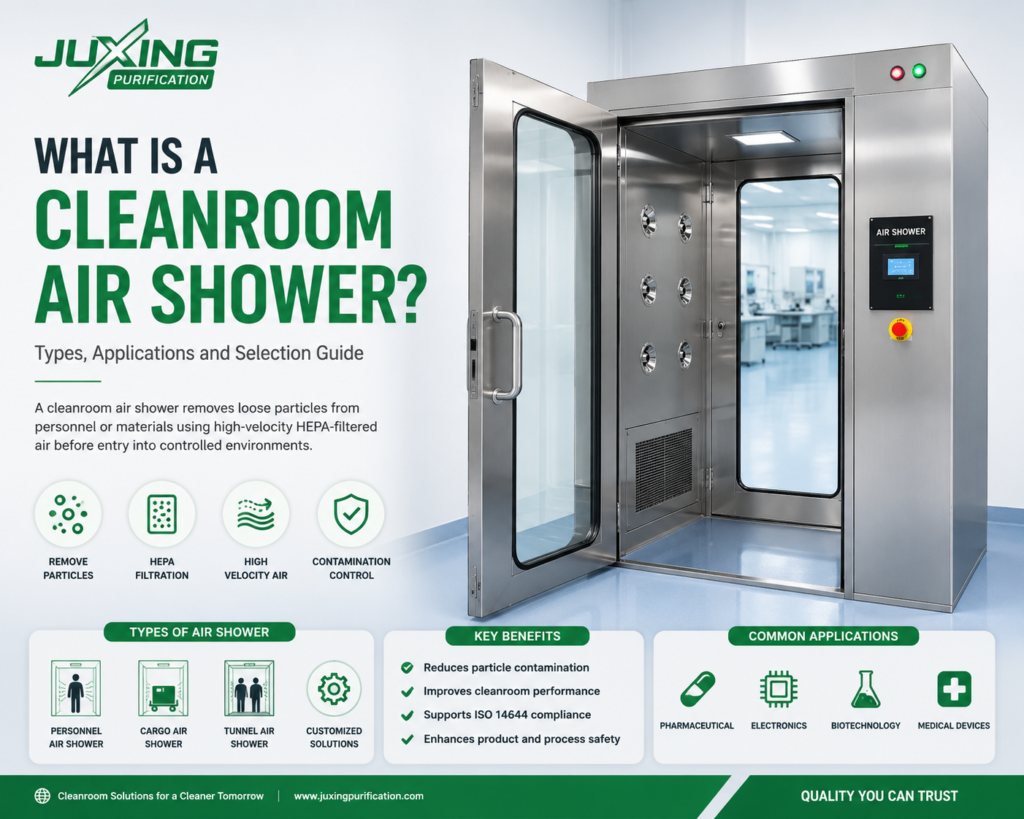
A cleanroom air shower is a contamination-control device installed at the entrance to controlled environments. It uses high-velocity HEPA-filtered air to remove dust and particles from personnel or materials before they enter cleaner areas. Although an air shower helps reduce particle transfer, it does not replace proper gowning procedures or cleanroom operational practices. Selecting the right air shower depends on personnel flow, cleanroom classification, available space, and project requirements.
Key Takeaways
- Air showers help reduce particle contamination before personnel or materials enter cleanrooms.
- HEPA-filtered high-velocity airflow removes loose particles from clothing and surfaces.
- Air showers complement—but do not replace—gowning procedures or cleanroom protocols.
- Different projects may require personnel air showers, cargo air showers, or customized configurations.
- Proper sizing and workflow planning are essential for effective contamination control.
Introduction
One of the most common ways contaminants enter a cleanroom is through personnel and material movement. Even after changing garments, dust and loose particles may remain on clothing, shoes, or transported items.
A cleanroom air shower provides an additional contamination-control step before entry into controlled environments. By directing high-velocity HEPA-filtered air through strategically positioned nozzles, it helps remove loose particles from personnel or equipment before they enter cleaner areas.
Air showers are widely used in pharmaceutical manufacturing, biotechnology laboratories, electronics production, food processing, and hospital clean areas. However, selecting the right air shower involves more than choosing dimensions—it requires understanding workflow, cleanliness requirements, installation conditions, and maintenance needs.
What Is a Cleanroom Air Shower?
A cleanroom air shower is an enclosed chamber installed at the entrance of a cleanroom or controlled environment.
Before entering the clean area, personnel or materials pass through the chamber while high-velocity HEPA-filtered air removes loose contaminants from exposed surfaces.
Typical components include:
- HEPA or ULPA filtration
- High-speed centrifugal fans
- Stainless steel air nozzles
- Automatic infrared sensors
- Door interlock system
- LED lighting
- Programmable control panel
Unlike an ordinary entrance, an air shower creates a controlled decontamination process that helps reduce contamination introduced by personnel or transported materials.
Why Are Air Showers Used?
Although cleanroom garments reduce contamination, they cannot eliminate every loose particle.
Air showers provide an additional protective barrier by removing contaminants immediately before entry.
Their benefits include:
- Reduced particle transfer
- Improved contamination control
- Support for ISO 14644 cleanroom operation
- Better product protection
- More consistent personnel entry procedures
What Types of Air Showers Are Available?
Personnel Air Shower
Designed for operators entering controlled environments.
Commonly installed in:
- Pharmaceutical facilities
- Electronics manufacturing
- Medical device production
- Laboratories
Cargo Air Shower
Designed for pallets, carts, equipment, and large materials.
Typical applications include:
- Pharmaceutical warehouses
- Material transfer corridors
- Electronics factories
Tunnel Air Shower
Suitable for facilities with high personnel traffic.
Multiple users can pass continuously, improving operational efficiency.
Customized Air Shower
Special projects may require customized dimensions, additional nozzles, automatic doors, or integration with access control systems.
How Does an Air Shower Work?
During operation:
- Personnel enter the chamber.
- Interlocked doors prevent simultaneous opening.
- Fans circulate air through HEPA filters.
- High-velocity air exits through adjustable nozzles.
- Dust is carried to return air grilles.
- Air is filtered and recirculated.
The complete process typically takes several seconds, depending on project settings.
Where Are Air Showers Commonly Used?
Typical applications include:
- Pharmaceutical manufacturing
- Biotechnology facilities
- Electronics production
- Semiconductor cleanrooms
- Food processing
- Medical device manufacturing
- Hospital clean areas
The installation location depends on personnel flow and contamination-control strategy.
How Should You Choose the Right Air Shower?
Selection should consider more than dimensions.
Key factors include:
Number of Users
Determine peak personnel traffic.
Cleanroom Classification
Higher cleanliness levels often require stricter contamination-control procedures.
Installation Space
Available space influences chamber dimensions and door configuration.
Air Velocity
The airflow should be sufficient to remove loose particles while maintaining user comfort.
Door Configuration
Swing doors and automatic sliding doors may both be suitable depending on workflow.
Maintenance
Choose designs that allow convenient filter replacement and routine servicing.
Buyer’s Checklist
Before requesting quotations, confirm:
☐ Number of users
☐ Air shower dimensions
☐ Door type
☐ HEPA filter grade
☐ Air velocity
☐ Nozzle quantity
☐ Control system
☐ Power supply
☐ Installation direction
☐ Project specifications
Common Misconceptions
Air Showers Can Sterilize Personnel
No.
Air showers remove loose particles but do not sterilize clothing or eliminate microorganisms.
Air Showers Replace Gowning
Incorrect.
Proper gowning remains essential for contamination control.
Larger Air Showers Always Perform Better
Not necessarily.
The correct size depends on personnel flow and available space.
More Nozzles Mean Better Performance
Not always.
Proper airflow distribution is generally more important than nozzle quantity alone.
Expert Tip
When specifying an air shower, provide information about daily personnel traffic, cleanroom classification, available installation space, and operational workflow. These details allow suppliers to recommend an appropriate configuration rather than simply selecting a standard model.
Frequently Asked Questions
What is a cleanroom air shower?
A cleanroom air shower removes loose particles from personnel or materials before they enter controlled environments using high-velocity HEPA-filtered airflow.
Do air showers replace cleanroom garments?
No. They are designed to complement, not replace, gowning procedures.
How long does an air shower cycle take?
Cycle times vary depending on project requirements and equipment settings.
Can cargo air showers be customized?
Yes. Dimensions, door configurations, airflow arrangements, and control systems are commonly customized.
Are air showers required for every cleanroom?
No. Whether an air shower is necessary depends on contamination-control objectives, facility layout, cleanroom classification, and project requirements.
Conclusion
A cleanroom air shower is an effective contamination-control device that helps reduce particle transfer before personnel or materials enter controlled environments. While it cannot replace proper gowning procedures or cleanroom protocols, it provides an additional layer of protection that supports cleanroom performance and product quality.
Selecting the right air shower requires evaluating workflow, cleanroom classification, personnel traffic, installation conditions, and maintenance requirements rather than simply comparing equipment specifications. A well-designed air shower system integrates seamlessly into the overall contamination-control strategy and contributes to efficient cleanroom operation.