
Executive Summary
Cleanroom door specifications can look simple, but small details often determine whether a door performs well in a controlled environment.
Before requesting a quotation, buyers should understand the key specification items:
- Door leaf material
- Door thickness
- Steel thickness
- Core material
- Frame structure
- Gasket design
- Vision panel
- Hardware
- Surface finish
- Fire rating
- Radiation shielding
- Automatic operation
- Wall compatibility
- Installation requirements
A cleanroom door specification should not be “as high as possible.” It should be appropriate for the room function, cleanliness requirement, cleaning procedure, traffic frequency, safety requirements, and project budget.
This guide explains the most important specification items so that buyers can prepare better RFQs, compare quotations more accurately, and avoid costly misunderstandings.
Who Should Read This Guide?
This guide is written for:
- Cleanroom contractors
- Hospital project managers
- Pharmaceutical engineering teams
- EPC contractors
- Procurement managers
- MEP consultants
- Healthcare architects
- Laboratory planners
- Medical device manufacturers
- International distributors
It is especially useful when preparing RFQs for cleanroom doors, medical doors, pharmaceutical doors, operating room doors, laboratory doors, or radiation shielding doors.
Why Cleanroom Door Specifications Matter
In international projects, many problems happen because the buyer and supplier are not discussing the same specification.
For example, two suppliers may both quote a “cleanroom steel door,” but the actual products may differ in:
- Door leaf thickness
- Steel sheet thickness
- Core material
- Frame design
- Gasket structure
- Hardware quality
- Surface coating
- Window sealing
- Packing method
- Installation accessories
A lower price may simply mean fewer included components or weaker specifications.
A clear technical specification helps buyers:
- Receive more accurate quotations
- Compare suppliers fairly
- Reduce variation orders
- Avoid installation conflicts
- Improve long-term performance
- Prevent over-specification and under-specification
Specification Snapshot
| Specification Item | Why It Matters |
|---|---|
| Door material | Affects corrosion resistance, cleaning, durability, and cost |
| Door thickness | Influences strength, stability, and compatibility |
| Steel thickness | Affects impact resistance and long-term performance |
| Core material | Influences weight, flatness, insulation, sound, and fire performance |
| Frame structure | Affects installation, sealing, and wall compatibility |
| Gasket | Supports airtightness and pressure control |
| Vision panel | Improves safety and visibility |
| Hardware | Determines daily reliability |
| Surface finish | Affects cleaning and corrosion resistance |
| Fire rating | Required for specific building safety zones |
| Lead lining | Required for radiation protection rooms |
| Automatic operator | Improves hygiene and workflow where needed |
| Packing | Protects products during long-distance shipping |
1. Door Leaf Material
The door leaf material is one of the first specification items buyers compare.
Common options include:
- Powder-coated galvanized steel
- SUS304 stainless steel
- SUS316 stainless steel
- HPL-faced door panels
- Lead-lined steel or stainless steel for radiation rooms
Material Comparison
| Material | Best For | Strengths | Limitations |
| Powder-coated galvanized steel | General cleanrooms, pharmaceutical, electronics | Cost-effective, smooth, customizable color | Less corrosion-resistant than stainless steel |
| SUS304 stainless steel | Hospitals, labs, wet areas, food clean areas | Good corrosion resistance, easy cleaning | Higher cost |
| SUS316 stainless steel | Highly corrosive environments | Superior corrosion resistance | Often unnecessary for standard projects |
| HPL surface | Some hospital interiors | Impact-resistant, decorative | Must be evaluated for cleanroom suitability |
| Lead-lined steel | X-ray, CT, radiation rooms | Radiation shielding | Heavy, requires special hardware |
Procurement Tip
Do not select stainless steel automatically. In many cleanroom projects, high-quality powder-coated galvanized steel provides a good balance of performance and cost. Stainless steel becomes more valuable when cleaning chemicals, humidity, or corrosion risk justify the investment.
2. Door Thickness
Door thickness affects strength, stability, sound insulation, hardware compatibility, and overall quality perception.
Common cleanroom door thickness varies by manufacturer and application. Buyers should confirm:
- Total door thickness
- Door leaf flatness
- Core type
- Edge structure
- Hardware compatibility
A thicker door is not always better. What matters is whether the door is structurally stable and suitable for the room.
Buyer Questions
Ask the supplier:
- What is the total door thickness?
- Is the thickness standard or customizable?
- Does the door remain flat after long-term use?
- Is the door suitable for the selected hardware and frame?
3. Steel Sheet Thickness
Steel sheet thickness affects impact resistance, durability, and product cost.
If the steel sheet is too thin, the door may be more vulnerable to dents, deformation, or reduced structural stability.
However, increasing steel thickness unnecessarily also increases weight and cost.
What Buyers Should Confirm
- Outer steel sheet thickness
- Inner reinforcement structure
- Edge construction
- Whether thickness differs between door leaf and frame
- Whether the supplier’s quotation clearly states the thickness
Procurement Tip
When comparing quotations, do not simply compare “steel door” to “steel door.” Ask each supplier to state steel sheet thickness clearly. Many price differences come from hidden material differences.
4. Door Core Material
The core material influences weight, flatness, insulation, sound performance, fire performance, and cost.
Common cleanroom door cores include:
| Core Material | Advantages | Typical Use |
| Paper honeycomb | Lightweight, economical | General cleanroom doors |
| Aluminum honeycomb | Good flatness, lightweight, stronger | Higher-grade cleanroom doors |
| Rock wool | Fire resistance, sound insulation | Fire-rated or higher safety areas |
| PU foam | Thermal insulation, lightweight | Temperature-controlled areas |
| Special composite core | Project-specific performance | Fire, impact, acoustic, or customized applications |
Buyer Questions
Ask:
- What core material is used?
- Is the core moisture-resistant?
- Does the core support fire rating if required?
- Will the door remain flat after long-term use?
- Is the core suitable for high-frequency traffic?
Expert Recommendation
For high-use hospital, pharmaceutical, and laboratory projects, door flatness and core stability are important. A door that deforms over time may lose sealing performance even if the surface material remains intact.
5. Door Frame Structure
The door frame connects the door to the cleanroom wall system. It strongly affects installation quality and sealing performance.
A good frame should:
- Match the wall thickness
- Provide stable support
- Reduce air leakage
- Allow proper gasket contact
- Be easy to clean
- Avoid unnecessary dust traps
- Coordinate with the wall panel system
Common Frame Types
- Steel frame
- Stainless steel frame
- Aluminum profile frame
- Wrap-around frame
- Flush frame for modular wall systems
Buyer Questions
Ask:
- What frame type is included?
- Is the frame suitable for my wall thickness?
- Is the frame welded or assembled?
- How is the frame fixed to the wall?
- Are frame section drawings available?
- Is the frame included in the quotation?
Procurement Tip
Some quotations appear cheaper because the frame, gasket, or installation accessories are not fully included. Always compare the complete door set, not only the door leaf.
6. Gasket and Airtight Sealing
The gasket is critical for cleanroom doors, especially in areas requiring pressure control.
Good gasket design helps:
- Reduce uncontrolled air leakage
- Support room pressure stability
- Improve acoustic performance
- Reduce dust entry
- Improve user comfort
Key Gasket Questions
Ask:
- What type of gasket is used?
- Is it continuous around the frame?
- Is the bottom seal included?
- Is the gasket replaceable?
- Is the gasket resistant to cleaning chemicals?
- How does the gasket contact the door leaf?
Procurement Tip
A cleanroom door without a reliable gasket may look good but perform poorly. Sealing details should be shown in drawings or product sections whenever possible.
7. Vision Panel Specification
Vision panels improve safety by allowing people to see through the door before opening it.
They are commonly used in:
- Cleanroom corridors
- Hospital operating departments
- Laboratories
- Pharmaceutical workshops
- Equipment transfer areas
Vision Panel Options
| Vision Panel Type | Typical Use |
| Single glass | General visibility |
| Double glass | Better cleanability and appearance |
| Flush-mounted glass | Cleanroom and hospital applications |
| Fire-rated glass | Fire-rated doors |
| Lead glass | Radiation shielding rooms |
| Blinds between glass | Privacy-sensitive rooms |
Buyer Questions
Ask:
- What glass thickness is used?
- Is the glass flush-mounted?
- How is the window sealed?
- Is lead glass required?
- Is fire-rated glass required?
- What is the window size?
Expert Recommendation
In cleanrooms, the window is not only a visual feature. Poor window sealing can become an air leakage point or a cleaning problem.
8. Hardware Specification
Hardware is one of the most common failure points in cleanroom doors.
Important hardware includes:
- Hinges
- Handles
- Locks
- Door closers
- Drop seals
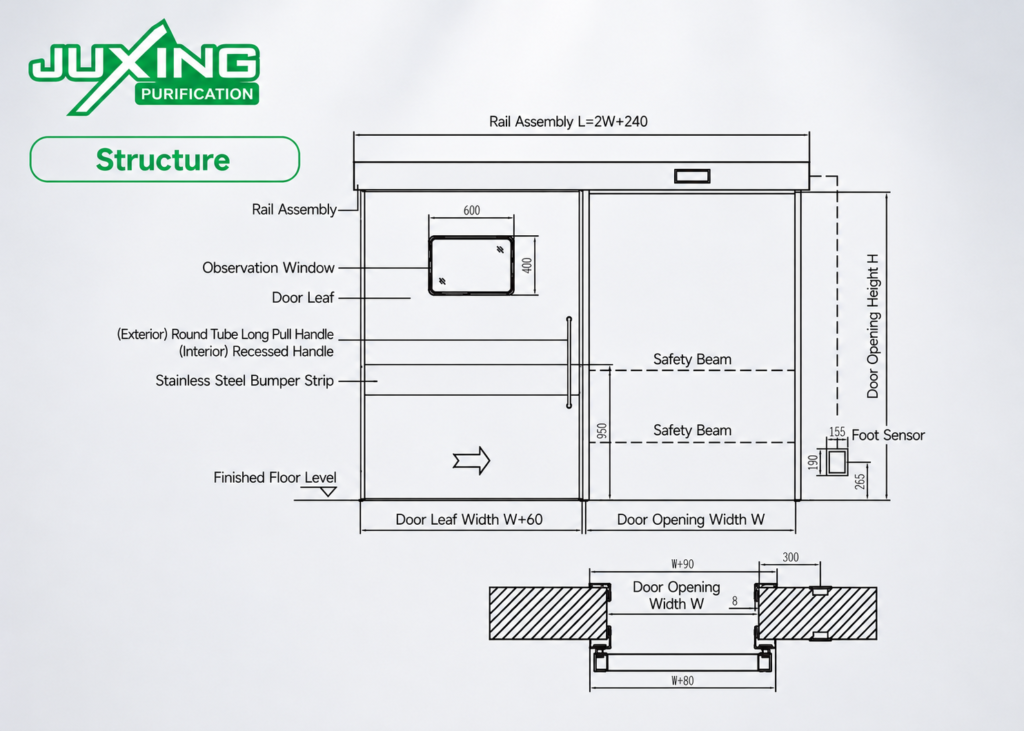
- Sliding tracks
- Automatic operators
- Access control accessories
Hardware Checklist
| Hardware | What to Check |
| Hinges | Load capacity, corrosion resistance, smooth operation |
| Handles | Cleanable design, comfortable use, corrosion resistance |
| Door closer | Adjustable closing speed, suitable force |
| Lock | Compatibility with room function |
| Drop seal | Airtightness and durability |
| Sliding track | Smooth movement and load capacity |
| Automatic operator | Motor quality, safety sensor, controller |
Procurement Tip
For high-frequency doors, hardware quality may matter more than small differences in panel price. Poor hinges or closers can create repeated maintenance problems.
9. Surface Finish
Surface finish affects appearance, cleaning, corrosion resistance, and long-term maintenance.
Common finishes include:
- Powder coating
- Brushed stainless steel
- Mirror stainless steel
- HPL surface
- Antibacterial coating in selected projects
Buyer Questions
Ask:
- What surface finish is provided?
- What color options are available?
- Is the surface resistant to cleaning agents?
- Is the coating quality tested?
- Are edges properly finished?
- Is the surface easy to wipe and disinfect?
Procurement Tip
Photos are not enough. Ask about the actual finish, coating process, and cleaning compatibility.
10. Fire Rating
Not every cleanroom door requires a fire rating.
Fire-rated doors are used when required by building codes, project specifications, or local fire safety regulations.
If fire rating is required, confirm:
- Fire resistance time
- Door core material
- Frame compatibility
- Fire-rated hardware
- Fire-rated glass if vision panel is included
- Test report or certification availability
Buyer Warning
A normal cleanroom door should not be assumed to be fire-rated. Fire performance must be specified clearly before production.
11. Radiation Shielding
Radiation shielding doors are required in rooms such as:
- X-ray rooms
- CT rooms
- DSA rooms
- Radiology departments
- Certain medical imaging areas
Important specifications include:
- Lead equivalency
- Lead sheet thickness
- Shielding continuity
- Lead glass vision panel
- Reinforced hardware
- Heavy-duty frame
- Installation method
Procurement Tip
Radiation shielding depends on the complete system. Lead in the door leaf is not enough if the frame, window, lock area, and wall connection are not properly designed.
12. Automatic Operation
Automatic doors are often used in operating theaters and high-traffic clean areas.
Specification items include:
- Motor type
- Controller
- Sensor type
- Opening speed
- Closing speed
- Safety function
- Manual override
- Power supply
- Access control integration
When Automatic Doors Are Worth Considering
- Operating theaters
- ICU areas
- Hands-free access zones
- High-traffic hospital corridors
- Material transfer routes
- Areas with trolley or bed movement
When Manual Doors May Be Better
- Low-traffic rooms
- Budget-sensitive areas
- Simple cleanroom access
- Areas where maintenance support is limited
13. Wall Compatibility and Installation
Before ordering cleanroom doors, confirm wall system details.
Important information includes:
- Wall thickness
- Opening size
- Wall panel material
- Finished floor level
- Door opening direction
- Ceiling height
- Installation method
- Site tolerance
Buyer Questions
Ask:
- What wall thickness does the door frame support?
- What rough opening size is required?
- Can the supplier provide installation drawings?
- Are installation accessories included?
- Is on-site adjustment required?
Procurement Tip
Many installation problems are caused by mismatched wall openings and door frames. Always confirm opening dimensions before production.
14. Export Packing Specification
For international buyers, packaging is part of the specification.
Poor packing can damage doors during sea freight, unloading, or site storage.
Good export packing should protect against:
- Scratches
- Moisture
- Impact
- Corner damage
- Glass breakage
- Hardware loss
Buyer Questions
Ask:
- How are the doors packed?
- Are frames and leaves packed separately?
- Is wooden crate packing available?
- Are accessories labeled?
- Are installation instructions included?
- Can packaging photos be provided before shipment?
15. How to Compare Quotations Correctly
When comparing quotations, do not compare only the final price.
Compare:
- Door leaf material
- Steel thickness
- Door thickness
- Core material
- Frame type
- Gasket
- Hardware brand and grade
- Vision panel
- Surface finish
- Accessories
- Packing
- Delivery time
- Warranty
- Installation support
Quotation Comparison Table
| Item | Supplier A | Supplier B | Supplier C |
| Door material | |||
| Door thickness | |||
| Steel thickness | |||
| Core material | |||
| Frame included | |||
| Gasket included | |||
| Hardware details | |||
| Vision panel | |||
| Surface finish | |||
| Packing method | |||
| Installation drawing | |||
| Warranty |
A higher quotation may be more competitive if it includes better hardware, stronger frames, proper packing, and technical support.
Specifications That Are Often Overlooked
Many buyers focus on visible materials but overlook practical details.
Commonly overlooked items include:
- Gasket replaceability
- Door closer quality
- Frame section design
- Bottom sealing
- Glass sealing
- Packing method
- Spare parts availability
- Wall opening tolerance
- Installation documentation
- Hardware corrosion resistance
These details often affect long-term performance more than appearance.
Cleanroom Door RFQ Template
You can use the following format when requesting a quotation:
Project Information
- Project country:
- Industry:
- Room application:
- Cleanroom classification:
- Quantity:
Door Requirements
- Door type:
- Door size:
- Wall thickness:
- Opening direction:
- Door material:
- Surface finish:
- Door thickness:
- Core material:
- Frame material:
- Vision panel:
- Hardware:
- Gasket:
- Fire rating:
- Radiation shielding:
- Automatic operation:
- Access control:
- Required delivery time:
Documents Required
- Quotation
- Technical drawings
- Frame section drawing
- Hardware list
- Packing details
- Lead time
- Warranty terms
Common Mistakes When Specifying Cleanroom Doors
Mistake 1: Asking for “cleanroom doors” without defining room application
A hospital operating theater door, pharmaceutical cleanroom door, and electronics cleanroom door may require different specifications.
Mistake 2: Comparing only material
Material is important, but frame, gasket, hardware, and installation are equally important.
Mistake 3: Ignoring wall thickness
A door that does not match the wall system may require site modification.
Mistake 4: Over-specifying stainless steel
Stainless steel is valuable in the right environment, but unnecessary over-specification increases cost.
Mistake 5: Forgetting packing
International shipping can damage poorly packed doors before they reach the site.
Mistake 6: Not requesting drawings
Drawings help confirm dimensions, frame structure, opening direction, and installation details before production.
Frequently Asked Questions
1. What is the most important cleanroom door specification?
There is no single most important specification. Material, frame, gasket, hardware, and installation compatibility all affect performance.
2. Is stainless steel always better than powder-coated steel?
No. Stainless steel offers better corrosion resistance, but powder-coated galvanized steel is suitable for many cleanroom applications and may be more cost-effective.
3. What core material is best for cleanroom doors?
It depends on the application. Paper honeycomb is economical, aluminum honeycomb provides better flatness, rock wool supports fire resistance, and PU foam supports insulation.
4. Do all cleanroom doors need fire rating?
No. Fire rating is required only when specified by project design, local code, or safety requirements.
5. Can cleanroom doors include lead lining?
Yes. Lead-lined doors are used in X-ray, CT, DSA, and radiology rooms. The required lead equivalency should be specified by the radiation protection design.
6. Should cleanroom doors have vision panels?
Vision panels are useful for safety and visibility, but their size and glass type should match the room function.
7. Why is the frame important?
The frame affects installation, sealing, alignment, and wall compatibility. A poor frame can reduce door performance even if the door leaf is good.
8. What should be included in a cleanroom door quotation?
A complete quotation should specify door leaf, frame, material, core, hardware, gasket, vision panel, surface finish, packing, lead time, and warranty.
9. Can cleanroom doors be customized?
Yes. Size, material, color, core, window, hardware, interlock, access control, and automatic operation can often be customized.
10. What causes price differences between suppliers?
Common reasons include different steel thickness, core material, hardware, frame structure, gasket quality, surface finish, packing, and technical support.
Final Thoughts
Cleanroom door specifications should be practical, complete, and project-specific.
A good specification does not simply demand the highest material grade or the most expensive hardware. It defines what the project actually requires and allows suppliers to quote accurately and fairly.
Before requesting a quotation, buyers should clarify the room application, wall system, material preference, sealing requirement, hardware, safety needs, and installation conditions.
A professional supplier should help buyers understand these details and recommend a door system that balances performance, durability, hygiene, cost, and long-term maintenance.
Need Help Preparing Cleanroom Door Specifications?
Juxing Purification Technology provides cleanroom doors, medical doors, hermetic doors, radiation shielding doors, pass boxes, FFUs, modular cleanroom systems, and operating theater solutions for international projects.
Our engineering team can help review your project requirements and recommend suitable cleanroom door specifications based on your room function, cleanroom classification, budget, and installation conditions.