
Introduction
Cleanroom performance is not only about achieving a target ISO class under stable conditions. In real operation, cleanrooms are affected by door opening, personnel movement, material transfer, equipment operation, and process activity.
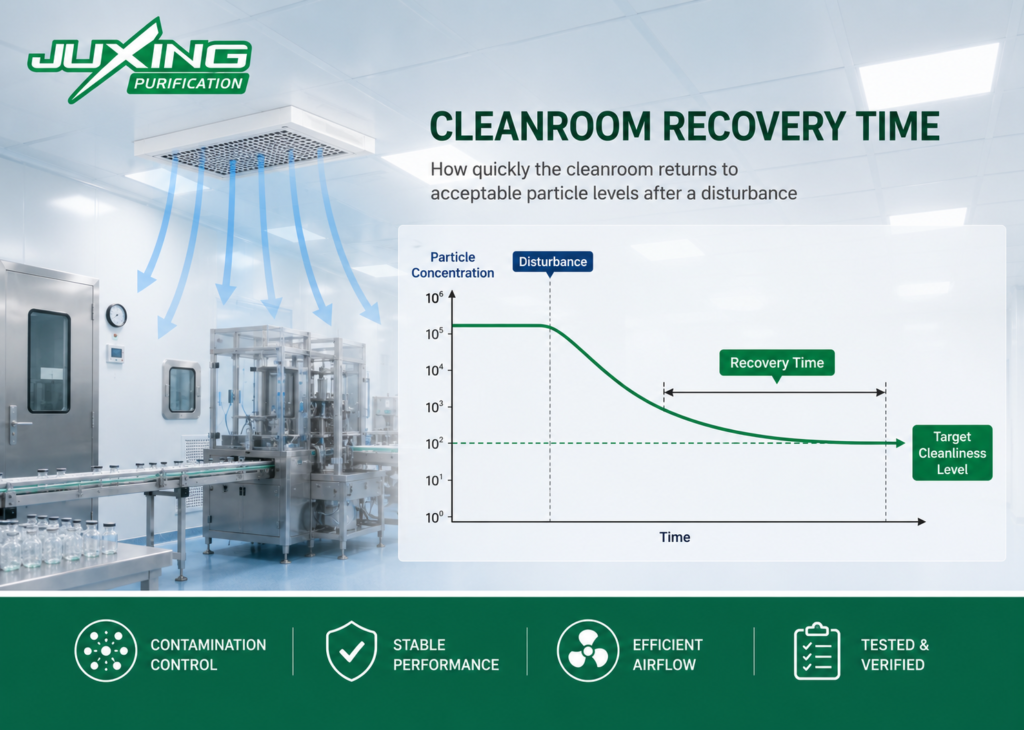
After a disturbance, the cleanroom must return to its required cleanliness level within an acceptable period. This is known as cleanroom recovery time.
For cleanroom engineers, EPC contractors, pharmaceutical manufacturers, hospital project teams, and procurement managers, recovery time is an important indicator of whether the HVAC system, HEPA filtration, airflow pattern, and room layout are working together effectively.
What Is Cleanroom Recovery Time?
Cleanroom recovery time refers to the time required for airborne particle concentration to return from an elevated level to a defined target cleanliness condition.
In simple terms:
Recovery time = How long the cleanroom takes to return to acceptable particle levels after contamination or disturbanceFor example, if particle concentration increases after door opening or activity, the recovery test evaluates how quickly HEPA-filtered airflow removes or dilutes airborne particles.
Why Recovery Time Matters
Recovery time is important because cleanrooms are not static environments. People move, doors open, materials enter, and equipment may generate particles.
A reasonable recovery time helps indicate that the cleanroom can:
- Remove airborne particles effectively
- Maintain stable contamination control
- Support ISO cleanroom performance
- Reduce risk after operational disturbance
- Confirm that airflow design is functioning properly
- Support qualification and commissioning activities
In pharmaceutical and sterile applications, recovery performance may also be part of a wider contamination control strategy, especially where airflow, pressure, filtration, and operational practices must work together.
Is Recovery Time the Same as ACH?
No. Recovery time and air change rate are related, but they are not the same.
ACH measures how much filtered air is supplied to the room per hour.
Recovery time measures how quickly the room returns to a target particle concentration after contamination or disturbance.
A cleanroom with higher ACH may recover faster, but recovery also depends on:
- HEPA filter efficiency
- Airflow pattern
- Return air location
- Room geometry
- Equipment obstruction
- Door opening frequency
- Particle source strength
- Personnel movement
- Leakage and pressure stability
Therefore, ACH is a design parameter, while recovery time is a performance verification result.
Does ISO 14644 Require Recovery Time Testing?
ISO 14644-3 provides test methods for cleanroom performance, including airflow testing and recovery-related testing methods. ISO describes appropriate methods for measuring cleanroom and clean zone performance, but the specific acceptance criteria should come from the project specification, user requirement, process risk, and applicable regulatory requirements.
For GMP sterile manufacturing, EU GMP Annex 1 includes cleanroom qualification expectations such as installed filter leakage and integrity testing, airflow tests, air pressure difference testing, airflow visualization, temperature and humidity testing, and recovery testing where relevant to the facility design.
So the safest wording is:
Recovery testing may be required or expected depending on the cleanroom design, process risk, regulatory framework, and qualification strategy.
How Cleanroom Recovery Time Is Tested
A typical recovery test involves three steps:
1. Create or observe an elevated particle condition
The room particle concentration is raised or measured after a controlled disturbance.
2. Monitor particle concentration
Particle counters are used to record how airborne particle concentration decreases over time.
3. Determine recovery time
The test records how long it takes for the room to return to the specified particle concentration or cleanliness condition.
The exact method, particle size, sampling locations, acceptance criteria, and test condition should be defined in the cleanroom qualification protocol.
Key Factors That Affect Recovery Time
1. Air Change Rate
Higher ACH generally improves dilution and particle removal, but it does not guarantee good recovery if airflow distribution is poor.
2. HEPA Filter Performance
HEPA filters remove airborne particles from supply air. Filter integrity and correct installation are essential for cleanroom performance.
3. Airflow Pattern
Good airflow should move particles away from critical areas and toward return or exhaust points.
4. Return Air Location
Poor return air placement can create dead zones where particles remain longer.
5. Room Layout
Large equipment, partitions, furniture, and process machines can block airflow.
6. Door Opening
Frequent or simultaneous door opening can disturb pressure balance and increase particle entry.
7. Personnel Activity
People are major contamination sources. Movement, gowning quality, and operator behavior strongly affect particle levels.
8. Differential Pressure
Stable pressure helps control airflow direction between rooms, reducing uncontrolled contamination migration.
Typical Recovery Time Expectations
There is no universal recovery time value suitable for every cleanroom.
Some projects may specify a recovery target such as returning to a defined cleanliness level within a certain number of minutes. Other projects may use risk-based qualification criteria depending on process sensitivity.
For critical GMP applications, recovery expectations should be defined by the user requirement specification, contamination control strategy, and qualification protocol.
Avoid using a fixed recovery time target without confirming:
- Cleanroom class
- Operating state
- Process risk
- Applicable GMP requirements
- Room size and airflow pattern
- Test method and particle size
- Acceptance criteria
Recovery Time in At-Rest and Operational States
Cleanroom recovery may be evaluated under different conditions:
At-Rest Condition
The cleanroom is complete, equipment is installed, and HVAC is operating, but personnel are not performing normal production activities.
Operational Condition
The cleanroom operates with personnel, equipment, and process activities present.
Operational recovery is usually more challenging because particle generation is higher.
For procurement and project planning, it is important to define which condition applies to the required recovery performance.
Common Design Mistakes
Mistake 1: Assuming ACH Alone Guarantees Recovery
A high air change rate does not automatically guarantee fast recovery if airflow is poorly distributed.
Mistake 2: Ignoring Airflow Visualization
Without airflow visualization, dead zones and turbulence may remain undetected.
Mistake 3: Poor Return Air Design
Return air grilles must support effective particle removal, not just architectural convenience.
Mistake 4: Oversized Equipment Blocking Airflow
Large machines can disturb airflow and slow particle removal.
Mistake 5: Weak Door Sealing
Air leakage and pressure instability can increase recovery time after door opening.
Mistake 6: No Clear Acceptance Criteria
Recovery testing must be based on a defined protocol. Otherwise, results are difficult to interpret.
How to Improve Cleanroom Recovery Time
Cleanroom recovery can be improved by:
- Optimizing HEPA filter layout
- Improving supply and return airflow distribution
- Selecting suitable ACH based on process risk
- Reducing airflow dead zones
- Maintaining stable differential pressure
- Using airtight cleanroom doors
- Reducing unnecessary door opening
- Improving personnel gowning and movement control
- Verifying airflow with smoke studies or visualization tests
- Performing regular cleanroom monitoring and maintenance
What Buyers Should Specify in an RFQ
When asking suppliers to design or quote a cleanroom, buyers should provide:
- Target ISO class
- Room dimensions
- At-rest or operational requirement
- Process type
- Personnel quantity
- Equipment layout
- Heat load
- Required ACH or airflow volume
- Pressure cascade
- HEPA filter requirements
- Recovery time expectation, if applicable
- Applicable standards
- Qualification and testing requirements
This helps avoid unclear quotations and reduces the risk of under-designed HVAC systems.
Conclusion
Cleanroom recovery time is an important performance indicator for contamination control. It shows how effectively a cleanroom can return to acceptable particle levels after disturbance.
Although ACH, HEPA filtration, and airflow volume are important, recovery time also depends on airflow pattern, return air design, room layout, personnel behavior, door control, and pressure stability.
For professional cleanroom projects, recovery time should be defined through engineering design, risk assessment, and qualification protocols rather than copied from a generic table.
A well-designed cleanroom should not only reach its required cleanliness class—it should also recover reliably during real operation.
FAQ
What is cleanroom recovery time?
Cleanroom recovery time is the time required for airborne particle concentration to return to a defined acceptable level after contamination or disturbance.
Is recovery time the same as ACH?
No. ACH measures supplied air volume per hour. Recovery time measures how quickly particle concentration returns to the required level.
Does higher ACH always improve recovery time?
Higher ACH can help, but airflow pattern, HEPA filter layout, return air position, room layout, and personnel activity are also important.
Is recovery testing required for every cleanroom?
Not always. Recovery testing depends on cleanroom design, process risk, regulatory requirements, and qualification strategy.
Why can two cleanrooms with the same ACH recover differently?
Because airflow distribution, return air placement, equipment obstruction, leakage, and personnel activity may be different.
How can recovery time be improved?
By optimizing airflow design, HEPA filter layout, return air position, pressure stability, airtight doors, and operational discipline.